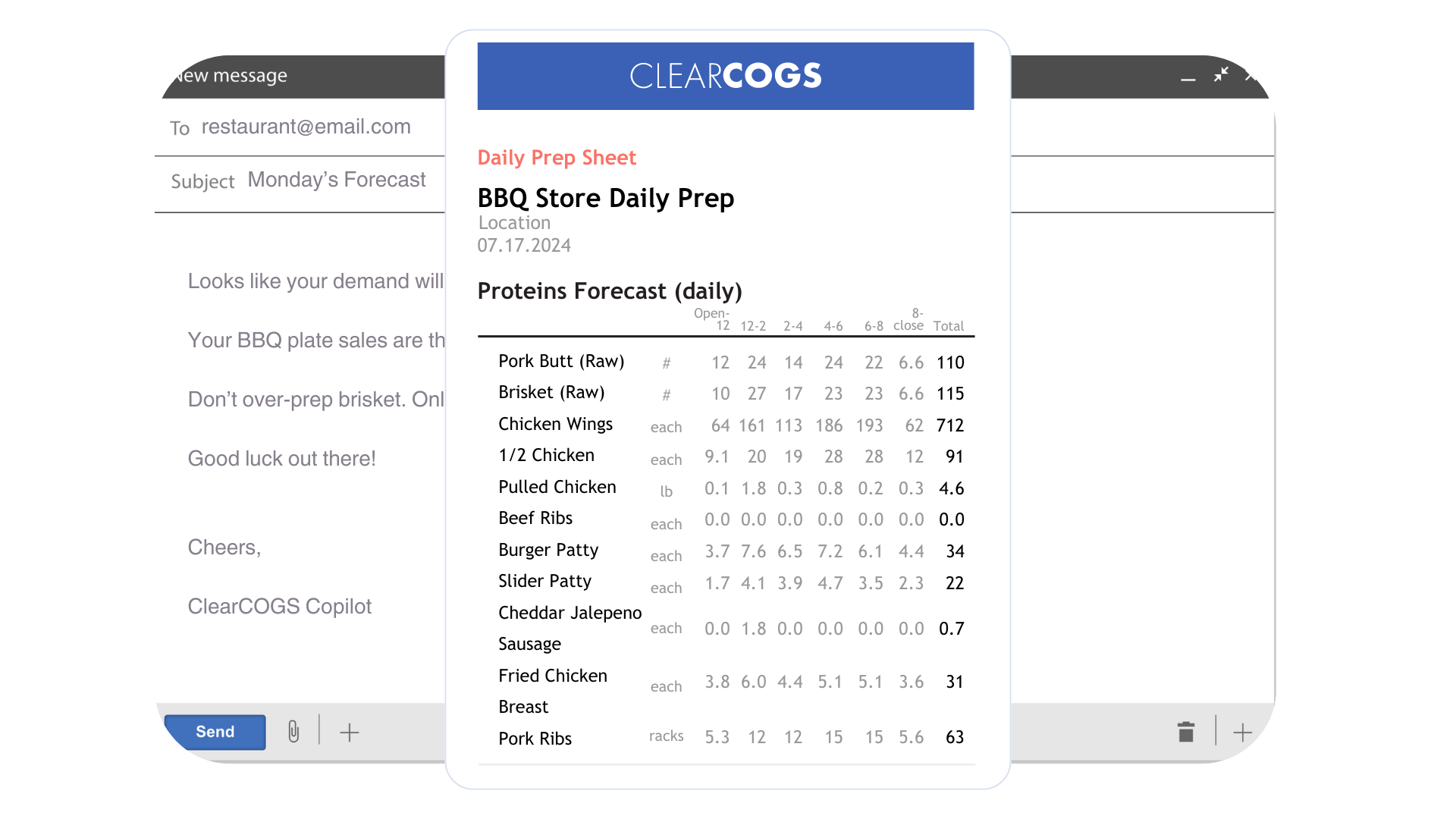



In an industry where average profit margins hover between 3-5%, the difference between thriving and surviving often comes down to one critical capability: accurate demand forecasting. The most successful restaurant operators have moved beyond intuition-based decisions to embrace data-driven forecasting that transforms both profitability and operational efficiency.
The Strategic Imperative: Why Forecasting Matters Now More Than Ever
Restaurant forecasting has evolved from basic sales prediction to comprehensive operational intelligence. Modern forecasting integrates multiple data streams: historical sales, weather patterns, local events, and market trends to create actionable insights that drive measurable business outcomes.
The numbers tell the story: Restaurants implementing systematic forecasting typically see 15-25% reductions in food waste, 2-3% improvements in profit margins, and significant gains in operational efficiency. These aren’t marginal improvements, they represent the difference between struggling to break even and building sustainable growth.
4 Critical Areas Where Forecasting Drives Profit
1. Inventory Optimization: The Hidden Profit Center
Poor inventory management represents one of the largest profit drains in restaurant operations. Effective forecasting enables operators to:
- Eliminate overordering by predicting precise demand for each ingredient
- Prevent stockouts during peak periods that lead to lost sales and customer dissatisfaction
- Reduce food waste by up to 50% through accurate demand prediction
- Optimize cash flow by purchasing only what’s needed when it’s needed
The impact is immediate and measurable. Restaurants often discover they can reduce weekly food costs by 8-12% simply by aligning purchasing with actual demand patterns.
2. Labor Cost Management: Precision Staffing for Maximum Efficiency
Labor costs typically consume 25-35% of restaurant revenue, making staffing optimization crucial for profitability. Forecasting enables:
- Precise shift planning based on predicted customer volume
- Elimination of overstaffing during slow periods
- Prevention of understaffing that damages service quality
- Strategic break scheduling to maintain service levels
The result: restaurants can often reduce labor costs by 10-15% while improving customer satisfaction through better service timing.
3. Revenue Optimization Through Dynamic Decision-Making
Understanding demand patterns unlocks sophisticated revenue strategies:
- Strategic pricing during high-demand periods
- Targeted promotions during slower times to drive traffic
- Menu engineering based on actual item performance data
- Capacity planning to maximize table turns and revenue per square foot
4. Operational Efficiency: The Compound Effect
Accurate forecasting creates operational efficiencies that compound over time:
- Reduced decision fatigue for management teams
- Improved vendor relationships through consistent, predictable ordering
- Enhanced food quality through optimized prep schedules
- Better cash flow management through precise purchasing
Building an Effective Forecasting System
Leverage Your Data Asset
Most restaurants sit on a goldmine of historical data but lack the analytical framework to extract value. The key is systematic analysis:
Start with pattern recognition: Analyze 12+ months of sales data to identify daily, weekly, and seasonal trends. Look beyond averages to understand the drivers of variation.
Incorporate external factors: Weather alone can impact foot traffic by 15-20%. Local events, holidays, and economic conditions all influence demand patterns.
OR, reach out to ClearCOGS who will do all of this for you.
Advanced Strategies for Maximum Impact
Micro-Forecasting: Hour-by-Hour Precision
The most sophisticated operators forecast by hour, not just by day. This enables:
- Precise prep scheduling to minimize waste
- Optimal staff deployment throughout the day
- Strategic promotion timing during slower periods
- Energy cost optimization through equipment scheduling
Demand Sensing: Real-Time Adjustments
Modern forecasting incorporates real-time data for dynamic adjustments:
- Weather updates for immediate demand shifts
- Event notifications for unexpected traffic changes
- Social media sentiment as an early demand indicator
- Reservation patterns for capacity planning
Measuring Success: Key Performance Indicators
Track these metrics to optimize your forecasting effectiveness:
- Forecast Accuracy: Target 85-95% accuracy for daily sales
- Food Cost Percentage: Maintain 28-35% of revenue
- Waste Percentage: Keep below 5% of food purchases
- Labor Efficiency: Optimize within 25-30% of revenue
- Customer Satisfaction: Monitor service quality during demand fluctuations
Eliminating the Guesswork
Restaurant forecasting represents a fundamental shift from reactive to proactive management. The operators who embrace data-driven decision-making aren’t just improving their current operations, they’re building the foundation for sustainable growth and competitive advantage.
The most successful restaurants in 2025 share a common characteristic: they’ve moved beyond guesswork to embrace forecasting as a core operational capability. In an industry where margins are thin and competition is fierce, this isn’t just an operational improvement, it’s a strategic imperative.
The question isn’t whether you can afford to implement systematic forecasting. The question is whether you can afford not to.