

By Matt Wampler, CEO of ClearCOGS
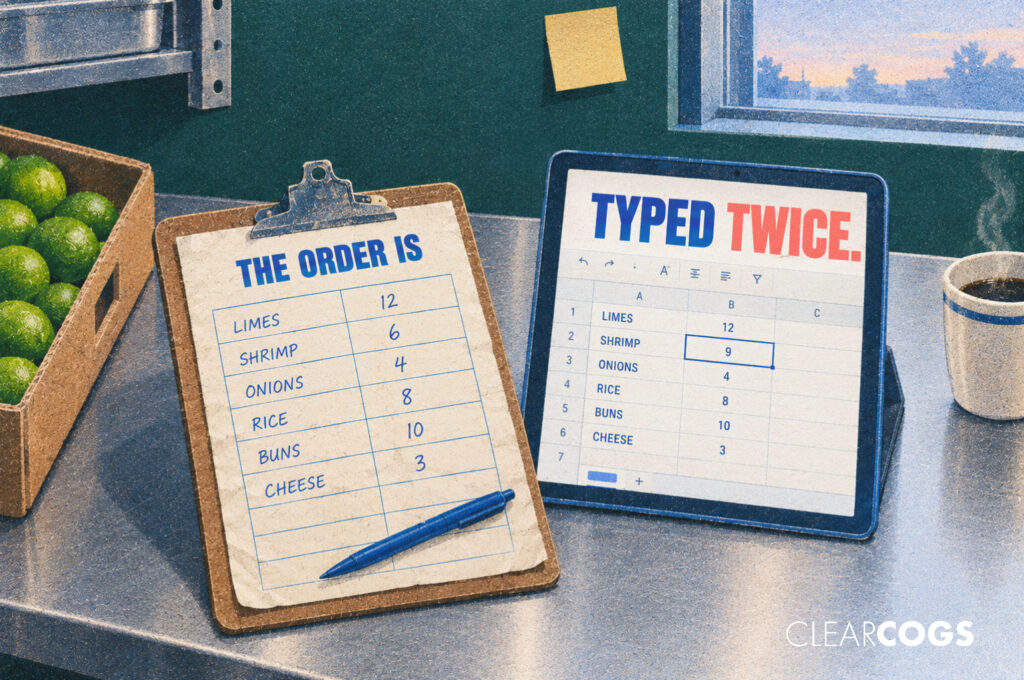
Here is one Monday order cycle in a full-service kitchen, taken apart minute by minute. It runs about 90 minutes, it happens three or four times a week, and the most expensive thing about it is a detail almost nobody writes down: the order gets typed twice. Once onto a count sheet, once into the distributor’s ordering portal. Everything between those two typings is where the time and the mistakes live.
The scene below is a composite. The pattern comes from full-service groups with a few dozen locations, where the person doing this is one of the most senior cooks in the building, because the job is too important to hand to anyone else. That is exactly the problem.
How long does a manual restaurant order take?
One order cycle, Monday morning. Composite timeline, times are illustrative.
6:00 a.m. The walk.
Clipboard, pen, walk-in first. Every item gets counted: cases, partial cases, pans, bags. Shrimp is counted by the bag, limes by the case and the half case. About 35 minutes.
6:35 a.m. The conversion.
Back at the desk. Each count gets turned into an order quantity in the sous chef’s head: what we have, minus what the par says we need, rounded up to a case pack. Nothing from this step is recorded. About 20 minutes.
6:55 a.m. The portal.
Log in. Pull up the order guide. Key every line by hand: item code, quantity, confirm. On a full-service menu that is well over a hundred lines. About 20 minutes.
7:15 a.m. The surprises.
Two items show as out of stock. One has a substitute with a different pack size, so the quantity has to be recalculated. Back to the clipboard to check what was actually counted. About 10 minutes.
7:25 a.m. The review.
Scroll the whole order once, looking for anything that looks wrong. This is the only quality check in the process, and it is done by the same person who made the entries, at the end of a 90-minute task, before service. About 5 minutes.
7:30 a.m. Submit.
Then again on Wednesday. And Friday. Some stores, Saturday too.
Add it up and the count itself is about 35 minutes. The other 55 minutes are the hand-off: converting, keying, correcting, reviewing. A lot of the advice on this focuses on the count. I’d argue the count is the healthy part. People are good at counting. The hand-off is where a number written at 6:20 becomes a different number by 7:00.
I’ve written before about how carefully built systems decay once the setup is over. This is the daily version of that. The inventory system is fine. The portal is fine. The gap between them is a human, standing up, before service.
Where do restaurant ordering errors come from?
I couldn’t find a published study of how often a restaurant order line gets keyed wrong. So I’ll borrow the closest measured example, which comes from healthcare, and I’ll flag it clearly as an analogy rather than a restaurant number.
In 2019, researchers at a large hospital system found a workflow where the same blood glucose result was being sent to the record automatically and also typed in by hand by clinic staff. That gave them 6,930 pairs to compare: the machine’s number next to the human’s number for the same reading. The humans got it wrong 3.7% of the time, or 3.2% if you only count mistakes in the digits themselves. About one error in seven was off by more than 20%. The most common failure was a digit dropped, added or swapped, so 153 became 53, or 1553, or 513.
3.7%
of hand-keyed numbers were wrong when checked against the machine record. Healthcare study, 6,930 entries, 506 staff.
1 in 7
of those errors was off by more than 20%. Not a rounding slip. A different order.
153 to 513
The usual mistake: a digit dropped, added or swapped. The same thing happens to 12 cases of limes.
Those were trained staff entering one number at a time, with a screen built for the job. A sous chef keying a hundred-line order from a clipboard, at 7 a.m., with a sub to recalculate, is not working in easier conditions. The study’s authors reached the conclusion most operators already feel: when a machine can pass the number along, let it. Re-keying is the risk.
Translate that to a kitchen, as a hypothetical. A 120-line order at a 3.7% error rate is about four wrong lines per order. At three and a half orders a week, that’s roughly 15 wrong lines a week per location, around 800 a year. Some are caught on the review scroll. Some show up as a short on Thursday. Some show up as nine cases of shrimp instead of six, and nobody connects the waste on Sunday to a keystroke on Monday.
What does manual ordering cost per location?
Start with the time, because it’s the easiest to count. Ninety minutes, three to four times a week, is 234 to 312 hours a year. The federal wage data for chefs and head cooks put the median at $28.33 an hour, so that’s roughly $6,600 to $8,800 a year per location in wages alone, before benefits and before the error tax above. Pick your group size.
5 locations
About 1,370 senior-cook hours a year on order entry. Roughly $39,000 in wages. Hypothetical, at three and a half cycles a week.
15 locations
About 4,100 hours a year. Roughly $116,000 in wages. That’s two full-time salaries spent typing numbers that already exist on a clipboard.
30 locations
About 8,200 hours a year. Roughly $232,000 in wages. Plus about 24,000 hypothetical wrong order lines a year across the group, if the analogy holds.
Two things make the real number worse than the wage math. First, these are senior people. The task doesn’t get delegated because the cost of a bad order is too high, so the hours come out of the person who should be training cooks and tasting food. Second, 7:30 a.m. is not a neutral time. Whatever didn’t get done between 6 and 7:30 gets done during service or not at all. For examples of what freed-up kitchen hours look like in practice, see the Breadless story and the Mediterranean restaurant that cut labor costs 11%.
What should change first?
Not the count. Keep counting on Monday if that’s what works. The fix is to stop typing the order a second time.
The information needed to build the order already exists before the sous chef sits down: the last count, the sales since then, the recipes that turn sales into usage, and a forecast of what the next few days will sell. If those four things are connected, the order can be built before anyone logs in. The job changes from “create 120 lines” to “scan 120 lines and change the ones that look wrong,” with the reasoning next to each line: last count, used since, on hand, needed through the next delivery, suggested order. A few minutes of review instead of 55 minutes of typing, and the review is now a real check against a number someone else produced rather than a person proofreading their own typing.
That’s the layer ClearCOGS works in. We forecast usage at the item level from your POS history, combine it with your counts and recipes, and hand the manager a pre-built order to approve. The count stays. The portal stays. The retyping goes away. If your inventory system and your distributor don’t talk to each other, the legacy tech post in the Ops Playbook covers why that gap tends to persist. And if your prep is still built on spreadsheet templates, the same logic applies there; the prep sheet template post is the place to start.
How many hours a week does your group spend typing orders?
Bring one location’s order routine to a 20-minute call. We’ll show you what a pre-built, reviewable order looks like from your own data, and where the time goes.
Who owns which part of the fix
| Role | What to measure this month | What it tells you |
|---|---|---|
| Operations | Minutes from “count done” to “order submitted,” at two or three stores | If the hand-off is longer than the count, the retyping is the bigger cost. |
| Finance | Order-entry hours times senior-cook wage, per location, per year | A budget line that has never had a line item. Now it does. |
| Data and IT | Whether counts, sales, recipes and the distributor order guide share item codes | If they don’t, every order is a translation job, and translations have error rates. |
| Franchise and multi-brand leaders | Which stores still key orders by hand and which have any pre-fill at all | Variance in process explains a lot of variance in food cost between stores. |
Frequently asked questions
How long does it take to place a restaurant order manually?
In multi-unit full-service kitchens, a manual order cycle that includes counting inventory and keying the order into a distributor portal commonly takes about 90 minutes and is repeated three to four times a week. Roughly a third of that time is the count; the rest is converting counts to order quantities, keying them, handling substitutions, and reviewing.
How often do manual data entry errors happen?
I couldn’t find a published figure for restaurant order entry. The closest measured example is a 2019 healthcare study that compared 6,930 hand-typed numbers with the machine record for the same values and found 3.7% were wrong, with about one in seven errors off by more than 20%. Treat that as an analogy for kitchen order entry rather than a restaurant statistic.
How much does manual ordering cost a restaurant?
Using the federal median wage for chefs and head cooks of $28.33 an hour, 90 minutes of order work three to four times a week costs roughly $6,600 to $8,800 a year per location in wages alone, before benefits and before the cost of order errors. Across 15 locations that is roughly $116,000 a year.
Should restaurants stop counting inventory to save time?
Not as a first step. The count is usually the shorter and more reliable part of the cycle. The larger saving comes from building the order automatically from the count, sales, recipes and a forecast, so the manager reviews a pre-built order instead of keying it line by line.
What is the difference between a count sheet and an order guide?
A count sheet records what is on hand, in whatever unit the kitchen counts (bags, pans, cases). An order guide lists what the distributor sells, in the distributor’s units and item codes. Translating one into the other by hand is where most of the time and many of the errors in a manual order cycle occur.
Bottom line
A manual order cycle has two halves. The count is the half people worry about, and it’s the half that works. The hand-off from clipboard to portal is the half that rarely gets measured, and it’s where a senior cook spends most of a 90-minute morning typing numbers that already exist, with an error rate that the best available evidence puts in the low single digits per line. Measure the hand-off at two stores this month. If it’s longer than the count, that’s your first project, and it doesn’t require changing how anyone counts.
ClearCOGS builds the order from your own counts, sales and forecast so the manager approves instead of types. If you’d like to see what that looks like for one of your stores, let’s talk.
About the author
Matt Wampler is the CEO and Co-Founder of ClearCOGS. Before founding the company, he ran Jimmy John’s franchise restaurants in the Washington, D.C. suburbs. He hosts the Restaurant AI Podcast.
Disclosure and methodology
The order cycle described here is a composite drawn from conversations with multi-unit full-service operators; the times are illustrative and no customer data were used. The 90-minute figure and the three-to-four-orders-a-week cadence reflect what operators have described, and your kitchens may differ. The error rate comes from a 2019 study in the Journal of the American Medical Informatics Association that measured manual transcription errors in a healthcare setting; it is used here as an analogy because I couldn’t find a comparable study for restaurant order entry, and the conditions differ. Wage figures are the Bureau of Labor Statistics’ Occupational Employment and Wage Statistics for chefs and head cooks, May 2023 release, which is the most recent release I could verify directly at the time of writing; a newer release exists and reports a somewhat higher median. The cost examples multiply hours by the median wage and exclude benefits, so they understate the fully loaded cost. ClearCOGS sells forecasting and ordering software, so read the recommendation section with that in mind.
Sources
- Mays JA, Mathias PC. “Measuring the rate of manual transcription error in outpatient point-of-care testing.” Journal of the American Medical Informatics Association, 26(3):269-272, March 2019. doi:10.1093/jamia/ocy170. Open access.
- U.S. Bureau of Labor Statistics, Occupational Employment and Wage Statistics, Chefs and Head Cooks (35-1011), May 2023.
Last reviewed: October 20, 2026