



By Matt Wampler, CEO of ClearCOGS
Restaurants have been trying to predict tomorrow for as long as they’ve been buying food today. For most of that history the forecast lived in one place: the head of whoever ran the kitchen. What changed, step by step, was where the record lived. A cash register in 1879, a store computer in 1973, a spreadsheet in 1979, a language model in 2023. Each one moved a piece of the job out of memory and into a system. This is a short, dated history of that shift, with only the milestones I could tie to a primary source, and a closing section on what it means if you run restaurants now.
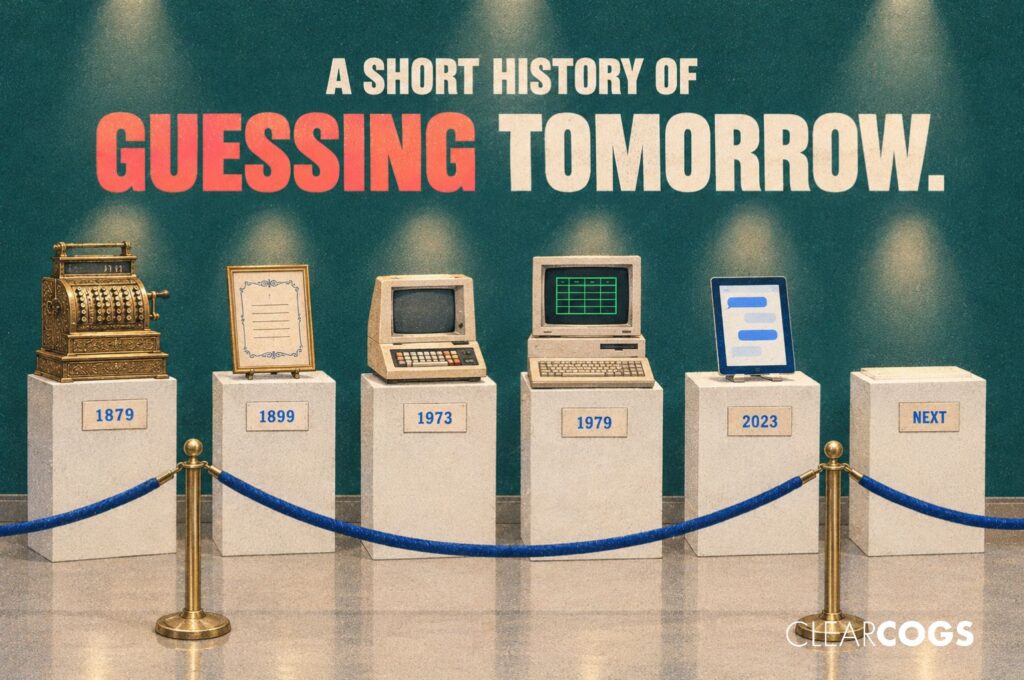
A short timeline of restaurant forecasting
November 4, 1879. An early sales record a restaurant didn’t have to trust a person for.
James Ritty, a saloon keeper in Dayton, Ohio, and his brother John received U.S. Patent 221,360 for a “Cash Register and Indicator.” Ritty’s problem was ordinary: cash was going missing between the customer and the till. The machine recorded each sale mechanically. It wasn’t a forecasting tool, but it was one of the first times a restaurant’s sales history existed anywhere other than in someone’s memory or handwriting. Ritty sold the business; John H. Patterson later bought it and renamed it the National Cash Register Company.
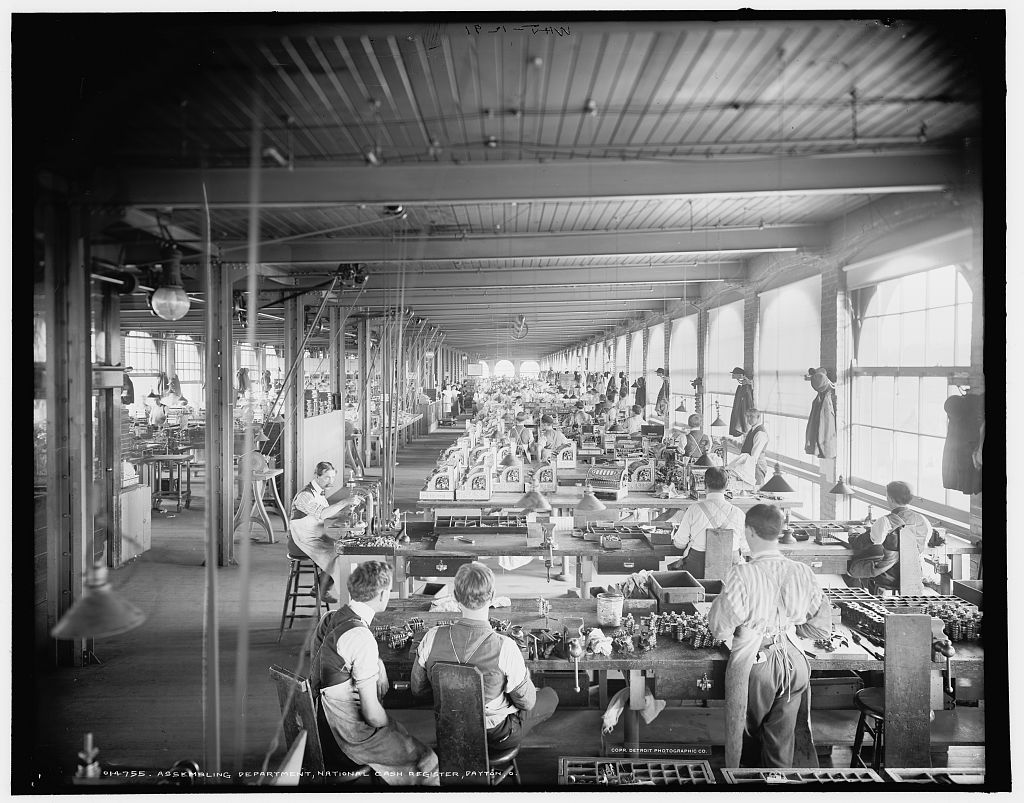
Assembling department, National Cash Register, Dayton, Ohio, about 1902. Library of Congress, Prints and Photographs Division, Detroit Publishing Company Collection. No known restrictions on publication.
1880s to 1900s. The menu is printed. The forecast isn’t.
The New York Public Library holds printed Delmonico’s menus from the 1880s through the early 1900s, including a dinner menu from 1899. So by the turn of the century a restaurant had two records: a printed menu that fixed what the kitchen promised to serve, and a register that recorded what it sold. Neither said how much to buy or prep. That number still lived with the chef, and it left when the chef did.
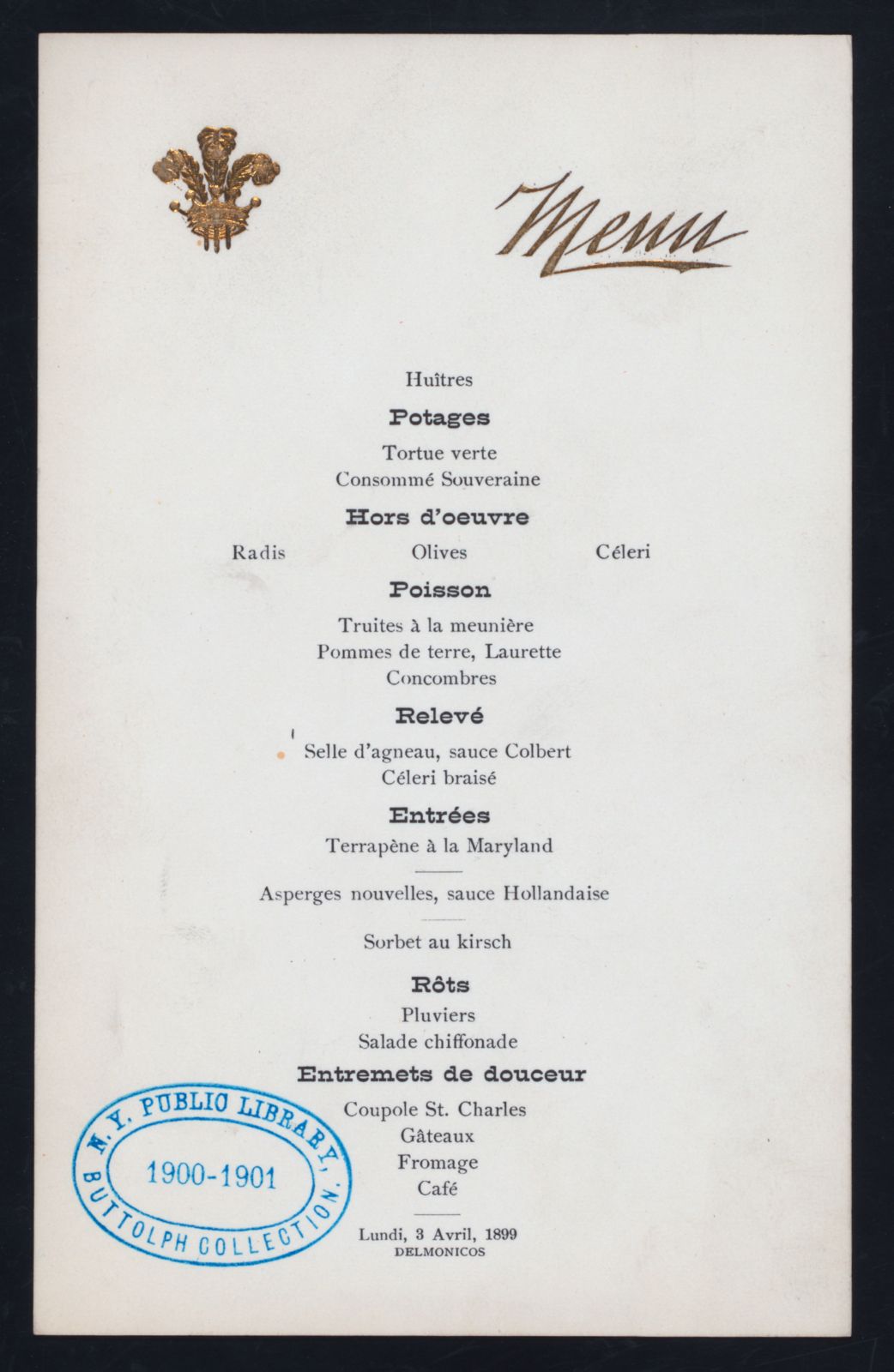
Delmonico’s menu, New York, 1899. From The New York Public Library. Public domain.
1973. The register talks to a computer.
IBM introduced the 3660 Supermarket System, the first of its point-of-sale systems with real computing power behind the counter. IBM’s own history records that, when linked to a System/370 mainframe, the system let store managers watch sales as they happened, make restocking decisions from that data, and even reorder automatically. The first customers were supermarkets and department stores, but the idea that would reach restaurants was born here: sales by item, by hour, stored where a machine could use them.
1979. The spreadsheet arrives, and so does the par sheet.
VisiCalc, the first electronic spreadsheet for personal computers, was released in 1979 and sold around a million copies. For restaurants, this is the moment the back office could do arithmetic on its own numbers. The weekly par sheet, the prep sheet and the order guide all became spreadsheets over the following decades, and in a lot of kitchens they still are. The spreadsheet moved the math out of the chef’s head. It did not move the judgment.
1990s. POS reaches the restaurant.
IBM’s history notes that in the 1990s its point-of-sale systems moved into fast food and gave restaurants reports and receipts they could manage for the first time, as touch screens and color monitors became affordable. From this point on, most restaurants with a modern POS have had a complete item-level sales history. Far fewer have used it to decide what to prep.
March 6, 2023. The forecast learns to talk.
At the MURTEC conference in Las Vegas, we showed an AI operations manager built on ChatGPT that could answer a question like “How many plain bagels should I bake today?” from a restaurant’s forecast. I’m putting our own milestone on this timeline because it marks a real change, not because we were the only ones working on it: the output of a forecasting model could now be asked a question in plain English by the person who had to act on it. The model had existed for years. The conversation was new.
“The computer can be used to plan for different traffic patterns at different hours.”
Marvin L. Mann, IBM, on the 1973 supermarket system, as quoted in IBM’s company history.
That quote is about the 1973 system, and it was said about grocery stores. Read it again as a restaurant operator. It describes, fifty years early, what many kitchens still don’t do: build the prep plan from the hourly pattern the register already knows.
What each era actually moved
What moved into a system
1879: the sales record
1973: sales by item and hour, readable by a machine
1979: the arithmetic
1990s: the full history, in most restaurants
2023: the question and answer
What stayed in someone’s head
How much to prep for Tuesday
Whether the weather changes that
What a slow lunch means for dinner
When to trust the number and when to override it
Who does it when the chef is off
Notice the pattern. Every step moved a record or a calculation. Until recently, none of them moved the decision. The spreadsheet gave the kitchen manager a faster pencil. The POS gave them a bigger filing cabinet. The forecast, the actual “how much do we make tomorrow,” kept living in the same place it lived at Delmonico’s.
What’s next
The next step is already visible, and it’s less about smarter models than about closing the loop. A forecast that is rebuilt every day from last night’s sales, that produces a prep sheet and an order rather than a chart, and that the manager approves or adjusts in a few minutes instead of building from scratch. The decision finally moves into the system, with the human kept where the judgment is.
Two things have to be true for that to work, and both are harder than the technology. The data has to be maintained, which is a habit problem rather than a software one. And the people have to trust the number enough to use it and know when to override it. We wrote about the second problem in why the rollout is harder than the tech. The January 2025 announcement on this site is a dated marker of where we were in early 2025, and the strategic guide to restaurant forecasting is the longer version of where it’s going.
Frequently asked questions
When was the cash register patented?
James and John Ritty of Dayton, Ohio received U.S. Patent 221,360 for a “Cash Register and Indicator” on November 4, 1879. James Ritty was a saloon keeper. The company he started was later bought by John H. Patterson and became the National Cash Register Company.
When did restaurants start using POS systems?
IBM introduced computerized point-of-sale systems for supermarkets and department stores in 1973. According to IBM’s company history, point-of-sale systems moved into fast food restaurants during the 1990s as touch screens and color monitors became affordable.
Why this matters for operators today
If you run a group of restaurants, you are sitting at the end of this timeline with every piece in place except one. Your registers record every sale, by item, by minute, and have for decades. Your back office can do any arithmetic on it. You can ask a model a question about it in plain English. The one thing that, in many kitchens, still works the way it did in 1899 is the decision about how much to prep and order, and it still leaves with the person who makes it.
Two translations. Finance: the prep decision is where food cost is won or lost, and it’s the one line the register can’t explain on its own. IT and data: the sales history is already there; the project is connecting it to the prep sheet rather than collecting more of it.
That’s the gap ClearCOGS was built for: taking the sales history the register has been keeping since 1879 and turning it into tomorrow’s prep sheet and order, every day, with the manager approving rather than guessing. If you want to see what your own sales history says about tomorrow, let’s talk. The register already did its part. It’s been waiting a long time for the rest of us to catch up.
About the author
Matt Wampler is the CEO and Co-Founder of ClearCOGS. Before founding the company, he ran Jimmy John’s franchise restaurants in the Washington, D.C. suburbs. He hosts the Restaurant AI Podcast.
Disclosure and methodology
This timeline includes only milestones I could tie to a primary or institutional source: the Library of Congress for the Ritty patent, the New York Public Library’s digital collections for the Delmonico’s menus, IBM’s published company history for the 1973 and 1990s point-of-sale milestones, the Computer History Museum for VisiCalc, and ClearCOGS’s own 2023 announcement for the final entry. Several milestones often included in histories like this one were left out because I could not verify them against a primary source in time for publication, including the Escoffier kitchen brigade, early chain standardization, and the first restaurant-specific computerized registers. The 2000s and 2010s, including cloud POS and online ordering, are also left out because I didn’t have primary sources in hand. The “first cash register” claim is avoided on purpose; the Ritty patent describes an improvement, and other devices existed. The Mann quotation is reproduced from IBM’s company history, which does not date the remark precisely. The 2023 entry describes a ClearCOGS product, so read it as a company milestone and judge its significance yourself. The images are public domain or carry no known restrictions on publication, as stated by the holding institutions; credit lines are given under each. ClearCOGS sells forecasting software, so read the last two sections with that in mind.
Sources
- Library of Congress, Inside Adams blog, “Necessity Is the Mother of Invention” (November 2010), on U.S. Patent 221,360, Ritty, November 4, 1879.
- Library of Congress, Prints and Photographs Division, “Assembling department, National Cash Register, Dayton, O[hio]”, Detroit Publishing Company, about 1902. No known restrictions on publication.
- The New York Public Library Digital Collections, Buttolph Collection of Menus, Delmonico’s menu, New York, 1899. Public domain.
- IBM, “Retail and point-of-sale systems,” IBM Heritage.
- Computer History Museum, Bob Frankston, 2004 Fellow, on VisiCalc (1979).
- Centre for Computing History (Cambridge, UK), VisiCalc collection record, for the sales figure of almost one million copies.
- ClearCOGS, “ClearCOGS Unveils ChatGPT-Powered AI Restaurant Operations Manager, Live in Las Vegas” (MURTEC, March 6, 2023).
Last reviewed: October 23, 2026


