




There’s a conversation that happens at nearly every enterprise restaurant brand exploring AI forecasting, and it usually sounds something like this: “We’re intrigued. We just don’t want to spend six months on a pilot that ultimately doesn’t work for us.”
That’s not a technology problem. It’s an operationalization problem.
Large restaurant operators running hundreds of locations, complex kitchen workflows, and deeply established prep traditions have generally already accepted that predictive forecasting is useful. The question isn’t whether AI can predict how many steaks they’ll sell on a Tuesday. The question is: how does that number get to the prep team in a way they’ll actually trust and use?
Getting that right is harder than the forecasting itself.
The Two Phases That Almost Everyone Confuses
When enterprise operators explore AI forecasting, there’s a tendency to evaluate the technology and the rollout simultaneously. That creates unnecessary friction. The smarter approach is to treat them as two distinct stages.
Stage one is proving the numbers. Before any prep team lays eyes on a new system, the forecasts need to be validated against reality. How accurately did the model predict potato rotation volume on a Thursday? What happened during the last holiday weekend compared to the forecast? This phase is backend work: data access, recipe mapping, accuracy review. No disruption to operations. No new behaviors required of kitchen staff. The goal is simply to establish a track record of accuracy against a handful of high-impact items.
Stage two is making it actionable. Once confidence in the numbers is established, the conversation shifts: where does this output actually land in the hands of the prep team? Does it flow into existing kitchen display systems? Does it show up alongside tools the AM already opens every morning? The science of forecasting is one thing, and the art of presentation is what determines whether it changes behavior on the floor.
Conflating these two stages is one of the most common reasons AI pilots stall. A March 2026 report from Restaurant Business Online found that while more than half of restaurant chains are already investing in AI, few have seen it meaningfully move the needle yet, a gap the report attributes largely to AI being layered onto disconnected systems rather than integrated into unified workflows. Operators get nervous about disrupting established workflows before the forecasts have even proven themselves. The fix is to separate the question of “does this work?” from the question of “how do we change what people do?”
Item Selection Matters More Than You Think
In an enterprise environment with hundreds of menu items and complex prep dependencies, one of the most practical decisions any operator can make is which items to pilot first.
The instinct is often to go broad, covering as much of the menu as possible to get a full picture. But a more effective approach is to select five to ten items that have clear business stakes attached to them. Items where running out costs something real. Items where over-prepping creates a measurable waste problem. Items that require lead time, meaning things that take hours or even days to prepare, where the value of an accurate forecast is most obvious.
Hand-cut proteins are a natural starting point. So are high-volume sides with tight prep windows. The goal isn’t comprehensive coverage. It’s a focused set of proof points that create genuine conviction before expanding scope.
This also makes the accuracy conversation much easier. When you’re evaluating whether a forecast is useful, “we were within 5% on steaks three Fridays in a row” is far more compelling than a broad average across a hundred items.
Operator Buy-In Can’t Be an Afterthought
Enterprise restaurant operators are often managing teams where certain kitchen leads have been running prep the same way for years, sometimes decades. They know their location. They’ve built a feel for what a busy Friday looks like. And they are, reasonably, skeptical of any new number that tells them differently.
This is why bringing operators into the process early matters. Not to ask for permission, but to get feedback. What does a useful prep output actually look like to someone who’s been running this station for seven years? What format would they trust? What would make them curious versus annoyed?
The answer varies enormously by brand and by individual kitchen culture. Some teams want granularity: item-by-item, hour-by-hour projections. Others want simplicity: a single number they can reference during setup. Building for the end user isn’t a nicety. It’s the variable that most determines whether the forecast changes anything on the floor.
The best rollouts start with pilots that generate reactions like: “If I could get this every day, it would actually help.” That moment, when an experienced operator looks at a forecast number and realizes it matches their intuition or improves on it, is the turning point. Everything after that is adoption.
The Real Risk of Waiting
Most enterprise operators have something in place already. Internal tools. Operator-built spreadsheets. Programs that have been running for years and cover some portion of the menu in some form. There’s an understandable tendency to wait until those systems are fully evaluated before introducing something new.
But those existing tools typically have one thing in common: they were built on historical averages. Four-week moving averages. Six-week trend lines. These models don’t account for what’s happening on the ground right now: the local event that’s going to drive traffic tomorrow, the promotion that just launched, the school schedule change that affects lunch volume.
Every week that prep decisions are made from stale averages rather than forward-looking demand forecasts is a week of over-prepped items, missed efficiency, and food cost variance that didn’t have to happen.
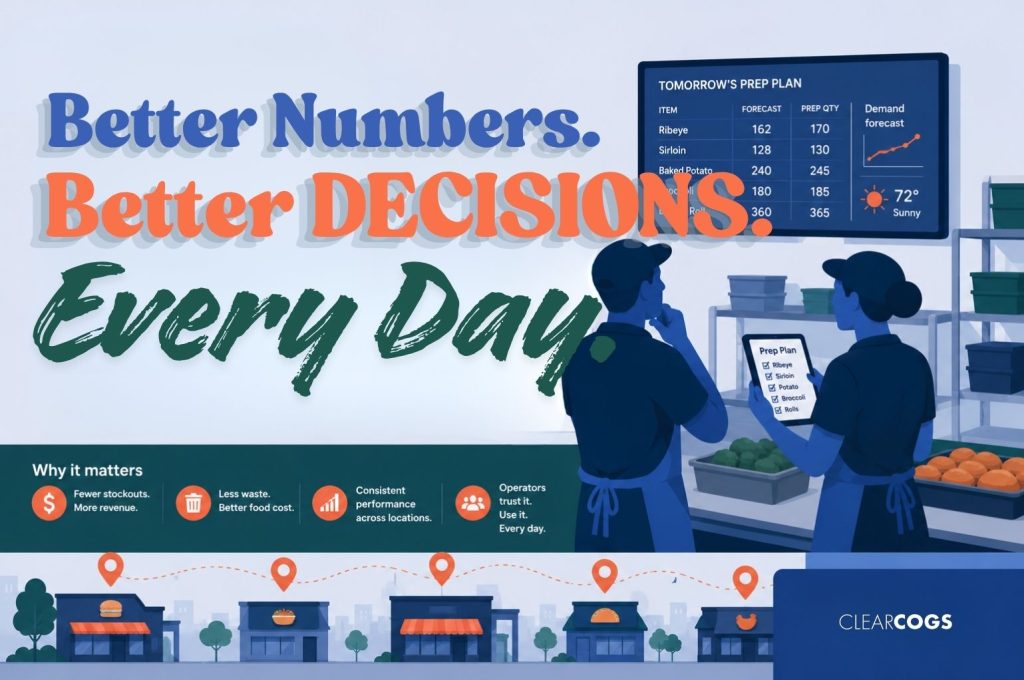
The goal of a well-designed AI pilot isn’t to replace everything at once. It’s to demonstrate, cleanly and quickly, that better numbers lead to better decisions and to build the operational foundation to act on those numbers every day.
That’s the gap worth closing.
Ready to see how forecasting accuracy translates to daily prep decisions at your locations? Let’s Talk


