




By Matt Wampler, CEO of ClearCOGS
Quick Answer: A forecast can predict demand to a decimal point. A kitchen produces in whole units: a pan, a tray, a recipe, a batch. Every forecast therefore gets rounded at the moment someone executes it, and because running short is more visible than having extra, it almost always gets rounded up. The size of your batch sets a floor on how much you will have left over, and no improvement in forecast accuracy can push waste below that floor. Choosing batch sizes deliberately is often a larger lever than improving the prediction.
The forecast and the kitchen speak different units
Here is a conversation that happens in some form during almost every forecasting project.
The system can tell you how many portions of a given item you will sell. That is the technically impressive part, and it is real. But a cook does not make portions. They make a batch, because the recipe is written for a batch, the pan holds a batch, and the equipment runs a batch at a time.
So the genuinely useful output is not how many portions you will sell today. It is how many batches to make, and whether what is left over can be used tomorrow.
That translation sounds trivial. It is where a large share of avoidable waste lives.
What rounding actually costs
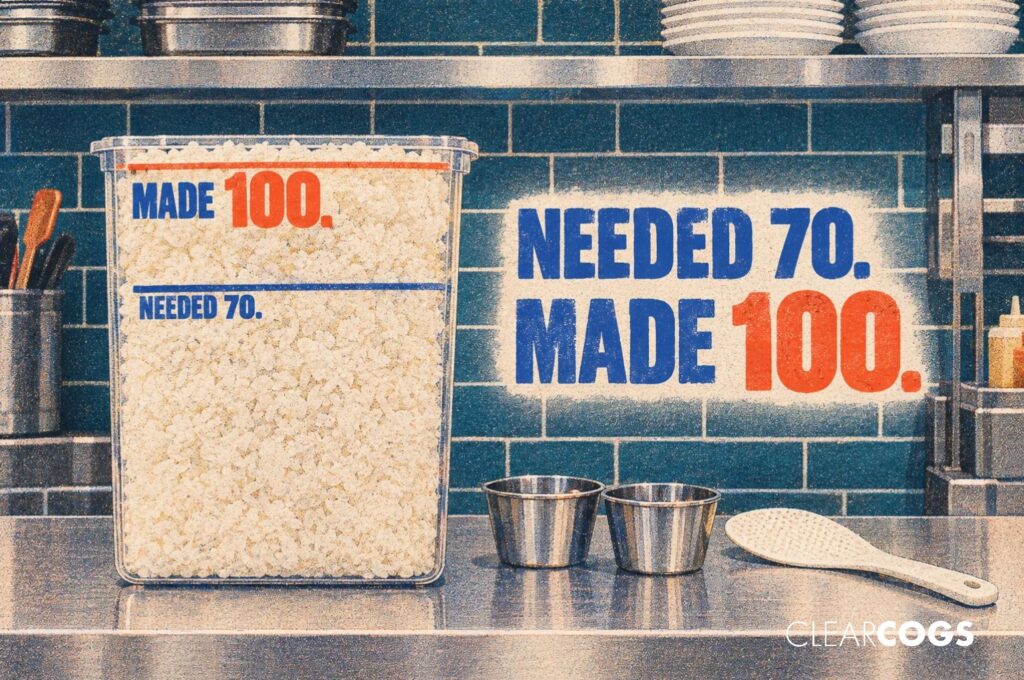
Suppose the forecast calls for 70 portions and your standard batch yields 100.
You cannot make 0.7 of a batch. You make one, and you are carrying 30 portions you did not need. If the item carries over, that is a timing cost. If it does not, 30 portions is waste, and it was decided the moment someone chose a 100-portion batch size, not when the forecast was generated.
Now run the same demand against different batch sizes:
| Batch yield | Batches made for 70 portions | Produced | Left at close | Waste floor |
|---|---|---|---|---|
| 100 | 1 | 100 | 30 | 30 percent of demand |
| 50 | 2 | 100 | 30 | 30 percent of demand |
| 25 | 3 | 75 | 5 | 5 percent of demand |
| 10 | 7 | 70 | 0 | None |
Illustrative only. Forecast is identical in every row; only the batch size changes.
This is why brands sometimes improve forecast accuracy meaningfully and see waste barely move. The prediction got better. The granularity of execution did not, so the rounding ate the gain.
Nobody decides the rounding rule
There is a second problem layered on the first, and it is human rather than arithmetic.
When the number does not land on a whole batch, somebody has to decide which way to go. In most kitchens that decision belongs to whoever is standing there, and it is not a neutral coin flip. Running out is visible, embarrassing, and gets discussed the next morning. Extra product in the walk-in is quiet. So the rounding goes up, consistently, across every item and every day.
Nobody wrote that rule. It emerged, and it is almost never revisited.
What the research says about granularity
This is well documented outside restaurants, in a setting with the same structure.
Researchers studying food waste at ultra-fresh retailers, where products have a shelf life of roughly a day, interviewed managers across seven case companies about what actually drives their waste. On replenishment, they found that most order sizes for low-volume products are simply the minimum order size, and that the discrete minimum order quantities may be larger than the average demand and hence result in waste per se. Their resulting proposition is direct: applying more granular minimum order quantities reduces the risk of food waste. They also state plainly that their study confirms minimum order quantities to be a major driver of food waste (Riesenegger and Hubner, Sustainability, 2022).
That is grocery retail rather than a restaurant kitchen, and an order quantity is not identical to a production batch. But the mechanism is the same one: a fixed, indivisible unit that does not match demand creates excess regardless of how good the demand estimate was.
The same work found something else worth keeping in view. Automated order suggestions get manually adjusted, and whether that helps or hurts depends entirely on what the person adjusting is measured on. One interviewee described two colleagues handling identical proposals differently, with one aiming to generate as few returns as possible and the other adding units to keep the display full in the evening. Same system, same number, opposite behavior.
Smaller is not automatically better
It would be easy to read all of this as an argument for the smallest possible batch. It is not, and the same research shows why.
That study also found that the size of the unit has a sales effect. One operator described keeping a full tray of product in the display precisely because a nearly empty display suppresses sales, with customers assuming what remains is leftover nobody wanted. They accepted predictable end-of-day leftovers in exchange for materially higher sales.
In a kitchen the trade-offs are different but equally real. Smaller batches mean more frequent production, which means more labor and more equipment cycles. Some items genuinely cook better in volume. And some batch sizes are fixed by the pan, the mixer, or the fryer and are not a choice at all.
So the goal is not minimum batch size. It is batch size chosen on purpose, item by item, with the trade-off understood rather than inherited.
How to work out your own
Four steps, and the first one is the whole exercise.
- Write down the batch yield for your top twenty items. Not the recipe card quantity, the quantity your team actually produces in one go. These frequently differ.
- Compare it to typical daily demand at your smaller locations. The problem appears where batch size is large relative to demand, which is usually your lowest-volume stores rather than your flagships.
- Flag anything where one batch covers more than a day of demand on an item that does not carry over. That combination guarantees waste, every single day, and no forecast will fix it.
- Change the unit, not the forecast, on those items. A half pan, a smaller container, splitting a mix into two cooks. Often the fix is physical rather than analytical.
For the items where a smaller batch is genuinely impossible, the answer is different: accept that those are the items where carryover planning and shelf-life management do the work, not production precision.
Frequently Asked Questions
Why does batch size cause food waste?
Because production happens in whole units. When expected demand falls between two whole batches, the kitchen rounds, and rounding up produces leftovers that have nothing to do with forecast quality.
Should restaurants always use smaller batches?
No. Smaller batches reduce rounding waste but add labor and equipment cycles, and some items cook better in volume. The goal is a batch size chosen deliberately for each item rather than inherited from a recipe card or a pan.
Will a more accurate forecast fix this?
Only partly. Accuracy improves which side of the rounding you land on, but the leftover amount is capped by your batch size. If one batch is much larger than daily demand, a perfect forecast still leaves product behind.
What unit should a prep sheet be in?
Whatever unit the team physically works in. Pans, trays, bins, recipe multiples. A sheet that says 47 portions forces a mental conversion at the busiest moment of the morning, and that conversion is where errors enter.
How does this relate to shelf life?
Directly. If a batch carries over at acceptable quality, rounding up is a timing cost rather than a loss. For items with no carryover, every rounded-up portion is waste. Those items deserve the smallest practical batch size.
Forecasting gets most of the attention because it is the interesting part of the problem. The unit of production gets almost none, because it was set years ago by whoever chose the pan.
But the forecast proposes and the batch size disposes. If a single batch covers more than a day of demand on something you cannot hold overnight, you have a waste floor that no model will get underneath, and the fix is a smaller container rather than a better algorithm.
If your forecasts have improved and your waste has not moved much, look at what unit your team is actually producing in.
Sources
- Riesenegger, Lena, and Hubner, Alexander. Reducing Food Waste at Retail Stores: An Explorative Study. Sustainability, 14(5), 2494. 2022. doi.org


