

By Osa Osarenkhoe, CTO and Co-Founder of ClearCOGS
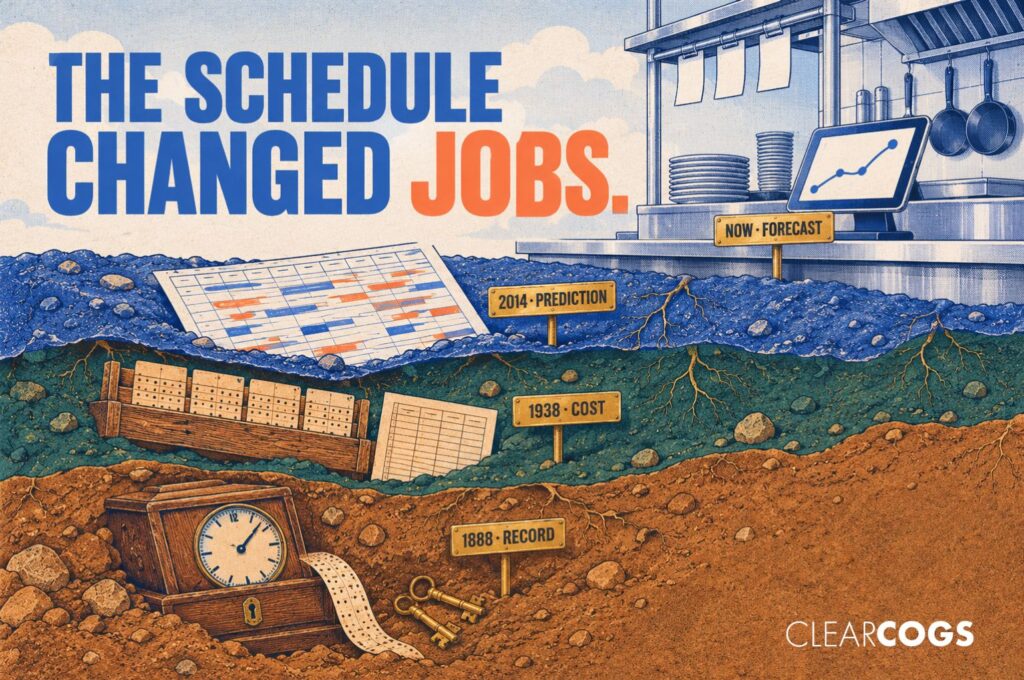
The short version. The restaurant schedule has changed jobs three times. In 1888 a time clock turned it into a record of who showed up. In 1938 the Fair Labor Standards Act put a price on hours past a weekly limit, so the schedule became a cost to be managed at the end of the week. In 2014 San Francisco passed the earliest of today’s predictive scheduling laws, requiring schedules two weeks in advance, so the schedule became a prediction that carries a penalty when it is wrong.
Each step moved the scheduling decision earlier in time. A decision made two weeks out is only as good as the forecast behind it, which is why the fourth change, now under way, is the schedule becoming an output of the demand forecast rather than a document a manager writes from memory.
I build forecasting systems for a living, so I tend to read history as a question about when a decision gets made and what information is available at that moment. The restaurant schedule is a good case. For most of its history it was a record of the past. Then it became a weekly cost. Now, in a growing number of cities, it has to be a prediction, and the law charges you when the prediction misses. This post walks through the three documents that made those changes, and what they mean for a group running ten or more locations today.
What did the 1888 time clock actually change?
It changed who kept the record and when it was made. On November 20, 1888, the U.S. Patent Office granted patent number 393,205 to Willard L. Bundy, a jeweler in Auburn, New York, for a “Time-Recorder.” The patent describes a clock with a keyhole; each worker carried a differently shaped key, and turning it printed the worker’s number and the hour on a paper strip inside the case. Bundy wrote that the purpose was to make employees record the time they entered the premises and so “save the extra expense of watchmen or time-keepers.”
Notice what the device does and does not do. It records arrival, after the fact, to the hour. It does not plan anything. The schedule, if there was one, lived in the owner’s head; the clock just produced evidence of what happened. For the next fifty years, “scheduling” in a kitchen meant deciding who came in, and the time clock meant you could check later whether they did.
From a systems view, this is where the restaurant gets a machine-readable labor record. It is a log rather than a plan. But a log is what every later step is built on, because you cannot forecast what you did not record.
Why did a 1938 law turn the schedule into a cost?
Because it made some hours cost more than others, and that gave the schedule a budget. On June 25, 1938, President Roosevelt signed the Fair Labor Standards Act. The Department of Labor’s own history of the act records what it did at the start: it set a minimum wage of 25 cents an hour and a maximum workweek of 44 hours, and it applied to industries covering about one-fifth of the labor force. The Department also notes the act took effect on October 24, 1938.
The workweek limit is the part that matters for scheduling. Once there is a line past which an hour costs more, the week has to be planned so that total hours land under the line. The schedule stops being a loose list of who is coming in and becomes a weekly allocation of a scarce, priced resource. The decision moves from “after the shift” to “before the week,” and the time clock’s log becomes the input to a weekly calculation.
This is still a backward-looking system in one important way. The planning happens a few days ahead, the check happens at week’s end, and the unit of control is the week. Nothing in 1938 asked the operator to know what next Tuesday at 5 p.m. would look like. It asked only that the week’s hours add up.
What did San Francisco change in 2014?
It made the schedule a legal prediction. On November 25, 2014, the San Francisco Board of Supervisors passed two ordinances together known as the Formula Retail Employee Rights Ordinances. The city’s Office of Labor Standards Enforcement summarizes the scheduling rules: covered employers, chain businesses with at least 40 establishments worldwide and 20 or more employees in San Francisco, must give employees their schedules two weeks in advance, and if a schedule is changed with less than seven days’ notice, the employer owes a premium of one to four hours of pay depending on the notice given and the length of the shift. Workers kept on call and not called in are owed two to four hours.
Read that as a systems requirement. The employer must commit, in writing, to a specific staffing plan for a day two weeks away, and pay when the plan changes. That is a forecast with a penalty attached. Before 2014 a manager could write Tuesday’s schedule on Sunday and fix it on Tuesday. After 2014, in San Francisco, the fix had a price, and the sensible move was to get Tuesday right two weeks earlier.
Other cities followed with their own versions. Seattle, New York City, Oregon and Chicago all require 14 days’ notice for covered employers, with different coverage tests and premiums. We laid those out in our Fair Workweek quiz, so I will not repeat them here. The point for this history is the direction of travel: the decision keeps moving earlier.
What is the pattern across all three?
Each document pushed the moment of decision back in time and raised the cost of getting it wrong.
| Year | The document | What the schedule became | When the decision is made | What a miss costs |
|---|---|---|---|---|
| 1888 | Bundy time recorder, U.S. Patent 393,205 | A record of who arrived, and when | After the shift | Nothing; the clock only records |
| 1938 | Fair Labor Standards Act | A weekly allocation of priced hours | Before the week, checked at week’s end | Overtime on hours past the weekly limit |
| 2014 | San Francisco Formula Retail Employee Rights Ordinances | A written prediction of each shift | Two weeks before the shift | One to four hours of pay per late change |
| Now | The demand forecast | An output of a 15-minute sales forecast | As far out as the forecast holds, refreshed daily | The premium, plus the turnover a badly shaped day causes |
Sources for the first three rows are listed at the end. The fourth row describes current practice at forecast-driven operators and is our view rather than a cited fact.
The 1888 clock produced data. The 1938 act gave that data a weekly budget. The 2014 ordinance demanded a two-week commitment. What none of the three supplied was a way to know, two weeks out, what a given Tuesday would do. Operators were asked to predict without being given a forecast.
Why does a two-week schedule need a forecast rather than a template?
Because the thing being predicted is not the week’s total. It is the shape of each day. A manager’s template, last year’s Tuesday or a standard weekday grid, gets the total roughly right and the shape wrong, and the shape is where both the premium and the turnover live. We showed the arithmetic in Your Labor Percentage Is Fine. Your Tuesday Night Isn’t: a day can hit 20 percent labor while sales per labor hour swings more than four to one between blocks.
A forecast that holds two weeks out has to do three things a template cannot. It has to carry each store’s own day-of-week and time-of-day shape, learned from the store’s history rather than assumed. It has to adjust for things that are known in advance, such as the calendar and local events, and refresh daily for things that are not, such as weather. And it has to be expressed at the resolution the schedule is written in, which for many groups is the quarter hour. When those three hold, the schedule written at day 14 is close enough that the changes at day 1 are small, and small changes are the cheap kind.
That is the fourth job for the schedule, and it is the one we work on. The annual version of the same idea is in our post on building a 2027 sales budget store by store: the yearly number and the daily number have different jobs, and the daily one is what the kitchen and the scheduler actually use.
What does this history mean for finance, IT and franchise leaders?
Finance. Each of the three documents added a labor cost that depends on timing rather than headcount: overtime past the weekly line, a premium for a late change, and the turnover a lumpy day causes. A finance team that budgets labor as hours times wage is budgeting the 1938 version. The 2014 version adds a line for premiums, and the current version adds the cost of rehiring. The question to ask the scheduling tool is how many changes were made inside the notice window last period, by store.
IT and systems. The time clock, the scheduler and the point of sale are three systems built in three different eras for three different jobs. The clock records, the scheduler allocates, the POS sells. A 14-day schedule needs all three to talk, because the forecast comes from the POS history, the plan lives in the scheduler, and the actuals come from the clock. If a person is still moving data between them by hand every morning, that person is the integration, and the forecast is only as current as their spreadsheet.
Franchise. Coverage tests count the whole system rather than the single store. San Francisco’s law looks at 40 establishments worldwide; the others we covered count locations or employees across the brand. A franchisee with two units can be inside a law because the franchisor has forty. The practical consequence is that scheduling standards, like brand standards, have to be set at the system level, and the forecast that supports them has to work the same way in every store.
What is the next change?
If the pattern holds, the decision keeps moving earlier and the information available at that moment keeps getting better. In 1888 the information was a key turned in a clock. In 1938 it was a week’s worth of punches. In 2014 it was whatever the manager remembered about last year. The next version is a forecast that already knows the store’s shape, the calendar and the weather on the day the schedule is written. The schedule stops being something a person predicts and becomes something a person reviews.
One honest limit. A forecast reduces the number of changes; it does not remove the need for judgment. A manager who knows a regular’s birthday party is Thursday still has information the model does not, and a good system makes that input easy rather than pretending it is unnecessary. The history here is not a story of people being replaced by machines. It is a story of the decision moving earlier, and of the tools finally catching up to where the law already put it.
If your group posts schedules two weeks out and wants to see what a 15-minute forecast does to the number of changes, Let’s Talk.
What else do people ask about the history of restaurant scheduling?
Was Bundy’s the first time clock?
The 1888 patent is the one histories of the time clock usually point to, and Bundy’s company went on to build them commercially. Other inventors filed similar devices in the same period, so “first” depends on the definition. What is clear from the patent itself is the purpose: to have workers record their own arrival time and reduce the cost of someone watching the door.
Did the Fair Labor Standards Act apply to restaurants in 1938?
The Department of Labor’s history says the 1938 act applied to industries covering about one-fifth of the labor force, and coverage expanded through later amendments. The principle it introduced, a priced line past a weekly hour limit, is what reshaped scheduling across industries as coverage grew.
Which city passed the first predictive scheduling law?
San Francisco’s is the earliest of the laws now in force that we could find. Its Board of Supervisors passed the two Formula Retail Employee Rights Ordinances on November 25, 2014, requiring two weeks’ schedule notice and predictability pay for changes made with less than seven days’ notice. Seattle’s ordinance took effect July 1, 2017, New York City’s fast food protections on November 26, 2017, and Oregon and Chicago followed with 14-day notice laws.
Disclosure and method
ClearCOGS sells restaurant forecasting software, including labor forecasting, so we have a commercial interest in operators scheduling from a forecast. I am the company’s CTO and co-founder. The 1888, 1938 and 2014 facts come from the primary documents linked below, read on November 10, 2026: the patent text, the Department of Labor’s published history, and the San Francisco Office of Labor Standards Enforcement’s ordinance page. The description of forecast-driven scheduling in the fourth table row and the “What is the next change?” section is our view of current practice, not a cited finding. No operator or sales call is described. This is not legal advice. Written November 10, 2026.
Sources
- U.S. Patent 393,205, “Time-Recorder,” Willard L. Bundy, Auburn, New York, granted November 20, 1888 (application filed August 3, 1887): patents.google.com/patent/US393205
- U.S. Department of Labor, “Fair Labor Standards Act of 1938: Maximum Struggle for a Minimum Wage,” by Jonathan Grossman, originally published in the Monthly Labor Review, June 1978: dol.gov/general/aboutdol/history/flsa1938
- City and County of San Francisco, Office of Labor Standards Enforcement, “Formula Retail Employee Rights Ordinance” (ordinances passed November 25, 2014; rules effective March 1, 2016): sf.gov/information–formula-retail-employee-rights-ordinance