

By Matt Wampler, CEO of ClearCOGS
Before you start. Four U.S. jurisdictions have scheduling laws that reach restaurants: New York City (fast food), Chicago, Seattle, and the state of Oregon. All four require written schedules 14 days in advance for covered workers. They differ on who is covered (from 30 locations in New York City to 500 employees worldwide in Oregon and Seattle), on the premium owed when a manager changes a posted shift (a flat $10 to $75 in New York City; one hour of pay or half the lost hours elsewhere), and on how much rest a worker gets between a close and an open (11 hours in New York City, 10 everywhere else).
Eight questions follow. Open each one for the answer and the source. Keep count; the scorecard is at the end.
Many of the multi-unit operators I talk to know the phrase “predictive scheduling.” Fewer can say which of their stores it applies to, and fewer still know what a last-minute cut actually costs in each city. That matters because the fastest fix for a slow afternoon, sending someone home, is now one of the most expensive scheduling moves you can make in these places.
Answers come from the enforcing agencies’ own pages, linked under each question. This is a quiz about what the rules say rather than legal advice; check the agency page for your city before you change a policy.
How well do you know the four scheduling laws that reach restaurants?
Question 1. A 25-location casual-dining brand opens two restaurants in Seattle. Does Seattle’s Secure Scheduling Ordinance cover them?
Answer: No, as described. Seattle covers retail and food service establishments with 500 or more employees worldwide, and full-service restaurants must also have at least 40 full-service locations worldwide. A 25-location full-service brand misses the location test. A limited-service brand with 500 employees would be covered at the first Seattle store. Source: Seattle Office of Labor Standards, Secure Scheduling Ordinance fact sheet.
Question 2. A franchisee owns two quick-service restaurants in Queens. The brand has 300 locations nationally. Does New York City’s Fair Workweek Law apply to those two stores?
Answer: Yes. New York City defines a fast food establishment as part of a chain of 30 or more establishments nationally that primarily serves food, offers limited service, and takes payment before the guest eats. The Department of Consumer and Worker Protection’s own FAQ uses this exact scenario: two franchised stores of a 300-location chain are covered. Separately owned franchises must comply when the brand total is over 30. Source: NYC DCWP, Fair Workweek Law in Fast Food FAQ, section I.c.
Question 3. How far in advance must a covered employer post the written schedule in New York City fast food, Chicago, Seattle and Oregon?
Answer: 14 days in all four. New York City counts it as 336 hours before the first day on the schedule. Oregon requires 14 calendar days before the first day on the schedule. Seattle requires a written schedule 14 days in advance. New York City retail workers, by contrast, get 72 hours. Sources: NYC DCWP FAQ section II.a; Chicago BACP Fair Workweek page; Oregon BOLI predictive scheduling page; Seattle OLS fact sheet.
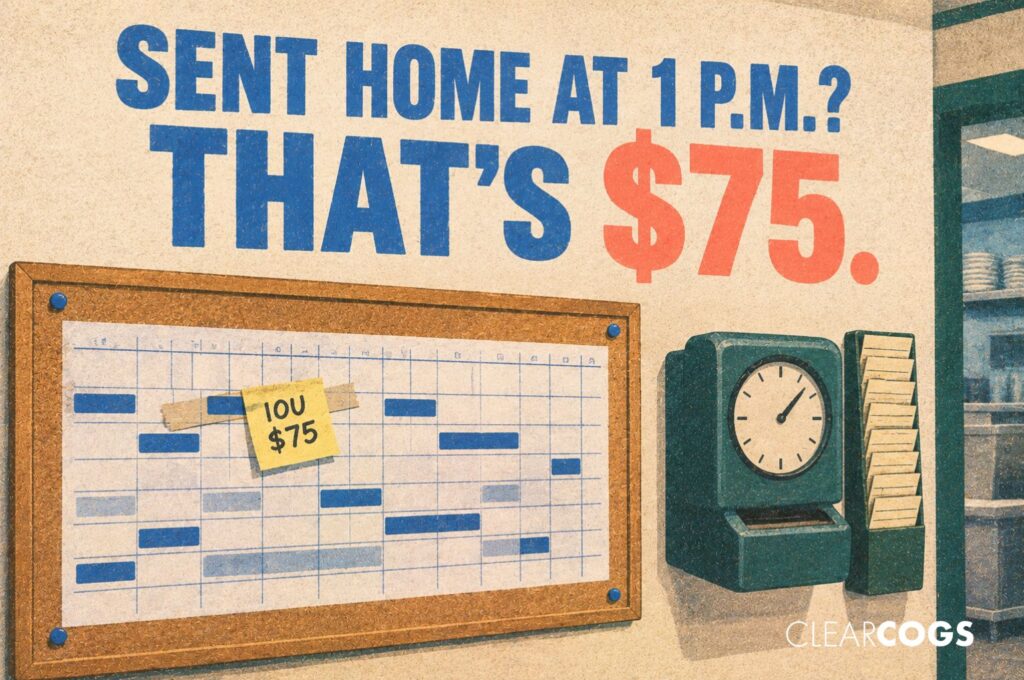
Question 4. It is a slow Monday at a covered New York City fast food restaurant. At 1 p.m. the manager tells a worker scheduled until 3 p.m. to go home. What does the employer owe?
Answer: A $75 schedule change premium, unless the worker is paid for the full shift. New York City’s premium table charges $20 for reducing hours with less than 14 days’ notice, $45 with less than 7 days, and $75 with less than 24 hours. The DCWP FAQ covers this scenario directly and notes one exception: if the employer pays the worker for the whole scheduled shift and keeps records showing it, no premium is owed. Asking for “volunteers” to leave early does not count as a worker-initiated change. Source: NYC DCWP FAQ, Schedule Change Premium Amounts and the Brenda and Pete scenarios.
Question 5. Same slow Monday, but the restaurant is in Portland, Oregon, and the employer is covered. The manager cancels a six-hour shift the day before. What is owed?
Answer: Half the regular rate for each scheduled hour not worked, so three hours of pay for a six-hour shift. Oregon pays one hour at the regular rate when an employer adds more than 30 minutes, moves a shift without losing hours, or adds a shift; and one-half the regular rate per hour for hours subtracted, shifts cancelled, or on-call shifts not called in. Seattle’s table is the same shape: one hour of pay for additions or moves, half the hours not worked for reductions. Source: Oregon BOLI predictive scheduling page; Seattle OLS fact sheet.
Question 6. A closer finishes at 11 p.m. and is scheduled to open at 8 a.m. How many hours of rest does each law require before a premium or consent is triggered, and what is the New York City premium?
Answer: 11 hours in New York City; 10 hours in Oregon, Seattle and Chicago. The New York City “clopening” premium is $100, and the worker must consent in writing. Oregon and Seattle pay time-and-a-half for hours worked inside the 10-hour window. Chicago gives the worker the right to decline hours that start less than 10 hours after the previous day’s shift. In this example, nine hours of rest would trigger all four. Sources: NYC DCWP FAQ section II.c; Oregon BOLI; Seattle OLS fact sheet; Chicago BACP.
Question 7. A Seattle manager texts the whole crew that a cook called out and asks who wants the shift. A worker takes it with four hours’ notice. Is a premium owed?
Answer: No. Seattle lists six situations where no pay for a schedule change is owed, and two of them fit: the employee responded to a mass message about hours available because another employee could not work, or responded to a message to currently working employees about hours available due to unanticipated customer needs. New York City treats the same situation differently: if management asks for volunteers, the employer initiated the change and a premium is owed. Sources: Seattle OLS fact sheet; NYC DCWP FAQ (Donut Street scenario).
Question 8. A Chicago full-service group has 28 restaurants and 400 employees. A Seattle manager asks a prep cook to stay 12 minutes late. Which one owes something?
Answer: Neither, as described. Chicago covers restaurants with at least 250 employees and 30 locations, so a 28-location group is under the location threshold. Seattle does not require additional pay for increases or reductions of less than 15 minutes; additions between 15 minutes and an hour can be prorated. Change either fact and the answer flips: a 30th Chicago location brings the group in, and a 20-minute stay in Seattle is pay owed. Sources: Chicago BACP Fair Workweek page; Seattle OLS fact sheet.
What do the four laws actually require, side by side?
| Jurisdiction | Who is covered (restaurants) | Schedule notice | Premium for a manager-made change | Rest between shifts |
|---|---|---|---|---|
| New York City | Fast food: chains of 30 or more establishments nationally, limited service, pay before eating; franchisees included | 14 days (336 hours) | $10 to $15 for added or moved time; $20, $45 or $75 for reduced or cancelled time, by notice given | 11 hours; $100 premium with written consent |
| Chicago | Restaurants with at least 250 employees and 30 locations; workers under a wage cap that the city sets | 14 days | 1 hour of predictability pay for a shift change inside 14 days | Right to decline hours less than 10 hours after the previous shift |
| Seattle | 500 or more employees worldwide; full-service also needs 40 or more full-service locations worldwide | 14 days | 1 hour of pay for additions or moves; half the hours not worked for reductions; under 15 minutes exempt | 10 hours; 1.5x pay inside the window |
| Oregon (statewide) | Retail, hospitality and food service employers with 500 or more employees worldwide | 14 calendar days | 1 hour at regular rate for additions over 30 minutes or moves; half the regular rate per hour for hours cut or shifts cancelled | 10 hours; 1.5x pay inside the window |
Compiled from the enforcing agencies’ pages listed under Sources, read November 10, 2026. Each law has exceptions (worker-requested changes, shift swaps, emergencies) and other duties (good-faith estimates, access to hours, posting). Confirm current amounts on the agency page before relying on them.
What does a last-minute cut cost a multi-unit group?
In New York City, one no-notice early cut costs $75 in premium, so a 20-store group making three cuts per store per week pays about $234,000 a year. Here is that math as a labeled hypothetical. A group runs 20 covered fast food stores in New York City. Each store sends one worker home early three times a week on slow shifts with no notice. That is 60 changes a week at $75 each: $4,500 a week, or about $234,000 a year in premiums alone, before any damages for unpaid premiums. The labor the managers “saved” by cutting was two hours of wages at a time; the $75 premium alone is more than those two hours cost at most hourly rates.
In Oregon or Seattle the same habit costs less per event, half the lost hours, but the direction is the same. The law is built to make the midday cut cost money, so that the schedule gets written correctly two weeks out instead.
That is why this is a forecasting problem as much as a compliance one. A 14-day posting rule only works for the operator if the forecast is good 14 days out. If the schedule is written to last year’s Tuesday and then fixed on the day, every fix is a premium. If it is written to a forecast that already includes the weather pattern, the local event and the store’s own day-of-week shape, there is less to fix. We covered the shape side of this in Your Labor Percentage Is Fine. Your Tuesday Night Isn’t.
Where do the controller and the regional director disagree on this?
They disagree on the fix, since both want fewer premiums. The controller sees premiums as a new line that should be zero, and a compliance exposure that scales with store count. The fix, from that seat, is a policy: no cuts, no call-ins, period.
The regional director sees stores that are dead on Tuesday afternoon and slammed on Friday night, and a crew that will walk if they are scheduled for the dead hours every week. A flat “no changes” policy, from that seat, means over-staffing the slow hours to be safe, which is its own cost.
The way through is the one the laws point at anyway: get the schedule right at the 14-day mark. The controller gets a premium line near zero because there are fewer changes. The regional director gets a schedule shaped to demand because it was built from a forecast rather than a flat rule. Neither side gets there by policy alone; it takes a forecast good enough to post two weeks ahead and stand behind.
Your score
7 to 8: you know where the lines are. The next question is how many premiums your stores paid last period, and whether anyone tracks it.
4 to 6: you know the headline (14 days) but not the differences that cost money. Pull the agency page for each city you operate in and compare it to your scheduling tool’s settings.
0 to 3: if you have stores in any of these places, start with the coverage test. Thresholds are counted worldwide and include franchise systems, so a small local footprint does not mean you are out.
If your group posts schedules two weeks out in any of these cities and wants a forecast that holds at that distance, Let’s Talk.
What else do operators ask about predictive scheduling?
Do these laws apply if my company is based outside the city?
Yes, where you have covered workers. New York City’s FAQ says the law applies to employers that fit the definition and employ workers in the city, wherever the employer is based. Seattle covers employees who work at a Seattle location at least 50 percent of their time. The thresholds (30 locations, 500 employees) count worldwide, not locally.
Can a worker waive the premium by agreeing to the change?
Not in New York City. The DCWP FAQ states that a worker’s written consent to a schedule change does not waive a premium that is owed. Seattle and Oregon exempt changes the worker requested, but a manager asking for volunteers is treated as a manager-made change in New York City.
Disclosure and method
ClearCOGS sells restaurant forecasting software, including labor forecasting, so we have a commercial interest in operators scheduling from a forecast. This post describes what four enforcing agencies publish about their scheduling laws as of November 10, 2026; it is not legal advice, amounts and thresholds change, and each law has exceptions and additional duties not covered here. The 20-store premium example is a hypothetical, labeled as such. No operator or call is described. Written November 10, 2026.
Sources
- NYC Department of Consumer and Worker Protection, Fair Workweek Law in Fast Food: Frequently Asked Questions, updated September 15, 2023: nyc.gov (PDF); summary page: nyc.gov/site/dca/workers/workersrights/fastfood-retail-workers.page
- City of Chicago, Department of Business Affairs and Consumer Protection, Fair Workweek: chicago.gov/city/en/depts/bacp/supp_info/fairworkweek.html
- Seattle Office of Labor Standards, Secure Scheduling Ordinance Fact Sheet (SMC 14.22), April 1, 2021: seattle.gov (PDF)
- Oregon Bureau of Labor and Industries, Predictive scheduling (ORS 653.412 to 653.490): oregon.gov/boli/workers/pages/predictive-scheduling.aspx