


By Matt Wampler, CEO of ClearCOGS
Quick Answer: Seasonal food operations lose operational knowledge because the people who carry it, the stand leads, cooks, and supervisors who learned what to order and prep, leave at the end of every peak season. The fix is not better hiring or longer training. It is moving the knowledge out of people and into systems: documented decision logic, data-driven pars, and forecasts built from the operation’s own sales history, so each new season starts from the numbers instead of from zero.
An executive at a multi-property agritourism operator described the problem to us in one sentence: the person running a given food stand this season is probably not the person who will be running it next season, so every year the operation restarts. Her business grows from a few dozen full-time staff to roughly ten times that many seasonal workers at peak, across a full-service restaurant, a handful of quick-service outlets, bars, and event spaces. And the institution’s answer to “how much should we order” still lived in a spreadsheet she maintained herself, tab by tab, outlet by outlet.
Her conclusion is the thesis of this article, and it deserves to be printed and taped to an office wall: systems, not people, should be what retains the knowledge.
Why Do Seasonal Operations Lose Operational Knowledge?
Because the turnover is structural, not a management failure. Seasonal expansion and contraction is simply how this part of the industry works: U.S. Bureau of Labor Statistics data shows that employment in food services swings by roughly 800,000 jobs between its winter low and summer peak in an ordinary year, and employment in amusement and recreation venues swings by nearly a third. Operations built around a peak season are hiring, training, and releasing enormous workforces on a cycle, by design.
A year-round restaurant loses knowledge gradually, one departure at a time, and the remaining team backfills. A seasonal operation loses it all at once, on schedule. The cook who learned exactly how many cases a hot Saturday consumes, the stand lead who figured out that the first warm weekend arrives before the calendar says it should, the supervisor who knew which outlet always runs short because the one next door borrows its stock: most of them will not be back. What they learned was real, and it walks out with them every fall.
What Knowledge Actually Walks Out the Door?
Not recipes or till procedures. Those are written down. What leaves is the estimating knowledge, the answers to questions no manual covers:
- Ordering quantities: how many cases each outlet actually burns through at each level of busy, per vendor, per delivery day.
- Prep pars by daypart: what “ready for a Saturday” means in trays and pans, and how that differs from a Tuesday.
- The exceptions: which weekends outperform their history because of weather, which events change the mix, which items sell out first.
- The workarounds: who borrows stock from whom, what gets substituted, and where the last-minute supply runs go, the things that keep a peak day alive and never appear in any system.
The operator we spoke with had lived every one of these. A peak weekend where staff had to be sent out mid-service to buy more of a staple. Inventory counted monthly, meaning thirty days of small daily leaks discovered all at once. Waste tracked on a clipboard in the kitchen that never met the ordering math. None of that is carelessness. It is what happens when the operation’s memory is distributed across hundreds of people who reset every year.
How to Build Systems That Retain the Knowledge
Four moves convert people-knowledge into operation-knowledge, roughly in order of effort.
- Get every outlet’s sales into one queryable place. Knowledge retention starts with data retention. If each stand, bar, and restaurant rings sales under its own revenue center in the point of sale, the operation automatically remembers what every outlet sold, every fifteen minutes, forever. That record does not quit in November. It is the single highest-leverage prerequisite, and it is configuration work, not a project.
- Write down the decision logic, not just the tasks. Most seasonal operations have checklists for opening a stand. Almost none have written logic for how the stand’s order quantities get chosen. Documenting even a crude rule (“we order to last year’s same weekend plus growth, adjusted for the forecasted weather”) turns a departing employee’s instinct into an artifact the next person inherits. If the rule currently lives in one executive’s spreadsheet, that spreadsheet is a single point of failure with a job title.
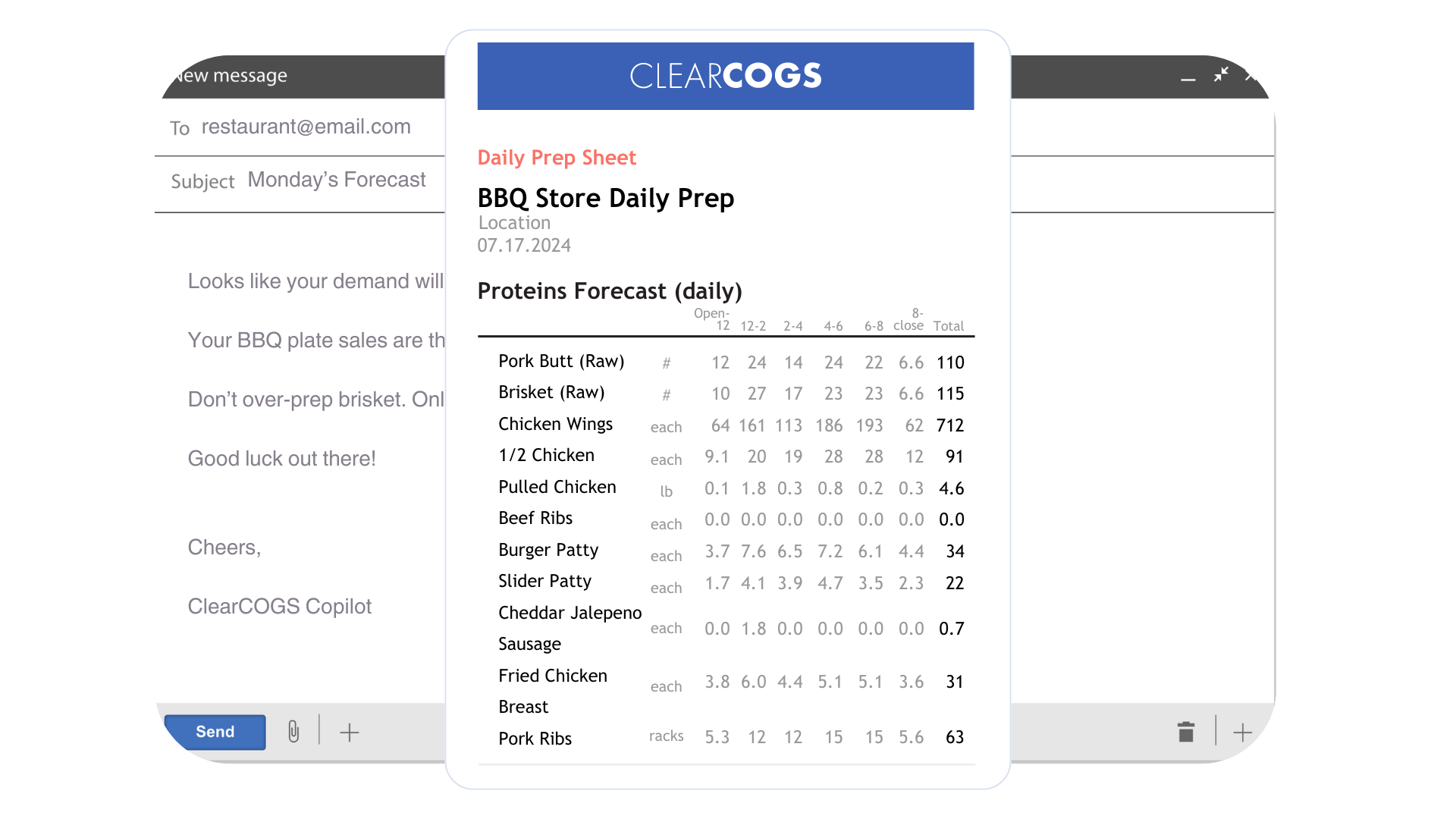
- Replace the peak-week average with a real forecast. The standard seasonal method, averaging the biggest weeks of last season and adding a growth multiplier, fails precisely where seasonal operations hurt most: the shoulder days, the early warm weekend, the event that shifts dates, the outlet whose mix differs from the property average. A forecast built from the operation’s own transaction history can learn each outlet’s pattern, weight the season, the day, the weather, and the event calendar, and produce order and prep numbers per outlet, per day. That converts the departed veteran’s pattern recognition into something better than memory, because it never worked here “only two seasons.”
- Give every new seasonal lead a number, not a guess. The point of the first three moves is the morning experience of the eighteen-year-old running a stand for the first time. With systems in place, their day starts from a defensible printed or emailed number: prep this many, this order arrives, here is the par. Their judgment gets spent on quality and guests, not on estimating from a blank page. New staff do not need the departed veteran’s intuition if the operation has encoded it.
Should You Just Try to Bring the Same Staff Back?
Returning staff are wonderful and worth every retention effort, and they are not a strategy. Even strong seasonal operations see most of the workforce change year to year, and the more the operation depends on specific individuals returning, the more fragile every season becomes. The honest test: if your best stand lead told you today they were not coming back, would anything about ordering and prep actually be lost? If the answer is yes, the knowledge is in the wrong place. The goal is an operation where experience makes people better but the numbers never depended on any one of them.
Frequently Asked Questions
How do seasonal restaurants forecast demand with staff that changes every year?
By forecasting from the operation’s data instead of the staff’s memory. Point-of-sale history persists across seasons even when people do not, and a model built on that history, plus weather, events, and calendar effects, retains and improves the pattern recognition that departing staff used to carry.
How much sales history does a seasonal operation need for useful forecasting?
Useful item-level predictions can begin within a couple of months of data, but seasonal operations benefit most from at least one full prior season, and ideally two, so year-over-year peak patterns are learned rather than guessed.
What should seasonal staff still be trained on if the numbers are automated?
Everything the numbers cannot do: food quality, safety, speed of service, guest experience, and how to flag when reality diverges from the forecast. Automating the estimating is what frees training time for the parts of the job only people can do.
Is this problem unique to agritourism and outdoor venues?
No. Stadiums, resorts, festival vendors, beach and ski towns, and any operation with a compressed peak season faces the same cycle: workforce expands, learns, and leaves. The scale differs; the knowledge-reset problem is identical.
Sources
- U.S. Bureau of Labor Statistics, Career Outlook. Summer Surge: Strong-Growth Industries with Seasonal Employment Spikes. bls.gov