


By Matt Wampler, CEO of ClearCOGS
On a recent intro call, someone helping modernize her family’s restaurant group, twenty locations, all centrally managed, described a problem that had quietly resisted every report they ran. Inventory goes missing, and nobody can say what happened to it. Product comes in, sales go out, and somewhere in between, food disappears. The audits do not reconcile. The branches run different menus, so usage is nearly impossible to trace. Her question was not really how do we stop it. It was how do we even find out what it is.
That is the honest version of a problem most operators only talk about in the who-did-it register. And the who-did-it framing is exactly what keeps it unsolved.
Every Missing Pound Looks the Same
Accountants have a clean word for the gap between what your records say you have and what is actually on the shelf: shrinkage. The causes are anything but clean. Theft, spoilage, over-portioning, prep waste, recording errors, vendor shorts, a case that never came off the truck, a refrigerator that failed over a weekend. In retail, industry surveys attribute most shrinkage to theft. In a restaurant, the honest answer is usually all of the above, in unknown proportions.
Here is the uncomfortable part: from the outside, every one of those causes looks identical. A missing thirty pounds of chicken carries no story with it. The count just comes up short. So operators do what humans do with an unexplained gap: they reach for the most emotionally charged explanation, usually theft, and start watching people. Sometimes that is right. Often it burns trust in a kitchen where the real culprit was a heavy-handed portion scoop and a prep list nobody updated when the recipe changed.
Restaurants Are the Hardest Version of This Problem
Retail has it comparatively easy. A store buys a product, marks it up, and sells the same physical object. If fifty units came in and forty-five are accounted for, five are missing, full stop.
A restaurant is a manufacturer. Chicken arrives as cases and leaves as eight different menu items, each with its own portion size, yield, and prep loss. To know whether chicken is actually missing, you have to know how much chicken your recorded sales should have consumed. That number does not exist on any invoice or in any register tape. It has to be computed: every menu item sold, mapped through its recipe, down to ounces, per location.
Now multiply that by twenty locations. Then make the menus different at each one, which is exactly the situation this operator described. At that point, even the fallback move of comparing branches to each other stops working, because no two branches should have the same usage in the first place. The group is left with a food cost percentage that drifts and a gap that has no name.
The Missing Number Is Expected Usage
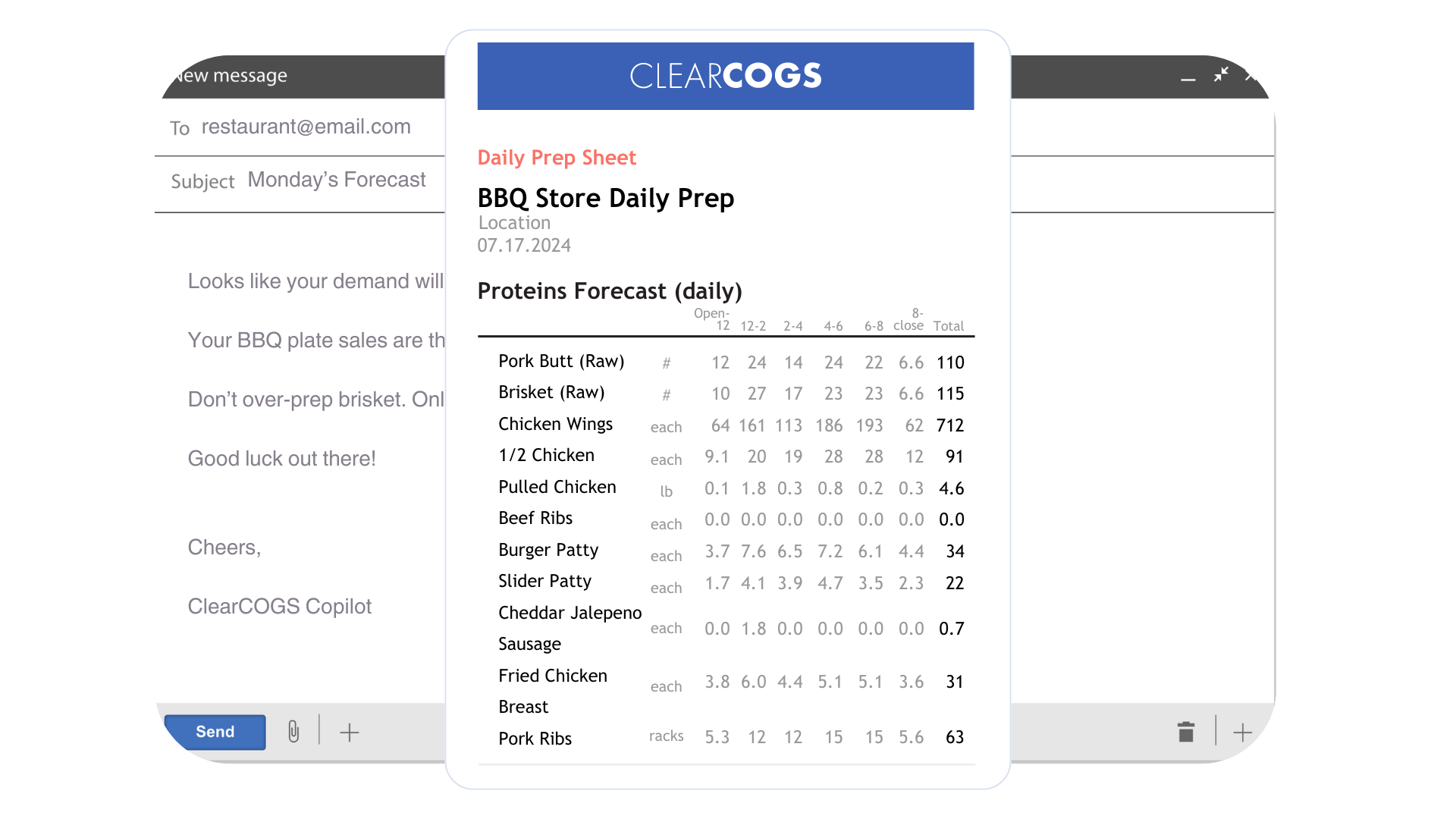
The fix is not a camera and it is not a lock on the walk-in, at least not first. The fix is a baseline. If you know what tomorrow’s sales are likely to be, and you know your recipes, you know what usage should look like: how many pounds of each ingredient each location should consume to produce the sales it records. That is the number the count gets compared against.
Once that baseline exists, the mystery gap turns into a variance, and variances have shapes. Spoilage clusters around delivery schedules and slow days. Portion drift shows up as one location running consistently heavy on one ingredient across every daypart. Recording errors appear and vanish in single weeks. Theft looks like none of those. You stop asking the unanswerable question, where did the food go, and start asking a tractable one: which location, which item, which week, and does the pattern match waste, drift, error, or something worse.
The operator on that call had good instincts about this. She was not hunting for a villain. She wanted visibility: what is actually happening to the inventory and the money, across all twenty stores, without flying between them. That is a measurement request, and measurement is buildable.
The Baseline Is a Forecast
Here is the part that surprises people: the foundation of that measurement system is not the count. Counts only tell you what is there. The foundation is the forecast, the expected-demand number that, run through your recipes, tells you what should be there. This is the problem we work on every day at ClearCOGS: turning each location’s own sales history into tomorrow’s expected usage, item by item, ingredient by ingredient, so prep, ordering, and yes, the inventory gap, all get compared against a real number instead of a feeling.
For a group at twenty locations, the payoff compounds. The same baseline that tells each kitchen how much to prep tells the office which gaps are normal and which one deserves a phone call.
If inventory is going missing in your operation and you cannot say where, resist the urge to start with suspicion. Start with the question this operator asked, because it is the right one: before we figure out who, can we first find out what? A gap you can measure is a gap you can close. A gap you can only feel will eat margin forever, and it will never once tell you its name.
Sources
- Oracle NetSuite. What Is Shrinkage in Inventory? netsuite.com