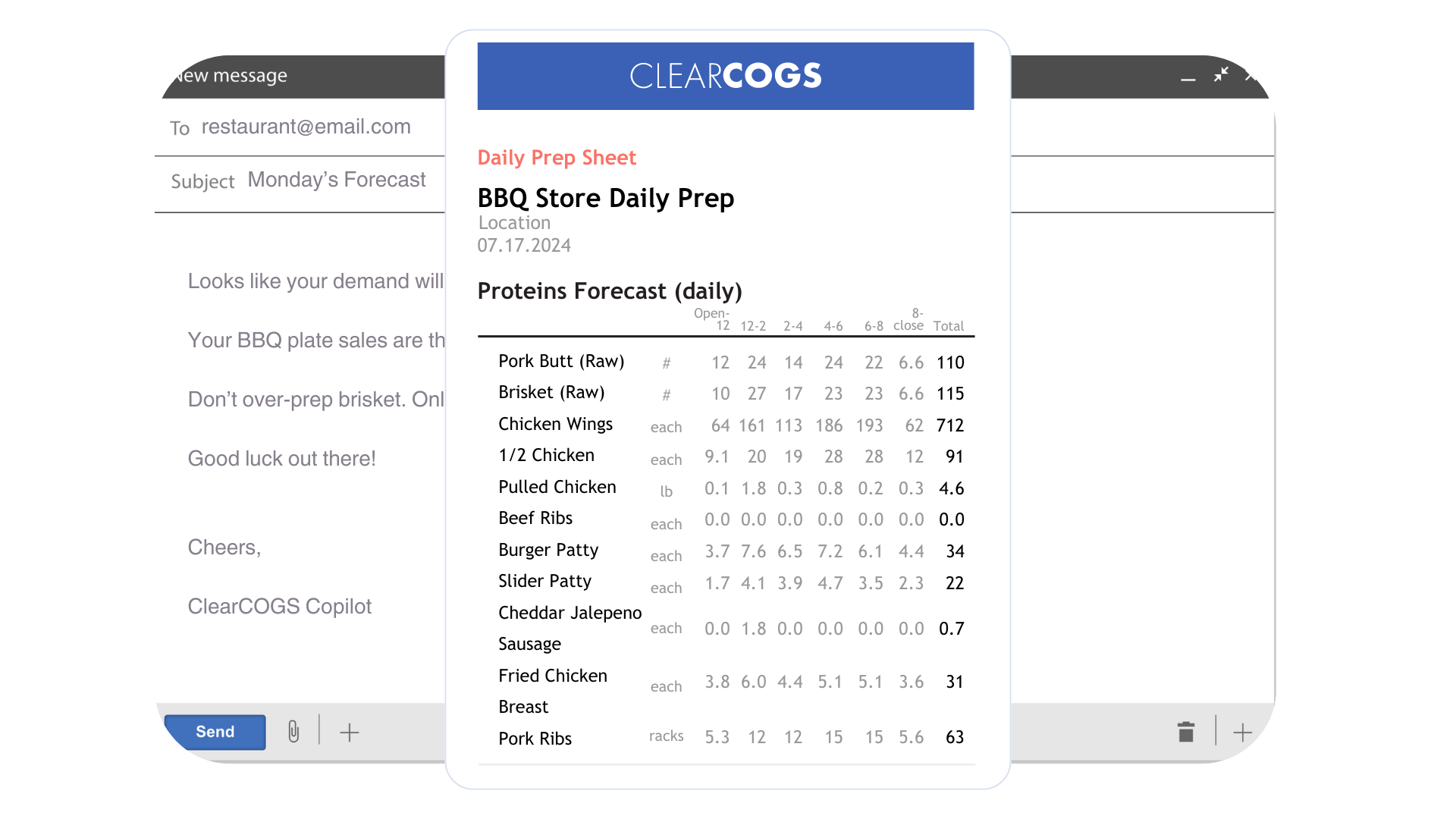



On a demo call, a technology leader at a national franchise brand with hundreds of locations described the most important piece of software in his kitchens. It predicts, hour by hour, how much of each core item every store should have ready. Field leaders visiting a location ask for it before they ask for anything else. It was built about 30 years ago, originally by one of the brand’s own franchisees, and it lives today in a Microsoft Access database.
His team was not on the call to defend it. They were there to replace it. And the way he talked about it holds a lesson for any operator running a beloved, aging tool: the chart was never the problem. The freeze was.
Good Tools Do Not Fail. They Freeze.
Here is what makes this story different from the usual legacy software complaint. Three decades ago, that production chart was genuinely ahead of its time. A franchisee built software that read the previous day’s sales mix from the point of sale, mapped it through recipes, and printed an hourly prep prediction. Most restaurants in that era were guessing on paper. This brand institutionalized forecasting so deeply that checking the chart became the first move of every field visit.
That success is exactly why it froze. Nobody replaces the tool that defines how the company operates. So the chart kept running on its original assumptions, taking an average day’s sales and spreading it across operating hours, while the world around it changed. The math was state of the art for its decade. The decade ended. The math did not.
This is not a restaurant problem. It is how organizations everywhere treat software that works. A July 2025 report from the U.S. Government Accountability Office found that the federal government spends over $100 billion a year on IT, with roughly 80 percent going to operating and maintaining existing systems, and that the eleven most critical federal legacy systems still in service range from 23 to 60 years old. Mission-critical software ages in place precisely because it is mission-critical. The more the operation depends on it, the scarier it is to touch.
The Migration That Exposes the Freeze
For decades, the chart’s plumbing was invisible. The sales data lived on a computer inside each store, the tool ran beside it, and everything just worked.
Then the brand did what most of the industry is doing: it moved to a cloud point of sale. The data left the building. To keep a 30-year-old local database fed, the IT team now runs a nightly relay: stores upload files, a SQL process reshapes them into the half-dozen formats the old tool expects, and the results get pushed back down to each location so an Access database can print a chart. The technology leader’s own description was that it is ridiculous they still do this. A cloud server exists solely to keep the old tool breathing.
This is the pattern worth internalizing. Cloud migration does not kill legacy tools directly. It cuts their oxygen, and then the organization pays a growing tax to pump air back in. Meanwhile the tool decays in quieter ways. At this brand, when the chart stops printing at a store, weeks can pass before anyone calls to say so. A tool that people can live without for weeks is a tool that has already lost its authority; the operation just has not admitted it yet. And the operations team is direct about the cost: when the numbers are off, food quality is what pays.
The Trap of Rebuilding the Same Thing
Here is the sharpest decision in the whole story. A back-office vendor offered to recreate the brand’s production chart on a modern platform, same logic, new plumbing. He turned it down. His reasoning: that would just be building the thing he already had. He was, in his words, not ready to go back in time.
That instinct deserves to be a rule. When a legacy tool finally comes up for replacement, the easy specification is “what we have, but supported.” It feels safe and it wastes the moment. The technology bar moved while the old tool was frozen. Machine learning forecasting can now model each location and each item on years of transaction history, factor in seasonality, weather, and local events, and update as patterns shift. A tool rebuilt to 1990s logic on 2020s infrastructure inherits the old ceiling with a new invoice.
The honest test for any modernization project is simple: would the person who built the original tool, with the ambition they had then, build this today? The franchisee who wrote that chart 30 years ago was not trying to enshrine averages. They were trying to give every kitchen the best available prediction of the day ahead. Honoring that intent means using today’s best method, not preserving yesterday’s.
What Actually Changes, and What Does Not
The hype filter matters here, because modernization gets sold as transformation and often is not. Replacing the plumbing alone changes IT’s workload and nothing in the kitchen. Replacing the math changes the kitchen: fewer overcooked batches held too long, fewer stockouts at the rush, field conversations about numbers instead of about whether the printer worked.
What does not change is just as important. The delivery still has to meet crews where they work, whether that is a printed sheet, an email before the shift, or a screen already in the kitchen. This brand spent 30 years teaching every store to trust one piece of paper. Whatever replaces it inherits that trust on day one and can burn it in a week of bad numbers. This is the practical layer we live in at ClearCOGS: taking the transaction history a brand’s systems already generate and turning it into the hourly production numbers its teams already know how to read, delivered wherever they already look.
If there is a tool in your operation that everyone checks first and nobody has questioned in a decade, that is not proof it is fine. That is the profile of the next chart. The question to ask is not whether it still works. It is whether the person who built it would still build it that way.
Sources
- U.S. Government Accountability Office. Information Technology: Agencies Need to Plan for Modernizing Critical Decades-Old Legacy Systems (GAO-25-107795). July 17, 2025. gao.gov