


By Matt Wampler, CEO of ClearCOGS
Quick Answer: Food halls struggle with vendor waste and inconsistent vendor profitability because every stall makes its own daily prep and ordering guesses, yet all of them depend on one shared demand driver: the hall’s foot traffic. Individually, vendors are too small to forecast well. Collectively, they are the easiest operation in food service to forecast, because the signal is shared. The fix is structural: the hall forecasts its own traffic and demand once, cascades stall-level numbers to every vendor daily, and provides it as house infrastructure, the same way it provides power and refrigeration.
We recently sat down with the operator of one of the country’s busiest food halls, a veteran running dozens of vendors under one roof with eight-figure annual sales, alongside a group planning a new hall of their own. Her diagnosis of the model was refreshingly blunt. On a revenue-share model, her income is a percentage of every vendor’s sales, which means every stall’s over-ordering, waste, and stockouts land, in part, on her P&L. She can see the leak. What she cannot do is reach into dozens of independent kitchens and stop it.
That is the food hall paradox in one sentence: the operator’s profit lives inside operations the operator does not control.
How Do Food Halls Actually Make Money?
Most modern food halls run some version of revenue share: vendors pay a percentage of sales, sometimes with a base rent, in exchange for a built-out stall, shared utilities, marketing, and the hall’s foot traffic. Industry research documented the model’s explosive rise, with the number of U.S. food halls growing from roughly 120 in 2016 to about 450 by the end of 2020, and it also documented the trade the vendors make: food hall vendors typically pay 20 to 25 percent of income in rent and usage fees, versus 6 to 10 percent for a conventional restaurant, in exchange for dramatically lower buildout, labor, and overhead costs.
Read those numbers as an operator and the stakes become clear. A vendor handing over a fifth to a quarter of every dollar has one of the thinnest tolerance bands in food service. A few points of avoidable waste is not an annoyance at that math; it is the difference between a stall that renews its agreement and a dark stall the hall has to re-lease. And because the hall’s own revenue is a slice of vendor sales, every vendor failure is the operator’s failure twice: lost percentage rent now, vacancy and churn cost later.
Why Do Food Hall Vendors Struggle With Waste?
Because a food hall multiplies the hardest part of running a restaurant, the daily demand guess, by dozens, while shrinking each guesser. The typical stall is a first-time operator or a small team chasing a dream, cooking excellent food with no analyst, no ops manager, and no historical modeling. Each one guesses prep and orders independently, usually by feel. The operator we spoke with sees the result across her hall constantly: over-ordering, spoilage, and product walking to the trash, at stalls whose margins can least afford it.
Her other observation matters just as much: getting dozens of independent vendors to adopt any tool individually is brutal. Each stall weighs every fee and every new system against razor-thin economics and a tenth of an owner’s attention, so even inexpensive tools see only a handful of takers. Her structural answer is smart: build operational requirements into new vendor agreements from day one, the way the lease already specifies hours and cleanliness. Standards adopted at signing never have to be sold twice.
The Insight: Every Stall Shares One Demand Signal
Here is what makes food halls different from any other multi-unit format, and it is the reason the waste problem is unusually fixable. A twenty-location restaurant group has twenty different demand environments. A food hall with dozens of stalls has, to a first approximation, one: the hall’s own traffic. The lunch rush, the Saturday families, the concert crowd, the rainy Tuesday, the private event in the mezzanine. Every vendor rides the same tide; they just capture different shares of it, by cuisine, price point, and position.
That means the expensive part of forecasting, modeling the demand driver, only needs to be done once, at the hall level, where the data is richest: door counts, aggregate sales, the events calendar, weather, seasonality. From that single forecast, stall-level numbers cascade: each vendor’s historical share of traffic, adjusted for day and daypart, translated through their menu into tomorrow’s prep and order quantities. The vendor who could never justify their own forecasting gets a daily number anyway, because the hall solved the problem one floor up.
This is the reframe we would offer every hall operator and developer: stop thinking of forecasting as a tool each vendor should buy, and start thinking of it as house infrastructure. No one asks stalls to negotiate their own electricity. Demand intelligence is the same kind of utility, and the hall is the only party with the data, the scale, and the incentive to provide it. On a revenue-share model, the operator is already a silent partner in every stall’s waste. Providing the number that prevents the waste is not a perk. It is the operator protecting their own margin.
What Should Hall Operators Do First?
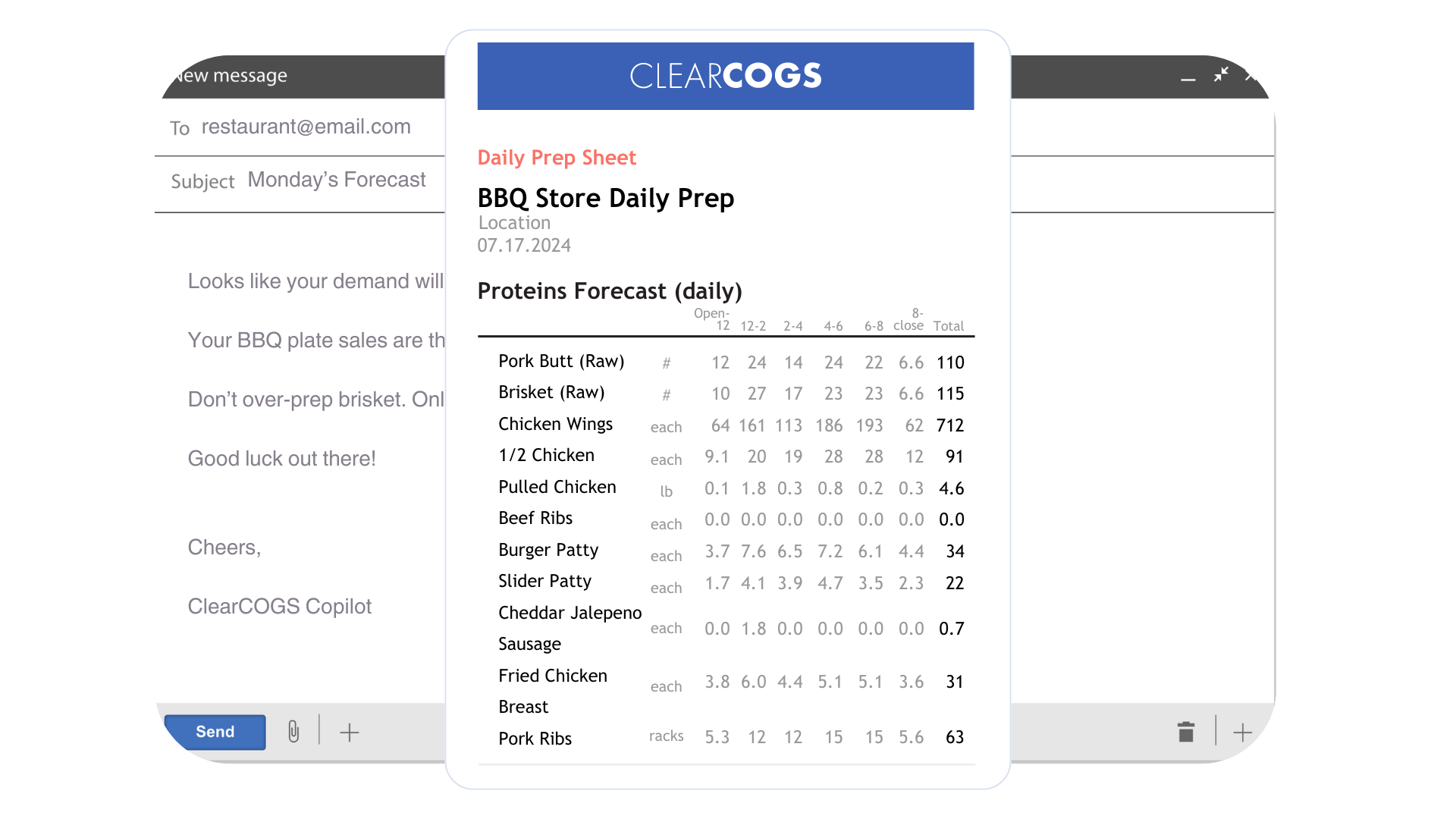
Three moves, in order of effort. First, get the data flowing: every stall on the house point of sale (or feeding it), with sales visible to the hall by vendor, item, and hour. Most modern halls already have this and use it only for billing. Second, forecast the hall: traffic and aggregate demand by daypart, driven by the events calendar and seasonality, which is exactly the class of problem forecasting systems handle well (and the layer we build at ClearCOGS for venue-style operations). Third, cascade and deliver: each vendor gets a simple daily sheet, tomorrow’s expected traffic, their expected sales, and what that means in prep quantities for their top items, delivered wherever they already look. Vendors keep full independence over their food. They just stop guessing about the tide.
Frequently Asked Questions
How do food halls make money?
Primarily through revenue share, taking a percentage of each vendor’s sales, often alongside base rent and fees for shared services. This aligns the hall’s income directly with vendor performance, which is why vendor-level operations are the hall’s business problem too.
Why do food hall vendors fail?
Thin margins meet inexperience: vendors pay a high share of income for their space while making daily prep and ordering guesses without data. Waste and stockouts that a conventional restaurant could absorb are often fatal at food hall economics.
Can a food hall really forecast demand for every vendor?
Yes, more easily than almost any other format. Because all stalls share the hall’s traffic as their demand driver, one hall-level forecast can cascade into stall-level prep and ordering numbers using each vendor’s own sales history and share of traffic.
Does providing forecasts interfere with vendor independence?
No. Vendors keep full control of menus, recipes, and execution. The hall provides a daily expectation of demand, like it provides power and foot traffic. What vendors do with the number remains their call, though halls can reinforce usage through new vendor agreements.
Sources
- ICSC. Food Halls Thriving, But Not Foolproof. Covering Cushman & Wakefield food hall research. icsc.com