


By Matt Wampler, CEO of ClearCOGS
An operations lead at a family-owned hospitality group recently walked us through his week. The group runs butcher shops, full-service restaurants, a wholesale arm, and a catering business under one umbrella, and to compute the true cost of a single product, he opens six different spreadsheets: inventory in one, internal transfers in another, yields in a third, and on down the line. He estimates three to five hours a week maintaining them, then corrected himself: that is probably an understatement.
He has shopped for software, and every vendor tells him the same thing: our system can handle it. He believes them, technically. One quoted a three-month build-out to get there. His response is the most economically literate sentence we have heard from an operator this year: why would I spend thousands a year on something that kind of works?
His situation looks exotic, but the forces behind it show up, in milder doses, in every kitchen that changes what it buys before selling it. And his conclusion about where to put the intelligence is one most growing operations should steal.
The Three Assumptions Inventory Software Makes
Standard inventory logic rests on three quiet assumptions. Units are fixed: a case is a case, and every case is the same. Identity is stable: the thing you purchased is the thing you sell. And demand is singular: one sales channel pulls from the stock.
This operation violates all three before lunch. It receives catch weights, meaning product billed by actual variable weight, so no two deliveries of “the same” item are identical. In his words, what they receive and what they sell are two totally different things: a normal restaurant buys a twelve-ounce strip steak, while his team breaks down primals and creates the twelve-ounce strip, making the group, as he puts it, technically a manufacturer. And the same coolers feed four demand streams at once: the retail case, the restaurant menus, wholesale accounts, and catering, with center-plate proteins transferring between his own butcher counters and his own dining rooms at prices ranging from thirty dollars a pound to well over a hundred.
Software built on the three assumptions does not fail loudly here. It “kind of works,” which is worse, because kind-of-working software still costs real money while the spreadsheets stay open.
The Yield Chain Is the Real Ledger
Here is why fixed-unit math cannot describe a transforming kitchen. University meat-science data lays out the chain plainly: retail cuts yield roughly 55 to 75 percent of carcass weight, about 65 percent for a typical animal, and the middle meats, the loin and rib cuts that command the highest menu prices, total only about 10 to 12 percent of carcass weight. The most valuable items on the menu are a tenth of what comes through the door; everything else cascades into roasts, grinds, trim, and stock.
Now watch what small yield drift does to cost, with illustrative numbers.
| Planned | Actual | |
|---|---|---|
| Primal purchased | 100 lb at $12.00/lb = $1,200 | 100 lb at $12.00/lb = $1,200 |
| Portion yield | 70% | 65% |
| Servable pounds | 70 lb | 65 lb |
| True cost per servable pound | $17.14 | $18.46 |
Assumptions: illustrative primal cost and yields; substitute your own invoice prices and cut sheets. A five-point yield slip raises true cost per servable pound by nearly 8 percent, silently, on a product line where menu prices were set against the planned number. A system that records fixed units never sees it. A spreadsheet sees it only three to five hours a week later, if the right tab gets updated. And the daily version of this bet is sharper still: deciding how many steaks to cut is irreversible. A primal broken into portions cannot be reassembled, so overcutting strands high-value product and undercutting strands the Saturday menu. Both mistakes are made with a knife, hours before the answer is knowable by feel.
Put the Intelligence Where the Decision Is
The conventional advice for this operator is a bigger record system: implement an enterprise-grade inventory platform, model every yield, and integrate the channels. He priced that path. The build-out is measured in months, the cost in five figures, and the end state, by every vendor’s own admission, is configuration work that eventually kind of works. His decision was to refuse, keep the inventory record in spreadsheets he already trusts, and automate something else entirely: the decisions.
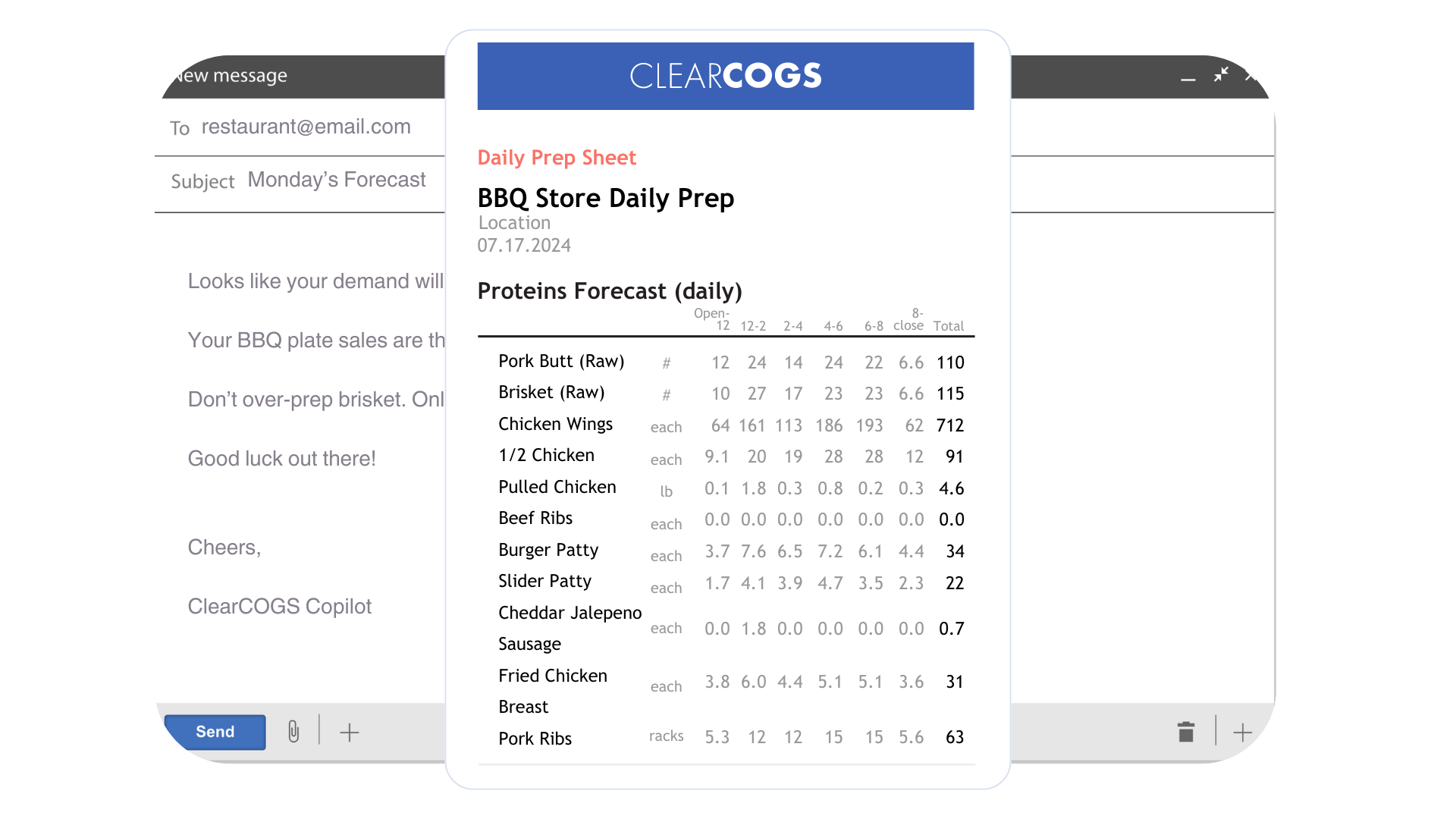
That instinct is architecturally correct, and it generalizes. A record system tells you what happened; a decision layer tells you what to do. The two are separable, and for nonstandard concepts, separating them is the whole game. Forecast what each channel will sell, per item, per location, per day: how many of each cut the dining rooms will plate, what the retail case will move, what the catering board already shows. Run that demand backward through recipes and yields, and the outputs are the exact artifacts his team needs each morning: a cutting list for the butchers before the knife commits, a transfer list for what moves between his own units, and a production list for the kitchen that makes the soups and sauces for everybody. None of it requires the ledger to be perfect. Decisions tolerate a messy record layer; a pristine record layer never once made a decision.
This is the lane we work in at ClearCOGS, and candidly it is why conversations like this one happen: the forecasting layer rides on top of whatever record-keeping an operation already has, spreadsheets included, because the goal is not a prettier history. It is a correct number arriving before the irreversible moment, at whatever address the team already checks.
The diagnostic for any operator evaluating software for a nonstandard concept takes two questions. When the vendor says “it can do that,” ask what the configuration actually costs, in months and dollars, before the doing starts. Then ask whether the result changes a decision someone makes tomorrow or just records one somebody made yesterday. This operator asked both, kept his spreadsheets, and pointed the budget at the decisions instead. The six spreadsheets are still there. The plan is for the hours spent inside them, and the guesses made at the cutting table, to go away first.
Sources
- South Dakota State University Extension. How Much Meat Can You Expect from a Fed Steer? extension.sdstate.edu