


By Matt Wampler, CEO of ClearCOGS
A finance lead at a growing independent restaurant group recently described what he found when he started auditing purchasing. In a single week, the same item had been ordered four times. Some invoices carried a single item, alone, when a full case would have cut the unit cost. The same vendor sometimes delivered several times within a couple of days. Inventory was counted once a month. And, in his own blunt assessment, the group had no food budget at all, because there was no number for anyone to be over or under.
Here is the diagnosis worth sitting with, because it applies to far more operations than his: this is not a discipline problem. Nobody at this group is lazy or careless. The problem is structural. Ordering is not a system there; it is a reflex. Whoever notices something running low orders it. And when ordering is everyone’s job, it is no one’s job.
What Ordering by Reflex Looks Like
The pattern is recognizable at thousands of restaurants. The daily ordering question is some version of “how much do you think you need for service?” A manager glances at the reservation book, forms a hunch, and places an order. At a multi-location group it compounds: each kitchen orders independently, on its own instincts and its own timing, even when the locations share a company, a vendor list, and in many cases a menu. Four restaurants, one business, zero shared backbone.
None of this feels expensive in the moment. Every individual order is small, justified, and placed by someone genuinely trying to not run out. The cost only becomes visible when someone finally reads a month of invoices side by side, which is exactly how this operator found it.
Every Order Has a Price Tag Before the Food Does
Inventory theory has been precise about this for over a century. As any supply chain textbook’s treatment of order economics lays out, every order carries a fixed cost regardless of its size, and total ordering cost scales directly with the number of orders placed. The entire discipline of order-quantity optimization exists because placing orders is not free, even when the invoice says the delivery was.
In a restaurant, that fixed cost is easy to itemize. Someone places the order. Someone meets the truck, checks in the delivery, moves it to storage, and rotates stock. Someone handles the invoice. Call it 30 to 60 minutes of combined staff and manager time per delivery. Then add the second cost reflex ordering triggers: the split-case premium. Single units and broken cases routinely price 10 to 30 percent above the full-case unit cost, which is precisely the money this group was leaving on the table with one-item invoices.
Here is the illustrative math for a single location.
| Reflex ordering | Owned ordering | |
|---|---|---|
| Deliveries per week | 6 | 3 |
| Receiving and invoice time per delivery | 45 min | 45 min |
| Weekly labor tied up in receiving | 4.5 hours | 2.25 hours |
| Annual receiving labor (at $25 loaded hourly) | ~$5,850 | ~$2,925 |
| Split-case and single-unit purchases | Frequent | Rare |
Assumptions: 45 minutes combined staff and manager time per delivery, $25 fully loaded hourly cost, deliveries consolidated from six to three per week. Substitute your own wages and vendor terms; the direction holds even when the numbers move.
That is roughly $3,000 a year in recovered labor per location before counting a single dollar of split-case premium, before the vendor’s small-order fees, and before the quieter cost this group also named: whatever gets over-ordered has a way of disappearing. Excess stock feeds shrinkage, and shrinkage at most restaurants is measured monthly at best, which means the reflex orders of week one are invisible until the count at week four.
Consolidation Requires a Number
The obvious fix, order less often and in fuller cases, has a prerequisite most operators skip. You cannot consolidate orders without knowing what you will need before you need it. A kitchen that orders by reflex is not choosing chaos; it is compensating for the absence of a forward-looking number. Take away the panic orders without adding the number, and you just get stockouts instead.
So the fix comes in a sequence. First, give every order an owner: one person, per location, per order day, so the same item cannot be bought twice by two well-meaning people. Second, give the owner a par: even a crude stock-up-to level per item converts “how much do you think we need” into “we are two cases below par.” Third, upgrade the par into a forecast. Pars assume every week looks the same; a demand forecast built from the location’s own sales history knows that this Saturday is not last Saturday, and turns the order into arithmetic: expected usage until the next delivery, minus what is on hand, order the difference.
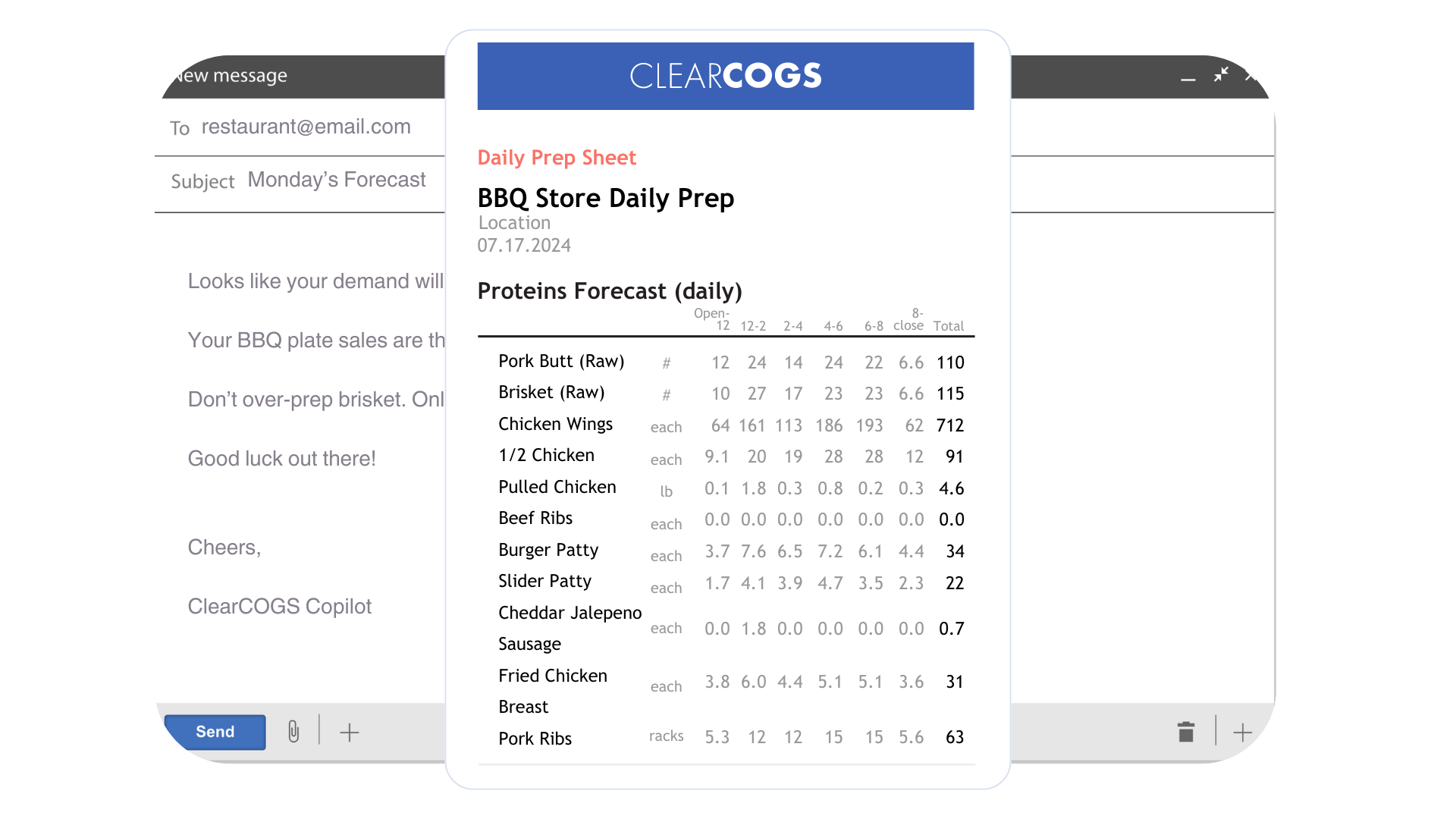
One honest boundary note, because this operator asked exactly the right clarifying question: forecasting and inventory systems of record are different tools. A count-and-store platform tells you what you have and what last week cost you. The forecasting layer, which is the part we build at ClearCOGS, tells you what the coming days will consume, so the order and the prep sheet stop being hunches. A group fixing reflex ordering will eventually want both, but the sequence above costs almost nothing to start and pays for itself in the first consolidated truck.
The audit that starts it takes one sitting. Pull last month’s invoices. Count deliveries per vendor per week. Circle every line item that appears on more than one invoice in the same week, and every single-unit purchase that had a case equivalent. Each circle is money that left the building without ever touching a plate, and every one of them traces back to the same root cause: the order had no owner and the owner had no number.
Sources
- Supply Chain Management: An Integrated Approach. Section 8.3: Economic Order Quantity (EOQ). Open Educational Resource. pressbooks.pub