




By Matt Wampler, CEO of ClearCOGS
Every franchise system has a list of things a franchisee cannot change. The recipe. The logo. The uniform. The building. Usually the point of sale.
Then there is a second list, rarely written down anywhere, of things the franchisor decided were the franchisee’s own business. Scheduling software. The accounting package. The back office system that tracks inventory, recipes, and food cost.
That second list looks like a courtesy. It is actually the most consequential technology decision a franchisor makes, because it determines what the brand will be able to see about itself for the next ten years.
How a brand goes blind
The pattern is consistent enough to describe plainly.
A brand once ran a single standardized back office platform across the system. Franchisees disliked it. It cost money, it was another login, it was corporate telling them how to run their own P&L. They pushed back, for years, and eventually the franchisor relented and let each operator choose their own.
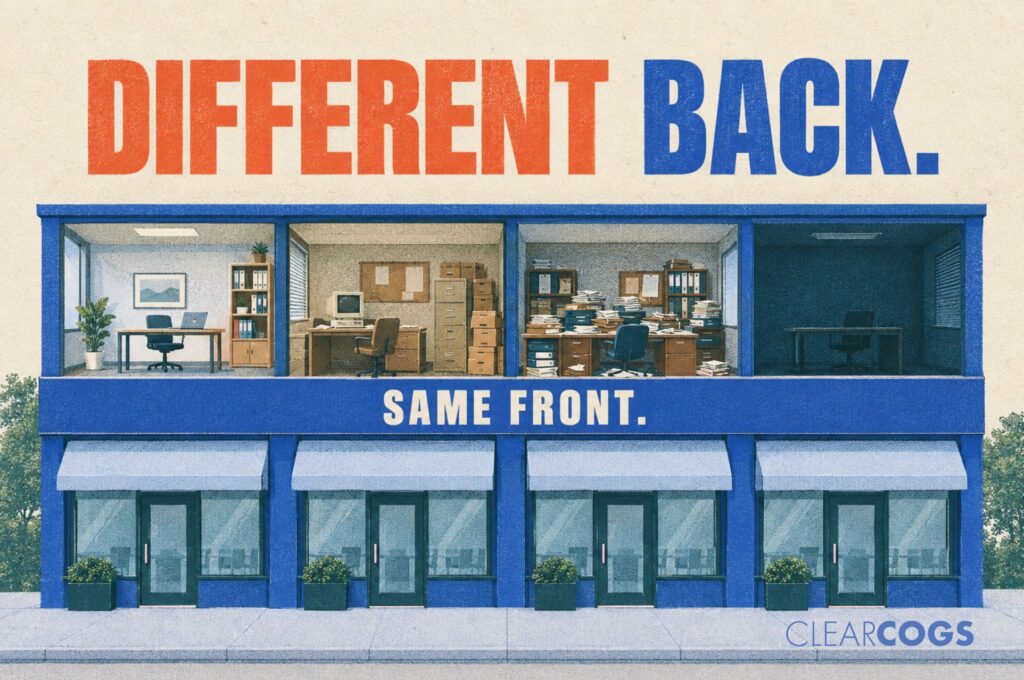
Fast forward. Every unit is now on something different. A few are on the major back office platforms. Several are on older systems nobody supports well. Some are running their restaurant out of basic accounting software. A handful are not really doing anything at all.
The one thing that never got deregulated is the point of sale, because that is tied to the brand’s transactions and guest experience. So corporate still has a clean, system-wide feed of sales and clock punches, pipes it into a warehouse, and reports on it.
And that is the entire picture. Ask that franchisor what the gap is between their best and worst performing units on food cost, or where waste is concentrated, or how labor efficiency differs across the system, and the honest answer is that they cannot see it. Not because they are not trying. Because the data stopped flowing when the platform requirement went away.
What the point of sale cannot tell you
Transaction data is excellent and incomplete in a specific way.
It tells you what was sold, when, at what price, and who was clocked in. It does not tell you what was produced, what was thrown away, what was counted, or what any of it cost. Those live in the back office layer, which is exactly the layer that got handed to the franchisees.
So a franchisor in this position can see revenue precisely and profitability only by inference. They can tell which locations sell more. They cannot tell which ones operate better, which is the question that actually drives franchisee survival and therefore royalty income.
That distinction matters more than it used to. When a brand is growing and margins are comfortable, you can run on sales data and intuition. When input costs move hard and franchisees are under pressure, the brand needs to know which units are struggling operationally before those units show up as closures.
Governance is not a side issue
It is tempting to file all of this under IT, which is how it usually gets treated. The research suggests it belongs much closer to the center.
A study modeling franchisor survival analyzed 220 franchisors operating in Spain over a decade, combining financial ratios with the contractual mechanisms that govern the franchisor relationship. Using the model’s standardized coefficients, the authors found that financial variables carried roughly 54 percent of the weight in predicting survival, which means close to 46 percent of franchisor failure or survival depended on governance mechanisms, and concluded that franchise governance or control mechanisms are important for the economic sustainability of the franchise (Calderon-Monge, Pastor-Sanz, and Huerta-Zavala, Sustainability, 2017).
One honest qualification: the governance variables in that study are contractual, covering fees, royalties, and the ratio of company-owned to franchised outlets. It is not a study about software. What it establishes is the broader point that how a franchisor governs its system is nearly as predictive of survival as its financial performance, and that control mechanisms are not administrative detail.
A decision about which systems franchisees must use is a governance decision. It gets made as a procurement question, debated as a cost question, and lands as a governance one.
The standard is changing shape
Here is what has shifted, and why this is worth revisiting now even in brands that settled the question years ago.
Brand standards were built for an era when the things worth controlling were physical. Portion sizes, signage, store design, service steps. You enforced them by sending someone to look.
That approach does not scale to the questions brands now need answered, which are continuous rather than periodic. Not whether a location looked right during a visit last quarter, but how its food cost has trended for six months, which items it wastes, whether its prep matches its demand.
Those questions require a data feed, not an inspection. Which means the modern equivalent of a brand standard is increasingly a data standard.
The good news is that this is a much lighter ask than the one franchisees rejected. The old fight was about forcing everyone onto one expensive platform. That is not what is needed now, and it was always the least popular version of the idea.
Standardize the output, not the tool
A more workable split for a franchise system today:
| Layer | Standardize or leave free | Why |
|---|---|---|
| Point of sale | Standardize | Guest-facing, carries transactions, already accepted |
| Recipes and item definitions | Standardize | The brand’s actual product, and the basis of any cost comparison |
| Back office or accounting platform | Leave free | Genuinely the franchisee’s business, and the fight is not worth it |
| Reporting output and format | Standardize | What corporate needs is the numbers, not the software producing them |
| Operational targets | Standardize | A shared definition of good makes comparison possible at all |
A recommended split between what to mandate and what to leave to the franchisee.
The distinction in the fourth row is the one that unlocks this. A franchisor does not need every unit on the same back office system. It needs every unit to produce the same handful of figures, in the same shape, on the same cadence. Most back office platforms can export that. Several will integrate it directly.
That is a meaningfully easier conversation to have with a franchisee advisory council than a platform mandate, because it leaves the operator’s own tooling alone and asks only for a report they already generate.
Where to start if you have already lost it
Three steps, in order.
Prove it on the company-owned units. Whatever visibility you want across the system, build it first where you control the stack. This gives you a working definition of the metric and real numbers rather than a theoretical spec.
Define the minimum set. Resist asking for everything. A small number of fields, clearly defined, collected reliably, beats a comprehensive schema nobody fills in. Food cost by period, waste where it is tracked, hours by location is a defensible starting point.
Make participation worth something. A franchisee who sends data and gets back a benchmark showing where they rank, and a specific thing to fix, will keep sending data. One who sends it into a corporate void will not. The reporting requirement and the value returned have to arrive together, or you are back to mandating.
Franchisors make this call once and live with it for a decade. It is usually made during a period of franchisee friction, with cost as the loudest argument in the room, and it is almost never framed as what it is.
The question is not which software to require. It is whether, five years from now, the brand will be able to answer questions about its own operations, or whether it will know only what the register recorded.
This is the work we spend our days on at ClearCOGS, turning the data a brand already generates into a specific number its operators can act on, and into a picture its leadership can actually see.
If you run a franchised brand and cannot currently compare your units on anything beyond sales, that gap is worth measuring before it is worth solving.
Sources
- Calderon-Monge, Esther, Pastor-Sanz, Ivan, and Huerta-Zavala, Pilar. Economic Sustainability in Franchising: A Model to Predict Franchisor Success or Failure. Sustainability, 9(8), 1419. 2017. doi.org


