


By Matt Wampler, CEO of ClearCOGS
Walk into almost any barbecue restaurant after closing and you’ll find the same thing: a freezer packed with cooked brisket, pork, and ribs.
Most operators see inventory waiting to be used.
They’re actually looking at yesterday’s forecasting mistakes.
A full freezer in a barbecue kitchen is not an equipment problem or a storage problem. It is what happens when the kitchen consistently produces more finished protein than demand requires, with nowhere else to put the evidence. Understanding what that surplus actually costs, and why it compounds differently in barbecue than in almost any other kitchen format, is the starting point for fixing it.
The Cut Is the Cost
Across foodservice, ReFED estimates that roughly 41% of tracked waste transactions stem from overproduction. Barbecue follows that pattern, but with one important difference: the highest-cost menu items are also the least flexible once they have been sliced.
Once a brisket is sliced, there is no way to recover its original economics.
A whole brisket held correctly overnight goes back into the next service at full price. A brisket cut into, partially served, and wrapped at close does not. The remaining portion gets repurposed into a lower-price application, recovering a fraction of what a plate would have generated. The loss is not just the food cost of the meat. It is the gross margin the plate would have produced.
The same is true for ribs. Cut a rack, fail to sell through it, and the entire rack is effectively downgraded, regardless of how many bones actually came off it.
This is not the same as produce that softens or dairy that expires. Those losses accumulate over time. In a barbecue kitchen, the forecast error and the loss event happen at the same moment.
Five Forecasting Problems, Not One
The reason barbecue forecasting is unusually difficult becomes obvious when you compare the proteins themselves.
A barbecue kitchen is solving five completely different forecasting problems simultaneously, each with its own lead time, its own failure direction, and its own cost when it goes wrong.
| Protein | Prep lead time | Failure direction | Cost of error |
|---|---|---|---|
| Brisket | Overnight (12-16 hrs) | Overprep | Full-price plate becomes a lower-margin repurposed item |
| Pork shoulder | Overnight (10-14 hrs) | Overprep | Same pattern; pulled pork holds slightly better |
| Ribs | 3-5 hrs | Both directions | Overprep loses a rack; underprep creates a mid-service stockout |
| Chicken | 20-30 min | Underprep / stockout | Lost sale, slowed ticket times, service disruption |
| Sausage | 15-20 min | Underprep / stockout | Lost sale; recovers faster but still creates service friction |
Overnight proteins are not harder because they are complicated. They are harder because the forecast is locked in before demand exists. By the time the kitchen knows whether yesterday’s brisket call was right, it is already too late to change it.
A single par list does not capture any of this. It captures yesterday’s batch size, applied equally to items that fail in opposite directions for entirely different reasons.
What That Actually Costs
To make the math concrete: imagine one extra brisket goes on the smoker on a Friday night. By closing, half of it sold. The remaining half gets chopped into beans for Saturday’s service. The food is not thrown away, but the economics are. Instead of generating the gross margin of a full-price plate (illustratively, $11 to $15 on an $18 to $22 entrée at a 30 to 35% food cost), that protein now contributes only a fraction of that value in a lower-priced menu item. One brisket. One decision. The margin difference is gone before Saturday opens.
One independent barbecue operator tracked waste consistently for one month and found approximately $1,000 in losses. At that level, the annual cost at one location is $12,000. Here is what it looks like as the operation grows:
| Monthly waste per location | 1 location | 3 locations | 5 locations | 10 locations |
|---|---|---|---|---|
| $500/month | $6,000/yr | $18,000/yr | $30,000/yr | $60,000/yr |
| $1,000/month | $12,000/yr | $36,000/yr | $60,000/yr | $120,000/yr |
| $1,500/month | $18,000/yr | $54,000/yr | $90,000/yr | $180,000/yr |
These figures cover only the direct food cost of waste. They exclude the labor that produced the surplus and the margin gap between a full-price plate and the repurposed application. The real number is higher.
Catering Sharpens the Problem
Day-to-day prep variance is chronic. A catering event is acute.
A scheduled catering order looks like the clearest demand signal a kitchen can get: a confirmed headcount, a set date, an agreed menu. But headcount is a reservation. It is not a demand forecast. A 50-person office lunch and a 50-person graduation party consume protein at meaningfully different rates. Without a systematic way to translate event type and headcount into protein quantities by item, the default decision is to over-prep. The surplus feeds straight back into the freezer that was already full from the week’s daily production misses.
Catering does not create a new problem. It amplifies the one that already exists.
Three Numbers Worth Tracking
The waste log tells operators what went wrong after it has already happened. These three metrics identify the problem before it shows up in the waste log.
Sell-through rate by protein. What percentage of each protein prepped actually sells at full price? Many operators target 85 to 90% on overnight proteins as an operational benchmark. A rate running consistently below that is a signal the par is ahead of demand.
Prep variance by item. How much did actual production exceed what demand required? A meaningful reduction in prep variance on brisket does not just reduce waste. It converts repurposed portions back into full-price plates, which compounds across a busy week.
Secondary-use ratio. What share of total protein production ends up in lower-price applications rather than full-price plates? A rising ratio is a direct and visible measure of what forecast error is costing, expressed in real dollars before the monthly P&L arrives.
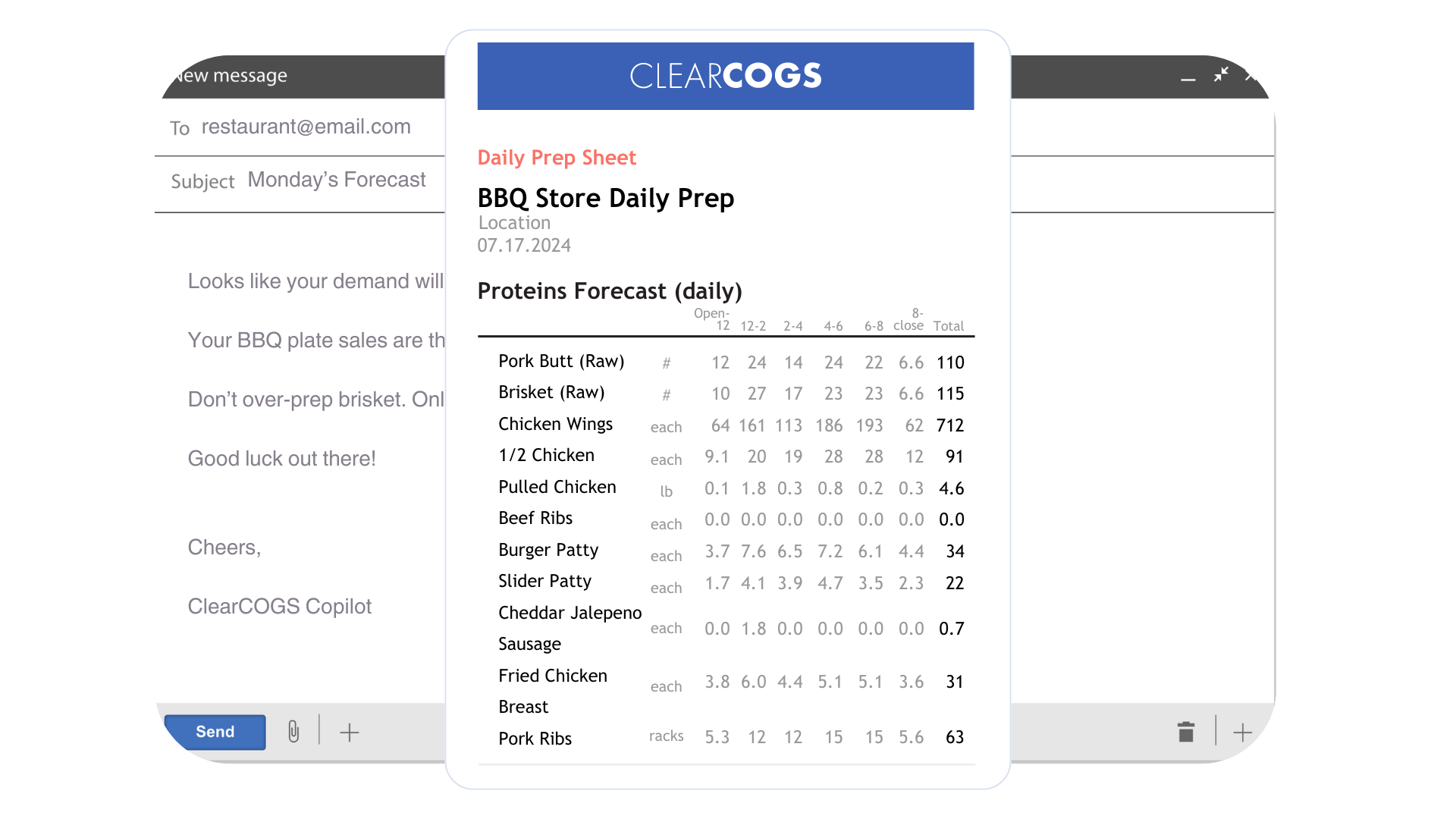
At ClearCOGS, this is the layer the platform is designed to work at: turning a kitchen’s own sales and production history into item-level prep recommendations that account for the different lead times, failure modes, and cost profiles of each protein.
Bottom Line
The freezer is not where the problem starts. It is where yesterday’s forecasting mistakes become impossible to ignore.
A prep model that treats every protein the same way, applies a single par to five different forecasting problems, and handles catering with a flat headcount estimate will fill that freezer consistently, regardless of how good the kitchen is. Fixing it does not require more storage.
That is the planning problem ClearCOGS was built to solve.
Sources
- ReFED. Foodservice Food Waste Action Guide. refed.org