


By Matt Wampler, CEO of ClearCOGS
Industry prime cost, the combined cost of food and labor, runs between 55% and 65% of revenue at most restaurants. A small number of multi-unit operators hold it in the high 40s. That gap does not come from better pricing or cheaper ingredients. It comes from replacing judgment-based decisions about prep, ordering, and scheduling with systems that produce the right answer consistently, at every location, regardless of who is running the shift.
What is prime cost in a restaurant?
Prime cost is the sum of a restaurant’s two largest variable expenses: cost of goods sold (food and beverage) and total labor cost, expressed as a percentage of revenue.
The formula is: (Total COGS + Total Labor Cost) / Total Revenue x 100.
If a restaurant generates $100,000 in monthly revenue, spends $28,000 on food and beverage, and $36,000 on labor, its prime cost is 64%.
Prime cost matters more than any single line item because it captures the two costs operators can actually influence most directly: how much food they buy relative to what they sell, and how many hours they schedule relative to how busy they are.
What is a good prime cost percentage for a restaurant?
Industry guidance puts a healthy prime cost between 55% and 65% of revenue, depending on service model. According to 2026 benchmarks, QSR prime cost typically runs 55 to 60%, fast casual lands between 58 and 63%, and full-service concepts often sit closer to 65%.
Those ranges reflect industry norms, not best-case performance. According to WhippleWood’s 2026 restaurant financial benchmarks report, drawing on National Restaurant Association data, full-service labor alone now runs at a median of 36.5% of sales. Profitable operators hold it closer to 34.2%. Add food cost on top, and even reaching 55% prime cost requires discipline most operations have not built.
The best-run multi-unit operators hold prime cost significantly below those benchmarks. One burger franchise group runs prime cost in the high 40s across multiple locations, a number most operators would consider implausible without significant trade-offs in quality or staffing. There are none. The difference is operational discipline applied at the level most groups skip entirely.
Why do most restaurants struggle to get prime cost below 55%?
Most restaurants make the same two decisions every day: how much to prep and how many people to schedule. At one or two locations, an experienced owner can manage both intuitively, adjusting based on feel, history, and the pattern built up over years.
That stops working somewhere between five and fifteen locations, when the owner can no longer personally walk every kitchen. The decisions that once lived in one person’s head now have to live in a process that works whether or not that person is present.
Most operators do not build that process until growth forces the issue. Prep decisions are made by whoever opens that morning. Scheduling runs from a template that has not changed in two years. Ordering is handled by a manager who eyeballs the walk-in and estimates. None of those processes are bad when the people making the decisions are good. They become expensive when the people are new, stretched thin, or simply having an off day, which at 20 or 50 locations is happening somewhere in the network every single week.
What a food budget is actually replacing
One of the clearest illustrations of the gap between systems and informal management comes from restaurant franchise acquisition. Due diligence has a way of surfacing exactly what sellers hope nobody notices: how the restaurant actually decides what to make tomorrow.
A multi-unit franchise group recently walked a location they were considering acquiring. Each location received a monthly food budget of $5,000. Once that amount was spent, the kitchen stopped buying food. Not because demand had dropped. Not because the menu had changed. Because the budget ran out, and no other mechanism existed to determine what to order or how much to prep.
By the final week of each month, menu items started disappearing one at a time until the kitchen quietly stopped looking like the restaurant it was supposed to be.
That $5,000 cap was not a financial control. It was a workaround for the absence of one. A real food cost system translates expected demand into a specific ordering and prep plan, day by day, item by item, accounting for the fact that Tuesday is not Saturday and a slow month does not mean every week in that month is equally slow. A dollar cap does none of that. It stops everything at the same number regardless of what the restaurant actually needs.
What high-performing operators do differently
The multi-unit group running prime cost in the high 40s did not get there through a single decision. They built precision into the places most operators treat as approximations.
Their labor planning works at the task level. They know, almost to the minute, how long it takes to prep a case of tomatoes, a case of lettuce, a case of protein. Scheduling is built to match that work to expected demand, not to a standard template. Closing tasks carry timelines too. If a manager clocks out an hour and a half after a store closes, it triggers a review, because it typically means labor leaked somewhere during the shift.
This is not exotic management. These are the same fundamental decisions every restaurant makes every day: how much to prep, how many hours to schedule, what to order. The difference is whether those decisions are made by a system producing the right answer or by whoever is on shift, guessing based on how last Tuesday felt.
At the core of both approaches is the same question: who or what is making the decision? An experienced owner at one location can be the system. At fifteen locations, that is no longer available.
Why the prime cost gap shows up most during acquisition
Franchise acquisitions create a specific pressure that makes the prime cost conversation unavoidable. The acquirer has to ask the question every seller prefers to leave unanswered: how does this restaurant actually decide what to make tomorrow?
For owner-operators running one or two locations, the answer can be “the owner figures it out,” and that can work. The trouble surfaces when the owner can no longer personally walk every kitchen and the decisions that used to live in one person’s head now have to live somewhere transferable.
Acquirers who specialize in buying underperforming franchise locations see this pattern repeatedly. The restaurants worth acquiring often have the largest gap between current performance and what is actually possible, precisely because nobody ever built the operational systems to close it. The $5,000 monthly food cap was not a sign of a failing restaurant. It was a sign of a restaurant that had outgrown its informal management model with nothing built to replace it.
For buyers, the operational assessment matters as much as the financial review. A restaurant with below-average financials and a clear operational systems gap can be a strong acquisition. A restaurant with decent financials built on one owner’s personal presence in one kitchen is a risk the moment it scales.
How prep and labor planning connect to prime cost improvement
Prime cost is a measurement. The decisions that determine it happen before service: what gets prepped, how many people are scheduled, and whether ordering matched what demand actually required that week.
Most traditional restaurant management tools report what happened after the fact. They show last week’s food cost and last month’s labor percentage. That information is useful for understanding trends. It is not useful for the prep decision happening right now.
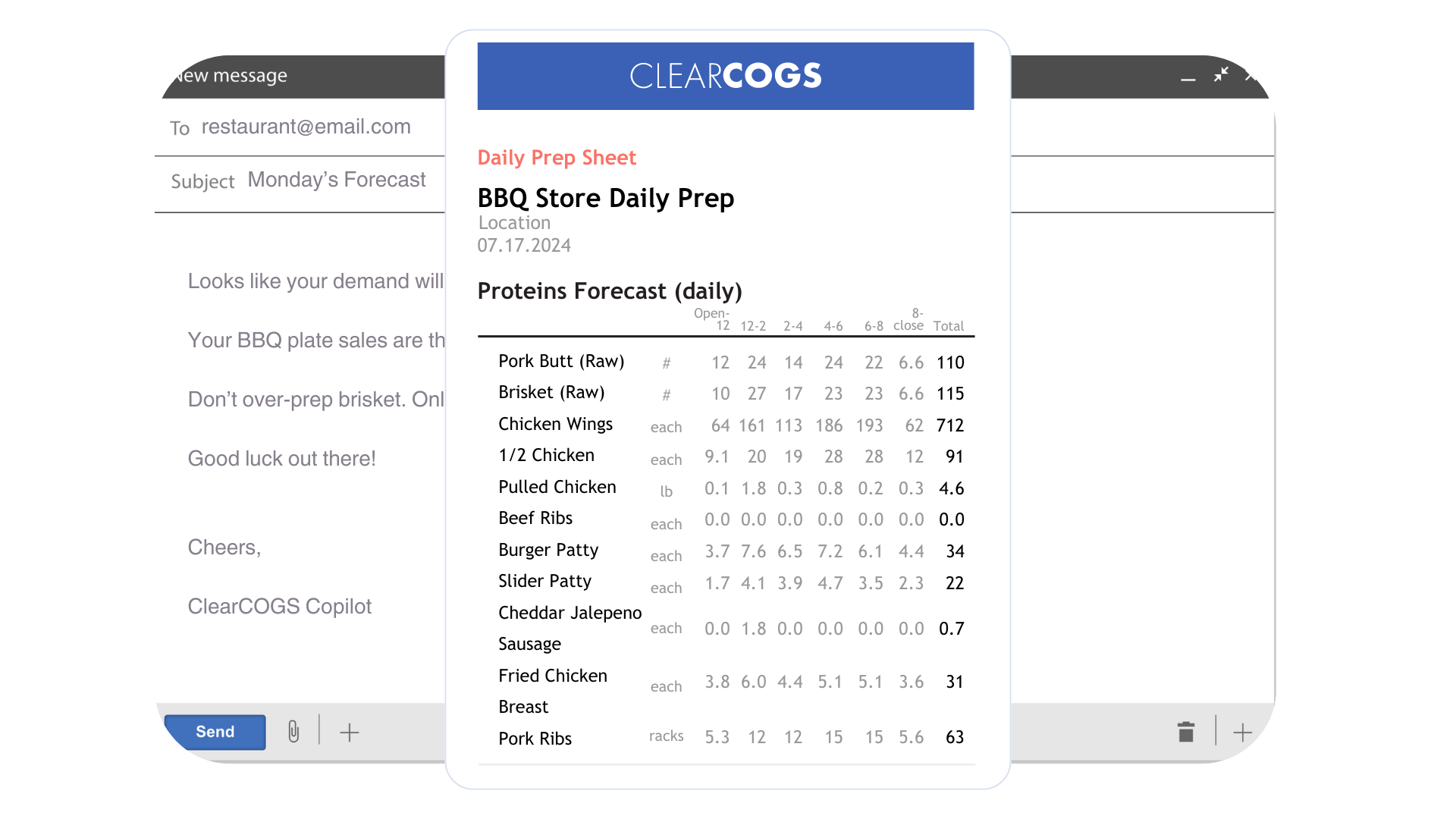
The operators closing the prime cost gap most reliably are making better decisions before the shift, not reviewing better reports after it. That means prep quantities built from demand forecasts rather than static par levels. Labor schedules built from projected volume rather than last week’s template. Ordering driven by what the kitchen needs tomorrow, not by how much is left in the monthly budget.
At ClearCOGS, this is the layer we focus on: turning a restaurant’s own sales data into daily prep recommendations and labor planning before the shift starts. Not explaining what went wrong last week. Giving the kitchen the right answer before the first order goes in.
Frequently Asked Questions
What is restaurant prime cost?
Prime cost is the combined cost of food and beverages (COGS) and total labor, expressed as a percentage of revenue. It is calculated as (Total COGS + Total Labor) / Total Revenue x 100. Industry benchmarks put a healthy prime cost between 55% and 65%, with profitable operators in well-run multi-unit groups often holding it significantly lower.
What is a good prime cost percentage for a restaurant?
A good prime cost depends on service model. QSR concepts typically run 55 to 60%, fast casual 58 to 63%, and full-service closer to 65%. Operators holding prime cost in the high 40s exist, but achieving it requires task-level precision in prep planning, demand-matched labor scheduling, and ordering discipline, not informal management.
How do multi-unit operators reduce restaurant prime cost?
Multi-unit operators reduce prime cost by replacing judgment-based daily decisions with systems. Prep quantities are built from demand forecasts. Labor schedules are matched to projected volume. Ordering is driven by what the kitchen actually needs that day rather than a static budget. The goal is to produce the right answer consistently at every location, regardless of who is running the shift.
What is the difference between a food budget and food cost control?
A food budget sets a dollar limit on purchasing. Food cost control translates expected demand into a specific prep and ordering plan, item by item, day by day. A budget stops spending without distinguishing between slow days and high-volume days. A food cost control system adjusts to actual demand, keeping food cost in range without causing stockouts.
Why do franchise acquisitions reveal prime cost and operational systems gaps?
Franchise acquisitions require buyers to assess how a restaurant makes daily operational decisions. Owner-operators at a small number of locations often manage informally, with experience substituting for a formal system. That approach does not transfer to 15 or 50 locations. Acquirers identify the gap when they ask how the restaurant decides what to prep and order, and the honest answer is that no consistent process exists.
Bottom Line
Restaurant prime cost does not improve because an operator pays closer attention. It improves when the daily decisions that determine it (prep, scheduling, ordering) are made by a system rather than by whoever is on shift. The gap between a restaurant rationing food by a monthly dollar cap and one running prime cost in the high 40s is not about talent or effort. It is about whether someone built the decision-making system before the restaurant grew past the point where informal management still worked.
Sources
- WhippleWood. Restaurant Financial Benchmarks: Key Metrics Every Owner Should Track. 2026. whipplewood.com
- NOVA Platform. Restaurant Prime Cost in 2026: Definition, Benchmarks. novatab.com
- Restaurant365. How to Calculate Prime Cost in a Restaurant. restaurant365.com