




Someone fills out a private event form on your website. A buyout, a corporate dinner, a fiftieth birthday. They also filled out four other forms on four other venues in the same five minutes.
The venue that answers first takes roughly eighty percent of that business. Not the better kitchen. Not the better price. The one that answers first.
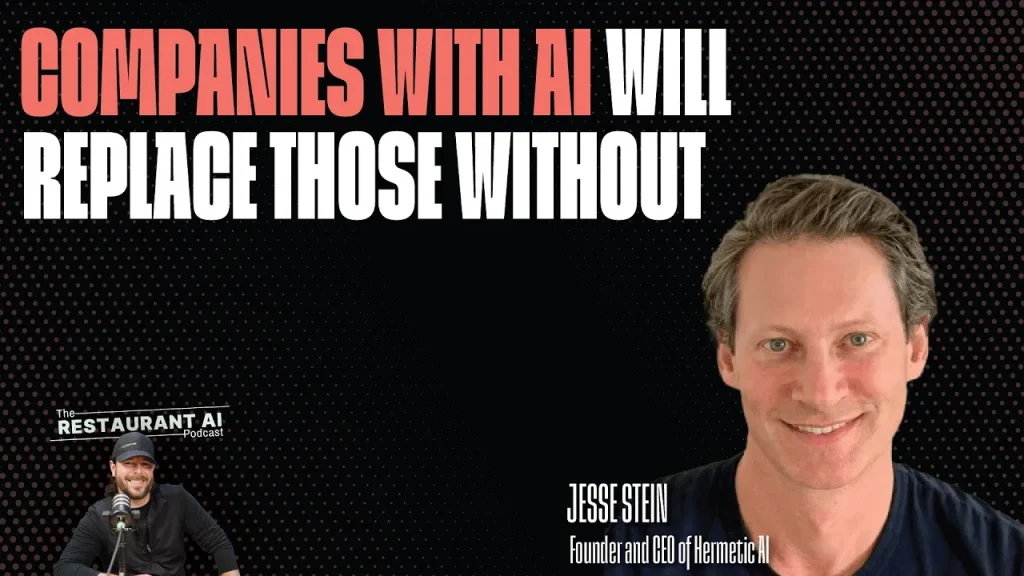
Jesse Stein, Founder and CEO of Hermetic AI, built a company around that single gap. Before this he spent more than two decades building and selling internet businesses, including sportsmemorabilia.com, which he grew into one of the largest authentic autograph retailers online before selling it to Michael Rubin at Fanatics. On this episode he walks Matt through how he picks which problems are worth solving, why hospitality was the vertical that finally felt right after six failed attempts, and what an AI agent actually does once a lead hits your inbox at two in the morning.
The Filter He Runs Every Idea Through
Jesse does not chase ideas. He chases pain he can see with his own eyes, then runs it through a short list of tests before committing a dollar.
The origin of his robotic handwritten notes company is the cleanest example. He noticed almost none of the mail in his physical mailbox ever made it to the kitchen counter. Then a handwritten envelope arrived from a real estate agent. That one made the counter. He opened it, read it, felt obligated to reply, and kept the note because throwing it away felt wrong. The demand was obvious and nobody had built the scale to meet it. He built the robots and ran it to 250 machines.
The rest of the filter is unsentimental. Seventy percent gross margins or better, so there is cushion under the business. A clear, repeatable path from prospect to customer, with sales and marketing expense at twenty percent of revenue or less. And underpriced media impressions, meaning some channel where reaching a qualified buyer is still cheap and sustainable. In his telling, every business he scaled had that last one. Every business that stalled did not.
His line on the ones that failed: the idea turns into a tree falling in a forest that nobody ever hears.
Six Wrong Verticals Before Hospitality
Hermetic’s core concept was settled early. An AI agent that converts inbound leads. What took time was deciding who to sell it to.
The team cycled through roofers, pest control, lawn care, home services broadly, and software companies. Jesse is careful not to say those markets are bad. He says he simply was not feeling it, and that when it is not flowing, it is usually not right.
Then he started demoing restaurateurs, hotel owners, and venue operators. He describes reading it in their micro gestures and the way their eyes lit up, and not because AI was a shiny object. These were operators saying plainly that they had to cut operating expense and drive incremental revenue after several brutal years.
He puts a hard rule on it: if it is not a hell yeah, it is a hell no. If you have to do missionary work to convert someone to your worldview, or you cannot fit the pitch on a bumper sticker, move on.
By his account they have pitched roughly 65 to 70 hotel groups, restaurant groups, single location restaurants, and entertainment venues without getting a no.
How Mia Actually Works
Mia is not one agent. She is several, handing work to each other.
An inquiry comes in. The first Mia engages within twelve seconds by text message, because SMS gets read essentially every time and gets replied to immediately, while email sets a tone of I will deal with this tomorrow. Jesse puts their response rate above ninety five percent.
From there the handoffs begin. One Mia qualifies the lead and confirms budget. Another has ingested the venue’s entire knowledge base, the schematics, the food and beverage minimums, the contracts, the FAQs, and tens of thousands of past emails between coordinators and guests, and answers questions from it. Another checks the calendar and CRM, and if the date is open, places a temporary hold so nothing gets double booked. Another schedules. Another follows up on the proposal. Another handles long-term nurture, so the guest who booked a birthday this year hears from the venue next year.
The handoff to the human happens through what they call a magic AI email. The coordinator clicks one button and gets a three paragraph email that already accounts for everything in the CRM, the full text thread with Mia, and whatever came in on the inquiry form, which on some platforms runs to twenty five fields.
Jesse’s framing on the compression: booking an initial walkthrough by email typically takes thirteen to seventeen back and forths. Mia does that work in fifteen or twenty minutes.
Integrations include Triple Seat, SevenRooms, and Salesforce, with OpenTable, ezCater, and Planning Pod in progress, plus direct calendar sync.
The 2 AM Test
The best story in the episode is the one nobody predicted.
When Hermetic started onboarding, several clients asked Mia not to reply to anything that came in overnight. A form filled at 2 AM should wait until 9 AM. It felt more professional.
They tested it. Responding immediately beat waiting by a wide margin, and the clients were the ones most surprised. A guest who submits at 2 AM and gets a clear-headed, patient, genuinely useful reply in seconds does not go shopping the other four venues. As Jesse puts it, you are the one-eyed man in the land of the blind. The guest’s read is simple: if they handle a question at 2 AM this well, they will handle my event this well.
He also has a rule on disclosure. Mia never volunteers that she is an AI, because unprompted it hijacks the conversation away from the guest’s event. But when asked directly, Mia always says so. Jesse says they have not had a single negative reaction to that answer.
The clearest illustration is a celebration of life inquiry that came into a Honolulu venue. That venue’s agent is named Lei, opens with aloha and closes with mahalo, because she scraped the client’s site and built the voice herself. Lei asked the person planning it what the man had loved. Hawaiian sunsets, and a particular Hawaiian musician. She looked up the sunset time for that date, suggested starting the event at six so the timing would land, and offered to find local talent who played in that musician’s style. Short messages. No overreach. The owner could not believe it.
Why He Refuses to Go Horizontal
Jesse’s argument for staying in one vertical is defensive, not idealistic. As a bootstrapped founder, he expects better funded competitors, and the only durable moat he can build is being unmistakably the best at one thing.
It compounds. Every testimonial on the site is hospitality. Every video is about private events specifically. A prospect lands there and sees themselves immediately, which is not true of the horizontal player who also serves roofers and also serves software companies and is great at everything.
On the long-term picture, he thinks the AI framing fades the way the internet framing did. In the late nineties everyone talked about the internet. Then it stopped being about the internet and became about the applications built on top of it. He expects the same here, with the durable value sitting in proprietary data the models cannot reach, the machine learning run against it, the user experience, and the CRM integrations.
His practical advice for operators evaluating AI: go to builtwith.com, type in the domain of a competitor whose technology you respect, and see what they run. Then book demos. He suggests an hour a week. His view is that trial and error is a slow boat, and following operators who already spent thousands of hours choosing is faster than pioneering.
Key Topics
- The four-part filter Jesse uses to decide whether a business is worth starting
- Why the handwritten note on the kitchen counter became a 250-robot company
- Six ideal customer profiles tested before hospitality felt right
- Why eighty percent of private event business goes to whoever responds first
- How multiple AI agents hand work off to each other inside one system
- The magic AI email and collapsing seventeen back and forths into twenty minutes
- What happened when they tested replying at 2 AM instead of waiting until morning
- When an AI agent should and should not disclose that it is an AI
- Why a bootstrapped founder treats vertical focus as a defensive moat
- Where the value sits once AI stops being the story
About Jesse Stein
Jesse Stein is the Founder and CEO of Hermetic AI, a Miami-based company building AI agents for private event bookings across restaurants, hotels, and entertainment venues. He has been a technology entrepreneur for more than twenty five years with three exits behind him, including sportsmemorabilia.com, which he built from a raw domain name purchased in 2006 into a leading authentic autograph retailer before selling it to Fanatics. By his own account he has also sold a digital agency to Insight Partners and scaled a skincare brand to eight figures in under two years, and he founded a robotic handwritten notes business that ran 250 machines. He lived in Japan early in his career and is based in Miami.

Subscribe to the Restaurant AI Podcast on YouTube or Spotify
Follow the Restaurant AI Podcast on LinkedIn
Connect with Matt Wampler and ClearCOGS on LinkedIn
Connect with Jesse Stein on LinkedIn and learn more about Hermetic AI
Full Transcript
Matt Wampler: Jesse, it’s a pleasure having you here.
Jesse Stein: Great to be here, thank you for having me.
Matt Wampler: We don’t have quite the weather you guys have down in Miami, but we’re starting to get there up in the Northeast.
Jesse Stein: Yeah, well it’s about to get really hot here, so we’ll be in the midst of it.
Matt Wampler: Well, look, I was really excited about this. You qualify in my mind as one of the most interesting people I’ve talked to. You lived in Japan for a long period of time, your first venture out into the business world. You end up selling your company for what, 32 million to Insight Partners, as a digital agency. You buy sportsmemorabilia.com, turn that into something Fanatics buys. And then out of total left field, you start doing robotic handwritten notes and you scale a skincare company in less than two years to what, 40 million or something like that, before it was acquired. That all sounded about right?
Jesse Stein: Yep, right place, right time.
Matt Wampler: I mean, if that doesn’t qualify as one of the most interesting people in the world, I’m not sure what does.
Jesse Stein: I’ve been at it a while. With all humility, I’ve been very fortunate, yeah.
Matt Wampler: Well look, I’m sure that you’ve had plenty of failures along the way, but you’ve had more successes than most people hope for in a lifetime. I’m curious, when you go into these business ventures, what is it that you see that makes you say, that’s the one, we should go into that?
Jesse Stein: Yeah, first of all, thank you again for having me, Matt. Really appreciate it. In the case of the interactive agency, sportsmemorabilia.com, skincare, the robotic notes business, for example, it’s oftentimes something I’ll see in the real world that feels like a really big pain point. And the execution of it, from the idea to actually launching a company, getting product market fit and scaling and getting traction, feels at hand. It feels within reach.
So that’s important, where I can actually visualize it. For example, with the robotic handwritten notes business, I just noticed that most of the mail in our physical mailbox wasn’t making it to our kitchen counter. And then one day we got a handwritten note from a real estate agent. The envelope was handwritten and I just noticed that that piece of mail made it to our kitchen counter. I opened it. The actual note inside was handwritten. I read the note. I felt guilty not responding. And so I took a selfie of me with the note and I sent it to the real estate agent. I responded to it. I kept the note because I felt guilty throwing it away. I even displayed the note on our kitchen counter.
And so I noticed that. That was like, wow, there’s a need for handwritten notes, but there was no scale to it. So we built these handwriting robots and the software, and ended up scaling it to 250 handwriting robots and really went deep into real estate agents. In that case, it was a real world need.
The other thing that I look for are businesses with at least 70 percent gross margins where you have some padding, some cushion. So you generate your revenue and you back out your cost of goods and then overhead, and you need to be profitable, obviously. And so the more gross margin you have, the more cushion. That’s important to me.
Probably the most important thing of all for me is, is there a clear sales and marketing motion. In other words, can I take this hope, this dream, this business plan, and turn it into a product. And all this goes without saying, this is always with incredible teams. So it’s, can we create a product? And most importantly, can we break through to the prospects and turn prospects into customers profitably? Sales and marketing expense, I like that to be 20 percent or less of revenue.
Matt Wampler: We always call it market pull. Is there a lot of pull from the market? Is it going to come to me if I just put it out there?
Jesse Stein: Yeah. And of everything, that path to seeking out underpriced media impressions, in other words a way that’s inexpensive, really efficient, sustainable, of reaching qualified prospects, and then turning those prospects into clients and turning the clients into volunteer marketers. That chain has to be pretty obvious, with a lot of stumbles and rocks on the road along the way, but it has to be really clear.
And in all the cases where I’ve been fortunate enough to scale businesses, in every case I’ve been able to find underpriced ad impressions, whether it’s search engine optimization or Facebook ads or generating leads via LinkedIn, for example, or Instagram. So that’s definitely a really important foundational part of these businesses. And the ones where I wasn’t able to find that, those are the battle scars. And I have a lot of those, ones where I wasn’t able to market it. And in that case, the idea turns into a tree falling in the forest that no one ever hears.
Matt Wampler: Well, taking that same thought and going back to sportsmemorabilia.com, it was the largest auction site of signed autographed merchandise?
Jesse Stein: Yeah, so we took it, I bought that as a raw domain name for $12,500 in 2006. And that year and the year after, I spent a million bucks on raw domain names. Spent $297,000 on hobbies.com and nothing was on these names, it was literally just a name. Biking.com, bought that, boating.com, yachting.com, barbecuing.com. But the one that took off was sportsmemorabilia.com.
And we found a way to get it ranked on Google all the way from 2006. And if you go today to Google, even though SEO is less important now than it was even a year ago or two years ago, any combination of player name, team name, plus the word autograph, signed, memorabilia, sportsmemorabilia.com pretty much ranks number one. And so we grew it into the biggest authentic autograph store on the internet and then sold it to Michael Rubin at Fanatics, which was pretty awesome.
Matt Wampler: I gotta tell you, my dad told me the story of the people that bought boats.com and whatever it was, right when the internet came out. I was always fascinated and loved that. I thought that was the smart guy seeing an opportunity and buying it. But I’m curious, as you were going through before, it was all about finding a need. That one kind of doesn’t sound like you had a need you were trying to fill so much as opportunistic. Is that fair?
Jesse Stein: Yeah, well the opportunity I saw there was kind of like the mailbox opportunity I described earlier. I was on eBay and noticed that there were a lot of complaints about memorabilia being inauthentic. Signatures not with proper authenticity, i.e. fake. And so I thought, well, if we could buy the domain name sportsmemorabilia.com, that’ll immediately confer authenticity. And then if we can reinvent the way that the industry does authenticity, which I’d like to think we did, because we had a lot of direct athlete relationships, we had great relationships with all the authenticators, we had people witnessing the signings, and we owned the domain. That’s why we never had an item returned for authenticity. That’s the big opportunity. So it was opportunistic, but we also saw that there was a huge void in the marketplace because so much of the memorabilia was fake.
Matt Wampler: And Jesse, whenever you see these, do you just dive in head first, or is this an iterative process where it’s like, I’m gonna kind of wade in, check box A, so I’m gonna go to box B? Or are you just all consumed, I see this opportunity, I’m gonna chew it to the bone?
Jesse Stein: Yeah, so sometimes to a fault I ready, fire, aim with these things. And I did certainly when I was earlier on in my entrepreneurial career. I think now I’m more considered, I’d like to think, in my approach. But throughout, I think I’ve been pretty good because I’ve been a bootstrapped entrepreneur almost entirely. I think I’ve been pretty good at allocating small amounts of money to things and then watching them carefully and seeing if they get traction. If they don’t, cut them off and move on. Because the idea is a very small part of it.
And I think what I’ve seen is a lot of entrepreneurs will get attached to ideas. An idea is like one percent of it, or three percent of it maybe. And if you look at VCs and seed funding and what it actually equals in terms of the whole value pie, it’s like three to five percent in terms of the value. It’s all in the execution, of course. And so I don’t mind ready, fire, aiming a little bit because it allows you to go fast and you don’t get analysis paralysis.
And the 80-20 entrepreneurs typically run circles around the perfectionists. And so if you can just move quickly and break things a little bit, and then if you notice that it’s not taking off and you’re in month two or month three and it’s feeling like not in the flow, or there’s just too much friction, or you’re not seeing the opportunity anymore, move on.
For example, our current company, I knew that the foundational idea was great, which is an AI agent that converts inbound leads for companies. But we cycled through like six different ICPs, or ideal customer personas, before we stumbled upon hospitality and it felt right. Before that, it was like roofers, pest control, lawn care, software companies. There were a lot of people that we were gonna go after and it just didn’t feel right. You know if it doesn’t feel right and it’s not in the flow, it’s probably not right and it’s not gonna work.
Matt Wampler: So what made it feel right? What was it about hospitality where you’re like, this is the right solution for the right problem?
Jesse Stein: The pain was palpable. I think when you’re pitching someone, it’s got to be a hell yeah. And if it’s not a hell yeah, it’s a hell no. I really feel strongly about that. And it’s not on the first pitch. You gotta pitch several people on it and kind of refine the pitch and make sure that you really have your demo dialed in, if that’s your sales motion.
But roofers, pest control, home services generally, I’m certain that there will be multiple agentic AI companies that crush it there, but I just wasn’t feeling it for us. Software companies, same thing. The moment I started talking to restaurateurs and hotel owners and owners of other special venues, hospitality venues, my God, the pain was just so obvious. And I could see from their micro gestures and the way their eyes lit up, not just because we’re an AI and that’s kind of a shiny new object. No, they were like, you know what, we have to cut operating expenses and we need to drive incremental revenue. The last several years, during COVID and post COVID, have been really tough. So I could feel it. It was palpable.
And then the other thing is that the total addressable market just needs to be huge. Even in a niche, let’s say hospitality, it’s a massive market for us. So that’s definitely another caveat, the total addressable market has to be interesting.
Matt Wampler: Take me back to the moment. Was it talking to a restaurateur? Was it a roofer that ultimately sparked this and then you went down to talk to restaurateurs? When did the magic happen where you connected the dots?
Jesse Stein: I mean, it was in like the first demo with a restaurant owner, and I remember it vividly. And he just was like, where have you been all my life type of look. And he was like, let’s get started right away. We’ve pitched like 65 or 70 hotel groups and restaurant groups and single location restaurants and special venues, Topgolf, K1 Speed, Puttshack type people, we haven’t gotten a no yet. And that is rare.
And so it was that first moment. And I think entrepreneurs need to be honest with themselves. Or at least, I’m not giving advice, it’s just my experience. You just have to be honest with yourself. If you’re having to do what I call missionary work, if you’re having to convert the person over to see your worldview, and if you can’t put what you have on a bumper sticker, then move on. And if the person’s not nodding their head and going, oh my gosh, this is unbelievable, I can’t believe it, let’s go. And then a bonus is if they had tried other solutions, or there’s other people out there that aren’t quite getting the job done, then you have something, in my view, really magical.
But then you have to figure out, okay, what’s your execution plan? It’s one thing to pitch a couple people that friends recommend, or somehow you drum up some demos, and another thing altogether to make it a real business. And so the real business part, that to me is the much harder part. How do you take that and scale it, and then how does it not bottleneck and cause a big problem? And I don’t know, Matt, if you’ve experienced this with your businesses, but if you’re blessed with people saying yes, I want to do it, how does that not bottleneck? How do you not make clients frustrated because you’re moving too slow at getting them onboarded? And then once they’re onboarded, how do you make sure that they’re super happy?
And then for me, the holy grail is turning your customers into volunteer marketers. How do you make them so enthusiastic, which is what we did with sportsmemorabilia.com, and it created this virality loop, which is incredible, because then your sales and marketing expense plummets. Referrals are phenomenal to deal with because there’s no marketing expense, very low sales and marketing expense, they’re already converts. They’re typically easier to deal with. They typically spend more. They’re lower friction. They’re nicer. That, to me, is the ultimate.
Matt Wampler: Well, all right, so for everyone’s sake that I’ve just kind of glazed over, what exactly are you solving and what is the solution to that problem?
Jesse Stein: Yeah, so a big problem for hospitality businesses, restaurants, hotels, other venues, is when a lead comes in for a private event specifically. So for a restaurant, it’s like large group dining, full restaurant buyout, on-premise large group party, corporate party, social party like a birthday. That lead comes in. How do you engage the lead before your competition does? Because that’s measured in minutes, hours at the most.
Most people, when they’re filling out an inquiry form for a private event for a restaurant or a hotel or another venue, they’re filling out multiple other forms with multiple competitors. Eighty percent of the business goes to the venue that responds first. Even if the service isn’t as good, the price isn’t as good, the food’s not as good, it goes to them. So the world of private events for hospitality belongs to the first mover.
But that’s only the beginning, right? Then there’s a need to qualify the lead and make sure that they have budget, make sure that you have a venue available for them. And then you have to follow up after you’ve sent the proposal. You have to book the initial meeting, the initial walkthrough, so that they get on the phone or in person with the event coordinator. Follow up on the proposal. Then you need to nurture them long-term. So Matt, if you did a birthday party at a restaurant this year, the restaurant should reach out to you next year as well.
And so that whole sales funnel, there’s a bunch of leaks in that sales funnel. And so what our AI agent, Mia, does is she engages these leads within 12 seconds of coming in with a personalized, human-like text message. Because text messages have a 100 percent read rate. And then all those touch points I just described, Mia handles those. She is basically completely sealing your sales funnel, and even post transaction. So the client does a corporate event and then Mia will reactivate that lead, because Mia follows that customer throughout their journey, even years later, and can reactivate and reactivate.
And today, and it’s not the event coordinators’ fault, it’s just that there’s no technology tool, they’re just woefully ill-equipped to do any of this. And event coordinators are answering the same 50 questions all week long. And so Mia really frees up the event coordinator to do much higher value, more sophisticated work.
Mia is not a replacement for an event or sales coordinator. Mia is the assistant that’s toiling away in the background, handling tons of pick and shovel work and low value work, engaging with leads 24/7, teeing up way more opportunity for event and sales coordinators, way more events. And so the sales coordinators can focus on being the face of the company, doing higher value work, earning more money and driving more revenue to the business.
Matt Wampler: So was this your first solution? Was it like, all right, we’re going to have an agent, where does it fit? Or did you look through it and say, do you have any other ways you thought about solving this?
Jesse Stein: No, it was also fortuitous because it just so happens that, I mean, I’ve been doing AI related stuff now for about five years, but it’s just perfect that the rise of these LLMs, or large language models like Gemini and ChatGPT, they’re just perfectly suited for AI agents.
And so yeah, we knew that it was going to be an AI agent. We just didn’t know who we were going to target it toward. And that’s why we cycled through five or six or seven different ideal customer personas before we landed on hospitality. And I think there’s a lot of value in my experience as a company in eating and sleeping and breathing one specific industry. So with Mia, this is all we think about. A lot of AI agent companies, and there’s a lot of them, they’re cropping up like mushrooms after a rainstorm these days, they are typically horizontal players. And so they’ll start with an agent, they’ll target a bunch of different verticals. For us, there’s a lot of value in being completely obsessed with one vertical and doing that the best of anyone.
Matt Wampler: Is that more to do with where the technology is today, or is there something fundamental to building very specific and vertical and not horizontal?
Jesse Stein: For me, it’s more defensive, if anything, because I’m a bootstrapped entrepreneur, so there’s always gonna be much better funded, much bigger competitors who I have to fend off. And if the best moat that I can build is becoming an expert at one thing and establishing a beachhead in that ideal customer persona, then I can expand out.
But it is extremely difficult for horizontal players, people targeting larger audiences, to ever compete against you if you are just obsessed with one vertical. Because remember, it’s a virtuous circle. All my testimonials are from clients in hospitality and the website’s all about hospitality. You go to our website, you see the videos, 100 percent not only about hospitality, but about private events within hospitality. So it becomes a great defensive move, I think, to do that. And defense, I think as an entrepreneur, is even more important than offense. But it allows you to just close more deals. Your conversion rate is gonna be way higher than someone who is like Joe’s Hardware and so much more. It’s like, we also do roofers, we also do hospitality, we’re great at everything.
Matt Wampler: Yeah, we’ve certainly seen that on the sales side of things more than anything, even selling predictive forecasting. Being able to sell that to a barbecue chain versus a full service restaurant, they’re very different things. You could really hyper-focus on barbecue and have a really great intelligent conversation there. I imagine it’s the same thing.
Going back to agents, I find agents to be fascinating. I remember when ChatGPT first came out, we actually were on the front page of Google in January 2023 for ChatGPT. And we’d figured out how to chain link together all of the different models so that you could answer all these specific questions. Walk me through the state of agents today. What is an agent? How do you look at them? And I’d love to know, technology wise specifically, how do you build them differently than maybe some of these wrappers we see?
Jesse Stein: Yeah, first of all, I’ll preface this with, I’m not a software engineer. So I will very quickly be speaking above my pay grade. But from a business perspective, I think I understand it pretty well.
Matt Wampler: Keep it conceptual. I have no idea either.
Jesse Stein: So what is an AI agent? An AI agent by definition has agency. So an AI agent can start to make decisions on its own. And you compare that to traditional software, SaaS software, it can’t do that. So that’s the first thing to realize. And that’s easy to remember because it’s AI agent, the agent will have agency.
Matt Wampler: Also the scariest thing, because who wants some agent making decisions for you at this point? That’s new.
Jesse Stein: That is new, but also the power of the LLMs, the large language models like ChatGPT and Gemini and Grok and so forth, those are new too. So what you’re doing is you’re taking advantage of the power of these large language models, and anyone that’s used these on a daily basis understands how powerful they are.
And so to harness that power you can create software where you can create a prompt for the agent. And all a prompt means is, you know, in Google when you query something, a prompt is a query essentially. And with an agent, you can have within your company, for example, Mia happens to be multiple agents in one. So with Mia, there’s a Mia that just schedules the appointment with the event coordinator. That’s a completely separate agent and it’s a completely separate prompt.
And so these agentic companies, it’s called agentic AI, so you’ll hear that a lot. And I know, Matt, you’re very much familiar with all the language. But for those who aren’t, you’ll hear agentic AI or AI agents becoming very, very popular. And so with agentic AI companies, there are these baton handoffs among agents within the same company that’s happening.
So Mia, when an inbound lead comes in, the engagement Mia will engage within 12 seconds and then we’ll go back and forth and qualify the lead. That’s like the first Mia. Then there’s another Mia that is able to answer questions, is able to ingest the restaurant’s entire knowledge base, all the venue schematics, all the food and beverage minimums, the contracts, everything. It will take in all that information, and it could be 10,000 back and forth emails between your event coordinators and guests. It will take all that and be able to answer questions. So there’s answer question Mia. There’s scheduling Mia. There’s follow up on proposal Mia. There’s long-term, near-term Mia.
So the cool thing about agentic AI is the agents can collaborate with one another. So imagine that you have a bunch of employees that don’t take breaks, that have perfect recall, that have perfect long-term memory, that are able to solve problems and collaborate with one another in the background and allow you, the human, to focus on higher value activities. And so that is the really basic scaffolding to think about agentic AI. And the agent will loop and take your prompt and keep going until it figures it out. So that’s the agency part. And that’s what’s really different from traditional software. The agents can collaborate with one another, they tap into the power of the LLMs, and they will actually get the problem solved. Not always, but it’ll loop until the problem is solved. What else do you have to add to that, Matt?
Matt Wampler: Well, so if I’m a restaurant, my greatest fear is how am I being represented by this agent? Is it talking like I do? Is it providing that customer service? I think it’s that fear that makes most restaurants wait three days to respond. I want to send the right response, not necessarily just the quickest response. It sounds like you’ve got five to eight different agents. One of them was on the actual event schematics, capacity, specific questions. Are all of the agents somehow trained to mirror me, or is it just that one?
Jesse Stein: They’re all trained. So this is key. In order for Mia to get up to speed, which she does very, very quickly, you give her tons of information. First of all, she scrapes your website. So for example, we have a client that’s one of the largest destination wedding venues in Hawaii. They’re in Honolulu. And so that Mia, for that venue, is totally Hawaiian. Actually, her name is Lei, L-E-I. And she starts off her messages with aloha. She ends them with mahalo. And she knows everything about Hawaiian musicians. We didn’t ask her to do any of this. She scraped the entire website of our client. Then she went off and looked in Google, hundreds of different sources.
Then the venue gave us all their information, the contract they send when they do a private event, all the venue schematics, the food and beverage minimums, their FAQs, everything, and most importantly, all the back and forth emails between their event coordinators and their guests. So just imagine, literally tens of thousands of emails and all the prior guests, all the prior events that have ever been done.
And then Mia almost instantaneously assimilates all that and puts it into what’s called a vector database, which by the way is completely inaccessible to the LLM. So one key thing about these AI companies, which Matt knows really, really well, is a lot of the value is the data that you have, that you have full dominion over, that you own. Just know that there’s a walled off garden there. All the data for that client in Hawaii is completely separate. ChatGPT, no one has access to that except us and our client. But we use the power of the large language models and query those large language models to create the appropriate responses from Mia, so she knows exactly what to say and when to say it.
She knows the brand voice, the brand language. So when a lead comes in from somebody who’s been to the restaurant 19 times in the last two years, she’s gonna treat that lead differently than someone who’s never been to the restaurant. And that is, after all, hospitality, isn’t it? It’s responding quickly in a totally human-like, personalized way and keeping in mind exactly what your preferences are and were. And it’s greeting you appropriately, which in this case is aloha, and then signing off with a mahalo.
So it is pretty mind-blowing what Mia is able to do. For example, a couple days ago a lead came in for this venue in Hawaii, and it was a celebration of life event. Mia was empathic, very intuitive, struck exactly the right note. She asked the bereaved who was planning the event, may I ask what his hobbies were, or favorite things, something that we could do to honor him. He said, well, he loved Hawaiian sunsets and this special type of Hawaiian music. Mia looked up what time the sunset was for the day that they were planning it and said, the sunset’s 6:53 p.m., I suggest we start the event at six, so we’ll get the perfect timing on the sunset. And may I ask what his favorite Hawaiian musician was? He named the musician. She said, excellent, we will find local talent to make sure that they sing in the style of this musician.
And it was just an incredible moment. And Mia didn’t overdo it. The messages were pretty short and sweet, but the guest was completely blown away. And the owner of our client, the owner of the venue, couldn’t believe it. So that is the best and highest use of AI agents.
Matt Wampler: Oh my gosh, if I was an event coordinator or I was managing an event coordinator, and I went and looked at that email chain and saw what my team was doing, I would be so proud and so impressed. I mean, that’s mind boggling. Were you expecting that, by the way? When you see these use cases, does your mind just get blown, like, wow, this was more than I would have ever expected?
Jesse Stein: Yeah, I’m just as surprised as everybody, I think. So I feel very fortunate to be doing this, and especially for hospitality companies. What better industry to support than people who dedicate themselves to being hospitable, the warm welcome? And it’s an industry that’s been having problems. And so every one percent of operating cost savings and every one percent lift in revenue compounds, and so it means a lot. Of course Mia does a lot more than one percent.
And then the event coordinators are thrilled because they’re like, oh my gosh, I have my late nights and weekends back because of Mia. Because instead of having to be glued to my phone all the time wondering when those leads come in, I know that Mia will engage them within 12 seconds and we’re not going to lose deals anymore. And then the event coordinators are thrilled because they’re earning more money and they’re teeing up more business.
So AI agents should be a win for everybody. The thing that everyone needs to know, and it’s not because I’m a hammer and the whole world looks like a nail, it’s not because I’m in AI so therefore I think AI is the next big thing, I really mean it when I say that humans with AI and businesses with AI will replace humans and businesses without AI. I mean, it’s just reality.
Matt Wampler: And by the way, it’s not too dissimilar to having a robot do handwritten notes. I want this note to go out to this individual and I don’t have the time. Now I can do that at scale and provide that hospitality.
Jesse Stein: That’s it, that’s it, yep.
Matt Wampler: All right, so one technical question, because this is always where the rubber meets the road. If I’ve got this agent and Mia’s talking, or Lei, she’s interacting with this person, she schedules it. How does that actually get into the scheduling management system? How does the other agent know that they can no longer book on top of that? How does Lei know a year from now to send a follow-up saying it’s the year anniversary, we just wanted to say we hope that life is going well and we appreciated you celebrating life with us? How does that actually all stay together?
Jesse Stein: Yeah, because we’re fully integrated with your CRM. And so we have really tight integrations with Triple Seat and SevenRooms, and just finishing off one with OpenTable and ezCater and Planning Pod and others. And then we’re directly integrated with your calendar system as well. So if you have Google Calendar and you’re an event coordinator, we’re integrated there. So Mia’s always synchronized.
So for example, if someone submits an inquiry for a private event for April 15th, Mia will go and check your calendar in Triple Seat, if you have Triple Seat, or we have a Salesforce integration as well, and check. And then if there is availability, she’ll let the guest know and she’ll actually earmark that, not with a permanent event, but with a placeholder event on your calendar, so there’s no double booking. So everything is synchronized with your CRM.
Mia’s discussions back and forth are synchronized, and probably a lot of people listening to this are wondering, how does the baton handoff happen from Mia, which is all text message? And it’s all text message because there’s a 100 percent read rate with SMS, unlike email, and the replies are instant. And Mia’s reaching out right when they’ve raised their hand and submitted an inquiry. So they are hot. And when you reach out by email, it sets the tone for, you know what, I’ll do this tomorrow, I’ll respond tomorrow. Especially if it’s an autoresponder, it gets ignored. But even if it’s a well-written, personalized, human-like email, the tone is, I’ll get back to it later. Text message, 12 seconds later, our response rate is 95 percent plus. Which is crazy.
And so the question becomes, all right, Mia has just had these discussions by SMS, qualified the lead, answered questions, talked about what favorite Hawaiian musician they’d like to have. How does the baton handoff happen? We have something called a magic AI email. The event coordinator clicks a button and it generates an email that contemplates anything in the CRM. So if the person had been a client in the past, it will bring in information, the back and forth conversations between the guest and Mia, and then whatever was put in the form. And some of those forms are long. Some of those Triple Seat forms, for example, can be 25 fields and then there’s a box. Mia will take all that information and put it into a three paragraph email that’s ready for the event coordinator to send.
So literally we’re compressing timeframes. What used to take a week, the back and forth and then finally creating the email, not because the event coordinators are slow, but because that’s just what it takes by email. Hey, are you free on Wednesday? Yes, I am, at 3 p.m. Great. Typically there’s 13 to 17 back and forths before scheduling an initial walkthrough. Mia’s doing all of it in about 15, 20 minutes. And then teeing up the email for the event coordinator, and it goes out and just keeps the deal moving down the sales funnel.
Matt Wampler: But you also get that human intervention to check and make sure that it’s on the right track.
Jesse Stein: Exactly. You can do that. Humans can go into the dashboard. It’s really cool. All of Mia’s conversations are happening in real time right in front of you. You log into your dashboard and you can literally see Mia having 13 simultaneous conversations. Not only with leads that came in, but with historical leads, because we hit your historical leads too. Because that’s a gold mine. So let’s say you’ve done 10,000 private events in your company’s history. Why would you leave those dormant? Why not reactivate those? Sixty five percent response rate on historical leads, which is insane. And so Mia will text message those. It’s really cool. You go into your platform and you’ll see Mia having all these conversations simultaneously.
Matt Wampler: That’s a fascinating one. You reached out to me last year about a birthday party, right? Can we recover that? It’s not even just incoming leads today, but we can start adding leads to the pipe.
Jesse Stein: Reactivations, yeah. Imagine all the money you paid for those leads over time just by being in business, all the sales and marketing you’ve ever done. Mia does not do any lead generation. Mia is about taking all that value that has come in through private events into your company and realizing that value. That’s what Mia’s about.
Matt Wampler: Is this the whole idea of going niche? I get the outbound from sales that’s now clearly done by an LLM and it’s just bad. I think on LinkedIn I’m categorized as a restaurant, so it’s always like, we see you’re doing predictive forecasting for restaurants, by the way, would you like to buy new cold tables for your restaurants? Clearly they did not do a very good job of this. Is that because they’re going so horizontal and not going niche?
Jesse Stein: Yeah, you can feel a company that is all things to all people and nothing to nobody, right? And then outbound lead generation is really tough because you have to research the person properly. You gave a great example of where they didn’t, and they’re just playing a massive numbers game. And maybe that’ll work, but those tend to be parlor tricks. They tend to work short term. And some people make that work and that’s awesome, good for them, but it creates a lot of smoke and heat and not a lot of fire and light, so to speak. And so there are great lead generation agentic AI companies, but that’s not us at all.
A lot of people just spray and pray. But how do you research Matt before you send Matt something? And I would argue that you just do a little bit more research and then your response rate probably skyrockets compared to the thing that you got.
Matt Wampler: All right, so the other one that I really like is, I always feel like these LLMs, they’re really just translation layers. They’re good at facilitating the conversation, but all the infrastructure that you built up of chaining these together, and what is the logic and how does it integrate to my CRM, how do I set it up for that event coordinator to get my full recap and hit the button? Those LLMs are almost interchangeable, I imagine, in your system. Have you tried them all? What are you finding? What are the best use cases for each one? Is Mia a composite of lots of different LLM models?
Jesse Stein: Yeah, we use a couple of LLM models. My philosophy on these things is pick one and stay with it. Because there’ll always be a DeepSeek that has a breakthrough, then Grok does, then Gemini, then GPT. But pick one and stay with it and build an awesome user experience. And then build that database, because a lot of your value will be in the proprietary data and in the machine learning behind that data.
So it’s a big part of our company and a big part of AI companies in general, is the machine learning. That’s why I like that our technical co-founder worked for BlackRock and Morgan Stanley for five years in machine learning and AI. What is machine learning? In our case, it’s just Mia is constantly running experiments on the back end. She’s constantly A/B testing, mainly around what should I say and when should I say it in order to keep the deal moving down the sales funnel. So Mia’s constantly getting smarter about that. What do I say to that guest to maximize, and when do I say it, to maximize the chances that they respond and that they keep moving down the sales funnel.
Matt Wampler: Is that global or is that individual customers? Do you start to learn that each individual restaurant brand has those things that you need to test and reinforce, or does it kind of rhyme across everyone?
Jesse Stein: It rhymes across. And in order to get statistically significant data on your test, you typically need to make them global, depending. But then we run a bunch of mini tests within specific clients, because a client with a huge restaurant in West Hollywood is going to be different than the client in Maryland, that’s different from the global hotel chain.
But there are a bunch of universal tests you can run, global tests across clients, and get to statistical significance much faster than if you were trying to run it on an individual basis. So yeah, we run a bunch of global tests and then we do run micro tests within even specific locations, for example, to understand when Mia should send messages and what she should say.
Matt Wampler: You may not know off the top of your head, but of the tests, are there any unusual learnings? What have you found?
Jesse Stein: Yeah, so one interesting learning, which I didn’t expect, is when we were first onboarding clients, a number of clients did not want Mia responding to any lead that would come in after a certain time. So if someone would fill out a form at 2 a.m., they’d be like, just wait till 9 a.m. to contact them.
And so we ran tests and we were surprised that it was way better to respond immediately than to wait till the next morning. In fact, the clients were doubly surprised that there was someone up and responding so quickly in the middle of the night. Not only responding quickly, but really clear-headed and willing to go back and forth and with endless energy at 2 a.m. And then the event coordinator would wake up, and all of a sudden these opportunities would be teed up. And a lot of the heavy lifting of qualifying the lead, checking the boxes of is it available, do they have budget. And then little nuances of, oh, five of our 50 people are gluten free, could you provide menus? There’s a bunch of little nuanced questions that happen.
What was surprising was clients were very appreciative of the fact that Mia would respond right away, and that translated into just much higher conversion rate. And by the way, if you respond right away at 2 a.m. to someone who has filled out not only your lead form but multiple of your competitors’ lead forms, then you are the one-eyed man in the land of the blind. Because there’s no way that client is going to go with anyone else, because you’ve already put a stake in the ground. You’re the one who responded at 2 a.m. So in their mind they’re thinking, oh my gosh, this company is unbelievable. If they do as good of a job planning my event, executing my event, as they did in responding to me and answering questions at 2 a.m., then I’m with the winning team.
Matt Wampler: Yeah, totally. When something goes wrong, I want the company that responds right away, because it inevitably does. All right, I’ve been sitting here this entire time trying to think how I had to say this, but from an ethics standpoint, if I send in a lead gen form and I get an automated response from an AI, no problem, I get that. Now, if it texts me and I still don’t know it’s not a real person, I think I’m okay with that too. But voice AI today, I could call them and pretend to be somebody. Do you ever sit there and think, where’s the line where I need to let somebody know you’re talking to an AI versus a real person?
Jesse Stein: Yeah, that’s a great question. We get that all the time. When asked, Mia will never lie. We’re not in the business of hiding anything. We’re in the business of responding very, very quickly to clients and freeing up event coordinators to focus on higher value work and driving more revenue and cutting operating expenses.
When asked, Mia will say, and we didn’t know, there’s a little bit of a drum roll, like how would leads respond? How would guests respond if they knew? It’s actually a positive, as it turns out. Not that Mia should say, it’d be awkward for her to say, by the way, I’m an AI. It takes the conversation away from their private event. If she just offered that unsolicited, all of a sudden they’re talking about AI agents and Mia and whatever. When asked, she’ll always say, actually, yeah, I’m an AI assistant and I’m here to support our team and to respond quickly to you and provide the best possible hospitality. And we haven’t had a single negative response to that.
Matt Wampler: Do you think it’s gonna be like when you call and you get the operator and it’s like dial one, and you just start hitting zero and you say, representative, representative? Eventually, is that kind of what it’s gonna be where everyone’s trying to bypass them? Or maybe you like interacting with an agent more than you like interacting with a human being?
Jesse Stein: Yeah, the interactions with Mia are very pleasant, unlike the auto attendant, I guess that’s called, where you hit three or whatever and you’re just hitting zero, zero, zero. We have not had that. And that equivalent with Mia would be, can you please introduce me to somebody else as quickly as possible? Can I please talk to a live person right away? We don’t get that at all, because Mia is so responsive and she’s very concise too. She’s not verbose. She’s very like, this is your event, and congratulations. She’s just really good, really efficient, and then she does the handoff. At the right time, she does the handoff to a human.
Matt Wampler: You know, it’s funny, I was having a conversation with someone in EdTech and they were doing AI tutors. And the funny thing they ran into is it’s really easy to teach PhD thesis type work, but the fewer words you have to use and the lower the reading level, by the time you get to like third grade, they couldn’t get any lower because you couldn’t use fewer words and you couldn’t use simpler words to try and get across a complex topic. So the fact that you can get it down to be succinct, that’s an achievement.
Jesse Stein: It’s taken a lot. There are a lot of bugs. Like anything, this is not straightforward, and it takes a lot. That’s why I’m not an armchair CEO or entrepreneur. I’m very much an operator. I love being in the engine room. I love being involved in every little detail. We had a two hour call this morning with our technical co-founder and my other co-founder just going through every pixel of the UI and UX, everything that Mia said over the weekend, any issues. It’s a work in progress, but it’s pretty extraordinary and very, very disruptive in a good way. Mia is really helpful.
Matt Wampler: Well, and it sounds like you have a team that’s going over what she said over the weekend, making sure that it’s not just running wild.
Jesse Stein: Yeah, that’s definitely my suggestion. Or again, not giving advice, but my own experience share is, I’ve made a lot of mistakes in my career, and one of them was around the time I acquired sportsmemorabilia.com in 2006. I was trying to do too much. I was trying to build out all those other domains. I was building the skincare business that was kind of happening at the same time, and I was spread really thin and I wasn’t doing a good job. I was really ineffective. And the moment I focused on sportsmemorabilia.com, and together as a team we did that, it really took off.
And so I find that focus, for me, is a superpower. Not that I have a superpower in anything, but it feels like just 10x the efficiency. And I know that’s very cliche, because focus, focus, focus. But if you’re a curious person, which I know a lot of your listeners are, Matt, I know you are, then you tend to lurch toward the shiny and the new. And if you’re curious and you pick up shiny pennies, and I know I have been guilty of that many times, you’re like, you know what, sportsmemorabilia.com can also do hobbies.com. Oh my gosh, this wrinkle cream business, this is just so interesting.
And you start out on the Yellow Brick Road and you’re headed toward Oz, and then you get distracted by the monkeys in the trees and the scarecrow and the tin man and the lion, and then you end up in Munchkinland instead of Oz. And I’ve definitely been guilty of that. And so I think for me as an entrepreneur, it’s being in the operations and really in the business as much as possible, every little tiny detail. I’m not a micromanager really, but being involved, and then just saying no, especially if it’s not a hell yeah, it’s a hell no.
Matt Wampler: So for everybody that’s weighing agents, whether it’s outbound sales or event coordinating, one of the things I’ve heard from you is niche. Is this the one thing they do? What else should I be looking for if I’m evaluating one of these companies?
Jesse Stein: Absolutely. So my advice to business owners, hospitality business owners, SaaS business owners, all your listeners, is go to a tool called BuiltWith. We talked about this before in a conversation we had last week. Go to builtwith.com and go to your biggest competition that you really admire and type it in.
So if you’re in the restaurant industry and you really admire José Andrés because you know that their technology is really buttoned up. Their CIO is a master. He built Hillstone and then he’s moved on to José Andrés, and he and his team have spent thousands of hours choosing the right technologies. Instead of trying to be a pioneer and guessing at what technologies you should adopt, what agentic AI, Mia-like technologies you should adopt, instead follow the people who have spent all that time and done things by trial and error. Because trial and error is a slow boat.
So you can type in on builtwith.com joseandres.com, Tao Group, whomever, and then you can see what technologies they use. They’re not always visible there, but there’s a bunch that are. And then all I would suggest is take demos with those people. Even if it’s taking a couple of demos a week and devoting an hour a week to AI, you will be way ahead of the curve as a result of leaning into AI.
And I’ve been a tech entrepreneur for 26 years now and I’ve seen things happen very quickly. I started before the dot com bubble, and nothing has moved as quickly as AI. So I truly believe you have to lean into it, otherwise you’ll be throwing a Hail Mary pass toward the end of your corporate existence in five years. I believe that. So take demos, lean in, go to YouTube, type in AI agents for hospitality. You’ll probably find your podcast, right? Just start consuming information. And the best way to do it is really to take demos with companies. You don’t have to commit to anything, but just take demos and learn about it.
Matt Wampler: So it’s the fastest thing you’ve ever seen as far as innovation goes. Where’s it going in the next two years? Where do you think it’s going to be in five, 10? I mean, what does agentic AI look like in the future?
Jesse Stein: I’m not Nostradamus, so I don’t know. But yeah, we can all pontificate. I think, again, that companies with these agents will replace the companies without. They’re that powerful when you see them in action.
So what will they do? I think in five years they will have replaced all of the pick and shovel work that humans had to do previously in white collar jobs, for example. So event coordinators specifically, all the questions that you could ever field will be answered by AI. And the AI will plan soup to nuts, beginning to end, within five years, most of the events. And then the need for humans will be in the face-to-face, in the walkthroughs, in the execution of complicated events. That’ll be the human working alongside the AI. What do you think, Matt? What do you think is gonna happen in five years?
Matt Wampler: You know what I think the most interesting part is, when they start to inform you what you should be doing. So going back to Lei, we’re not currently open at sunset. By the way, if you were open at sunset, I think I could increase booking rates by 10 percent more. I think you could charge for A, B, and C. It seems like everybody doesn’t want caviar, they all want barbecue brisket. I don’t know why barbecue’s on the mind today, but it is. You know what I mean? I think that’s where it gets really interesting, where all your tests now start to inform me what do I do in the real world to make the experience even better.
Jesse Stein: I love that. And I totally agree that we’re headed there quickly.
Matt Wampler: Yeah, I think the other one that I’m constantly fascinated by is, do the agents from an OpenAI get so good so quickly that they independently, horizontally take over everything? Or is there always going to be a need for that niche player that really understands that? Because it doesn’t feel like it was ever possible to go horizontal in a good way before. But I sit here and wonder if AI will get good enough that the one size fits all platform that every restaurant has always wanted might actually be achievable, because AI can make everything niche for them.
Jesse Stein: Yeah, I mean, I think it’s going to be less about AI. I think it’ll be just like the internet, where in the late 90s, early 2000s, people just talked about internet, internet, internet. And then it wasn’t about internet anymore. It was about the applications that were on top of the internet. So the browser, and all the applications that you ended up using, all the e-commerce sites and so forth, Google of course, all the search engines. And then the phone launched, and same thing. It was about the applications on top of the phone. The application layer is where all the value is.
I think AI is the same thing, where it’s the applications that are being built on top of AI that are the power. And so it’s the data that you have and only you have, that the large language models won’t have access to. All the experimentation and machine learning you’ve done on the back end that they don’t have access to, that only you do. And the UI and UX, the user experience that you build, and creating these relationships with thousands of clients, and then the integrations that you build with their CRMs and so forth. I think all that makes up an application layer that is really hard for the LLMs to disintermediate.
Matt Wampler: Love it. Well, Jesse, how can people find you? What information would you like to share?
Jesse Stein: Jesse, J-E-S-S-E, at hermetic.ai, H-E-R-M-E-T-I-C dot A-I. Go to my LinkedIn, and you can go to our website, Hermetic AI.
Matt Wampler: You’re a bold man putting your email address out there. Well, I appreciate having you on. Thank you for stopping by. This was great, man.
Jesse Stein: Thanks, Matt.


