




By Matt Wampler, CEO of ClearCOGS
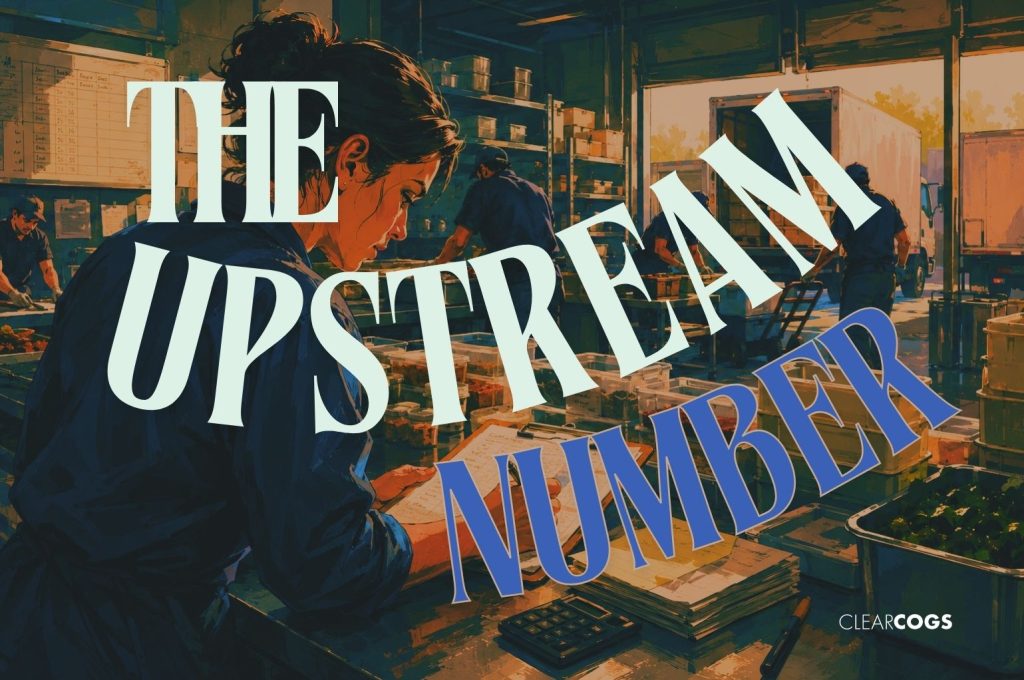
Every morning, somewhere inside a multi-unit restaurant group, someone walks into a commissary at 6am, pulls up a spreadsheet or a clipboard, and starts doing math.
How many batches? Which sizes? What goes to which store, and how much? Some of it comes from store orders placed the night before. Some of it gets estimated because a location forgot to order, or because last Tuesday looked like a better reference point than anything else on hand.
The whole process takes about 45 minutes, if everything goes well.
If it doesn’t, the day starts falling apart before most stores have unlocked their front doors.
The Commissary as the Upstream Problem
There’s a pattern in multi-unit restaurant operations that rarely gets talked about directly: every forecasting conversation tends to start and end at the store level. How much should we prep today? What did that location do last Friday? Are the pars right for the weekend?
Those are real and important questions. But in operations that run a commissary model, the store-level prep question is actually downstream of a different, higher-stakes decision made hours earlier: how much should we produce today, and how do we route it?
Get that number right, and 26 stores start their day with what they need. Get it wrong, and the consequences compound fast. Stores that are short on product send people out for emergency runs. Drivers log mileage. The best cook on the line gets pulled off to cover prep that should have arrived already. And the director of operations finds out not by seeing a report, but by noticing which stores submitted mileage logs at 7am.
That’s not a reporting problem. It’s a forecasting problem that lives one level above where most operators are looking.
When One Number Feeds Many Stores
Here’s what makes commissary forecasting structurally different from store-level prep planning: a commissary error does not stay in one place.
A store that over-preps dough loses some margin. A commissary that over-produces dough has a waste problem across the entire network. A store that runs short on bacon calls a neighbor and logs mileage. A commissary that routes bacon incorrectly has the same problem replicated across every store in its service area.
The multiplier effect is real, and it runs in both directions. The commissary is also where the biggest accuracy gains live. If you can get the commissary number right, you’ve stabilized the starting point for every store downstream, before anyone’s shift has started.
But that accuracy requires something most commissary operations don’t have: visibility into what all 26 stores are actually going to need tomorrow, not just what they ordered yesterday.
What Makes the Commissary Calculation Hard
Store orders are an imperfect signal. They reflect what a manager thought they’d need, based on their own read of the week, filtered through whatever habits or rules of thumb they’ve developed over time. That’s useful, but it’s not the same as demand.
A store that consistently over-orders is hiding its own waste. A store that consistently under-orders is training the commissary to short-change them. And a store that simply forgot to order, which happens, leaves the commissary guessing based on last week’s numbers, which may have nothing to do with this week’s demand pattern.
Meanwhile, the commissary team is also managing shelf life, batch minimums, size mix, and routing windows. Some stores get delivery every day. Some get it every two days. The decision isn’t just how much to make, it’s how to distribute it so that each store has enough without running past its own shelf limits.
The National Restaurant Association estimates that U.S. restaurants generate between 22 and 33 billion pounds of food waste every year. A meaningful share of that originates not at the store level, but at centralized production, where overproduction at scale becomes routine because the alternative, running short, is worse.
The Fix Starts Upstream
Getting the commissary number right requires knowing what each location is actually going to sell, not what they ordered, and not what they sold last Tuesday. It requires a bottom-up forecast that starts at the item level, accounts for local demand patterns at each store, and translates those forecasts into production and routing guidance before the commissary batch decision gets made at 5am.
That kind of forecast can also account for the variables that make standard ordering behavior unreliable: give-back nights at a local school that drive three times the normal Tuesday volume, college campus schedules that shift demand dramatically, weekends at a store that’s quietly becoming one of the group’s busiest locations without anyone having adjusted its pars.
When the commissary team starts the day with that kind of signal, the 45-minute manual calculation becomes something faster and more reliable. The mileage runs stop. The best cook stays on the line. And the director of operations wakes up knowing what’s actually happening, instead of reading the mileage log as a proxy.
Multi-unit operators spend a lot of time optimizing at the store level. That work matters. But in a commissary model, the upstream decision is where the day is really won or lost. The forecast that feeds the commissary doesn’t just plan production. It sets the ceiling on what’s possible for every store that depends on it.
That’s the number worth getting right.
If your commissary is still doing production math by hand every morning, we’d be happy to show you what changes when the numbers are right before the batch decision is made.
Sources
- National Restaurant Association. Working to Reduce Food Waste. restaurant.org


