

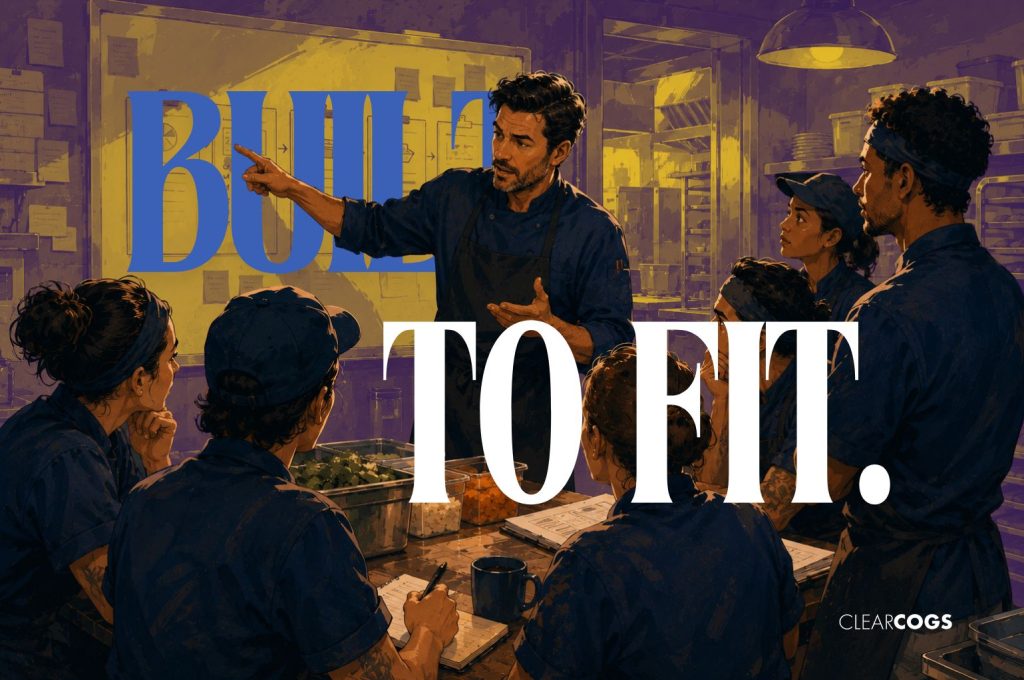



By Matt Wampler, CEO of ClearCOGS
Here is a question worth asking the next time you evaluate a restaurant technology vendor: “How long will it take to train our staff on this?”
It is a reasonable question. Most operators ask it. But it may be the wrong question.
The question assumes that adoption is a training problem. In most cases, it isn’t.
The Gap Between Knowing and Using
According to the National Restaurant Association’s 2024 Technology Landscape Report, three in four restaurant operators believe technology gives them a competitive edge. Only 13 percent describe themselves as technology leaders. That is a striking gap, and it shows up on the ground in a familiar way: brands invest in tools that never get fully used.
The usual explanation is that staff resisted change, or that training wasn’t thorough enough, or that managers didn’t follow through. Those things may all be true. But they are symptoms, not causes.
The deeper issue is that most restaurant technology is designed to be learned, not integrated. It arrives with its own logic, its own screens, its own workflows. Staff are expected to adapt to the tool. When they don’t, the blame lands on the people instead of the design.
The Behavior Change You’re Actually Asking For
Think about what a typical back-of-house technology rollout requires from a line cook or a prep lead.
They are already doing their job. They have a rhythm. They know where to look, what format they trust, and how information flows in their kitchen. Now they are being asked to check a new screen, or log into a new system, or follow a new process that does not quite match what they were doing before.
Even when the new system is genuinely better, the ask is significant. You are not just teaching them software. You are asking them to rebuild a daily habit while still hitting every prep target, every shift, every day.
That is a high bar. And it is why so many technology rollouts plateau after the first few locations or the first few months, no matter how thorough the onboarding was.
A Different Starting Point
The alternative is to start with a different question entirely.
Not: “How do we train staff to use this?”
But: “What does this tool need to look like for staff to use it without being trained at all?”
That reframe changes the evaluation criteria substantially. The relevant questions become:
- Can this tool deliver information in the format my team already trusts? A printed sheet, a kitchen display, a simple email, a number on a screen?
- Can the output fit into the workflow that already exists, rather than creating a new one?
- Can store-level staff get what they need without knowing they are using software at all?
For prep forecasting specifically, this matters more than most operators realize. A prep number only helps if the person who needs it sees it in time, in a format they trust, without having to go find it. The accuracy of the underlying forecast is almost irrelevant if the delivery doesn’t reach the right person in the right way.
What Flexibility Actually Looks Like
The brands that have figured this out tend to describe their best technology implementations not as “we trained everyone on the system,” but as “we figured out exactly how each location needed to receive the information, and then made it happen that way.”
For some locations, that means a printed prep sheet waiting in the kitchen before the morning crew arrives. For others, it means a number on a kitchen display that everyone already checks. For others, it means a simple daily email that the GM reviews before the shift. The underlying system is the same. The presentation changes based on what already works.
This is harder to build than it sounds. It requires a vendor willing to spend time understanding how your stores actually operate before deciding how to deliver data to them. Most vendors don’t do that. They have one output format, and the expectation is that your team will learn to use it.
The ones who approach it differently tend to frame their job as removing friction from your existing workflow, not adding a new one.
The Question That Clarifies Everything
When evaluating any back-of-house technology for a multi-unit rollout, one question cuts through a lot of the noise:
“Can this tool adapt to how my team already works, or does my team need to adapt to the tool?”
If the honest answer is the second one, the adoption ceiling is already set. You will get the locations where you had strong managers who drove the change through. You will lose the others over time.
The brands consistently seeing results from operational technology are the ones that found tools flexible enough to meet staff where they are, in the format they already use, inside the rhythm of the shift as it already runs.
That is not a training advantage. It is a design advantage. And it is one of the more useful things to look for before you sign anything.
At ClearCOGS, we spend a lot of time on the question of delivery before we spend time on the question of accuracy. A forecast that reaches the right person, in the right format, before the shift starts is worth more than a perfect forecast that nobody checked. If you are working through a technology evaluation for your operation, we are happy to talk through what that actually looks like. Let’s Talk
Sources
- National Restaurant Association. Restaurant Technology Landscape Report 2024. restaurant.org


