




By Matt Wampler, CEO of ClearCOGS
There is a gap in most restaurant expansion plans, and it sits right after the lease is signed.
Everything before that moment gets enormous attention. Real estate analysis. Site selection. Demographic research. Buildout specifications. The brand has thought carefully about why this market, why this location, what the opportunity looks like. Then the lease is signed, and the conversation shifts entirely to construction timelines and hiring schedules.
The operations question, how will this team actually run the restaurant, tends to get deferred to a later conversation. We’ll figure that out once we’re open. We’ll train them when the equipment arrives. We’ll build the prep process as we go.
What follows is predictable to anyone who has watched a brand expand. The first few weeks of a new location are operationally expensive. Over-prep, because the team has no demand signal and is erring on the side of not running out. Labor inefficiency, because scheduling was built on guesswork about how busy different shifts would be. Waste that does not appear on a budget line anywhere, because nobody is tracking it against a baseline yet.
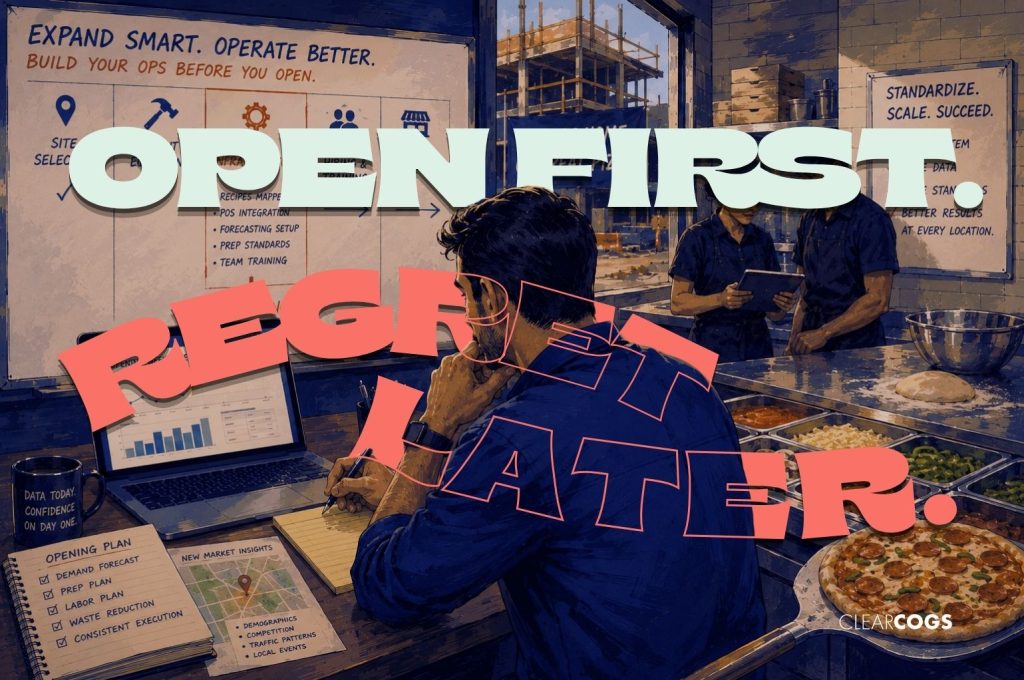
The brands that handle expansion well treat the pre-opening period as the highest-leverage moment in the whole process. Not as a countdown. As a setup window.
The Hidden Cost of the Learning Curve
Every new location goes through a calibration period. The team learns the pace of the market. The demand patterns become clearer over weeks of actual service. The GM develops instincts about which days run heavy and which run light. Eventually, prep decisions start reflecting reality rather than anxiety.
That process takes time. In a restaurant concept where freshness is part of the product promise, where toppings and dough and proteins cannot be carried over from one service to the next, the calibration period is expensive. Over-prep is not an occasional error. It is the default mode of a team that does not yet have a data foundation.
For a pizza concept or any fresh-prep model, the temptation is to over-prep early and tighten up later. The logic is understandable. Running out of a core ingredient in the first weeks of a new market is worse than wasting some product. You are building a reputation. You cannot afford to disappoint early guests.
But the daily cost of just-in-case prep compounds. What feels like a reasonable margin of safety in the first week becomes a structural habit by the fourth. And if you are opening multiple new locations simultaneously, each team is making the same conservative guesses independently, multiplying the waste across the whole opening push.
As Modern Restaurant Management noted in its 2026 industry outlook, brands that expand aggressively without matching their operational infrastructure to their growth rate face compounding risk that is often not visible until it shows up in the margin.
Why Institutional Knowledge Does Not Cross Borders
Brands that have operated successfully in one market often assume their operational knowledge travels with them. It does not, at least not automatically.
The GM at your original location has developed a feel for demand at that specific site. She knows that Tuesday evenings are quieter than Tuesdays at lunch. She knows which weeks of the year run heavy because of local events or school calendars. She knows what the weather does to foot traffic in that specific neighborhood.
None of that transfers to a new market. A team opening your first Texas location from a California base is starting from scratch on all of it. Without a system that can surface demand intelligence from the brand’s existing data, their only option is to guess conservatively and wait for the learning to accumulate.
That learning curve takes months. In some cases it takes a year before a new location’s prep discipline reaches the standard of the established ones. Every week of that gap has a cost.
What the Pre-Opening Window Makes Possible
The setup work for a forecasting system does not require the new location to already be generating sales data. It requires the brand’s POS to be connected and the recipes to be mapped. Both of those things are available before the location opens.
With that foundation in place, the forecasting system can produce an opening-week prep estimate based on the brand’s existing demand patterns, the location’s demographic context, the day of week, and the local event calendar. The new team does not start from zero. They start from a data-supported baseline that tightens as the location builds its own transaction history.
By the time the second and third locations in that market open, the brand has a process it can replicate. The calibration period shortens. The opening costs look different. And the operational DNA of the brand, the prep discipline, the demand intelligence, travels with the expansion instead of needing to be rebuilt from scratch at every new door.
That is the real compounding advantage of treating the pre-opening period as infrastructure time rather than transition time. The investment gets cheaper the more you use it.
Sources
- Modern Restaurant Management. 2026 Outlook: Experts Discuss Restaurant Trends and Challenges. 2026. modernrestaurantmanagement.com


