




By Matt Wampler, CEO of ClearCOGS
Inventory counting is one of the most consistent sources of management overhead in restaurant operations. It is also, in large part, a problem that mathematics can partially solve before a manager ever picks up a clipboard.
The full physical inventory count survives in most restaurants not because it is the most accurate method, but because it has always been the method. It was designed for a world without connected POS systems, without clean recipe data, without the ability to calculate theoretical ingredient usage from actual sales. That world no longer describes most multi-unit restaurant operations. Yet the full count remains.
According to QSR Web’s reporting on restaurant inventory practices, 70% of restaurant managers cite inventory as their least favorite responsibility, and the full counting cycle consumes 15 to 20 hours of management time per week per location when counting, reconciling, and ordering are combined.
That number is worth translating into dollars.
The Cost of the Current Model
Assume a general manager at $65,000 per year, a loaded hourly cost of approximately $31. At 15 hours per week, the inventory function consumes $24,180 per year in management time at one location. At 20 hours, it is $32,240.
| Weekly hours on inventory | 10 locations | 50 locations | 100 locations |
|---|---|---|---|
| 15 hours/week | $2.4M/year | $12.1M/year | $24.2M/year |
| 20 hours/week | $3.2M/year | $16.1M/year | $32.2M/year |
These are not food costs. These are the labor hours of your most experienced location-level managers, spent walking coolers with clipboards rather than on the floor.
The more important question is how much of this is actually necessary.
What Physical Counts Are Actually Solving
Physical inventory counts serve two functions. The first is to establish what you have on hand as the basis for ordering decisions. The second is to catch variance between theoretical usage (what the recipes and sales data say should have been used) and actual usage (what is actually on the shelf), which reveals waste, theft, portioning errors, and receiving mistakes.
Both purposes are legitimate. But both can be served without a full count of every item.
If you know what you ordered, and you know what you sold at the ingredient level, and your recipe data is clean, you can calculate theoretical on-hand without counting. The formula is straightforward:
Theoretical on-hand = opening inventory + purchases – theoretical usage
Where theoretical usage = sum of (sales volume per menu item x ingredient quantity per recipe).
If this calculation is accurate and your receiving records are reliable, the physical count serves as a periodic validation of the theoretical number, not as the primary source of it. The question becomes not “what do I have” but “does what I have match what I should have, and if not, why?”
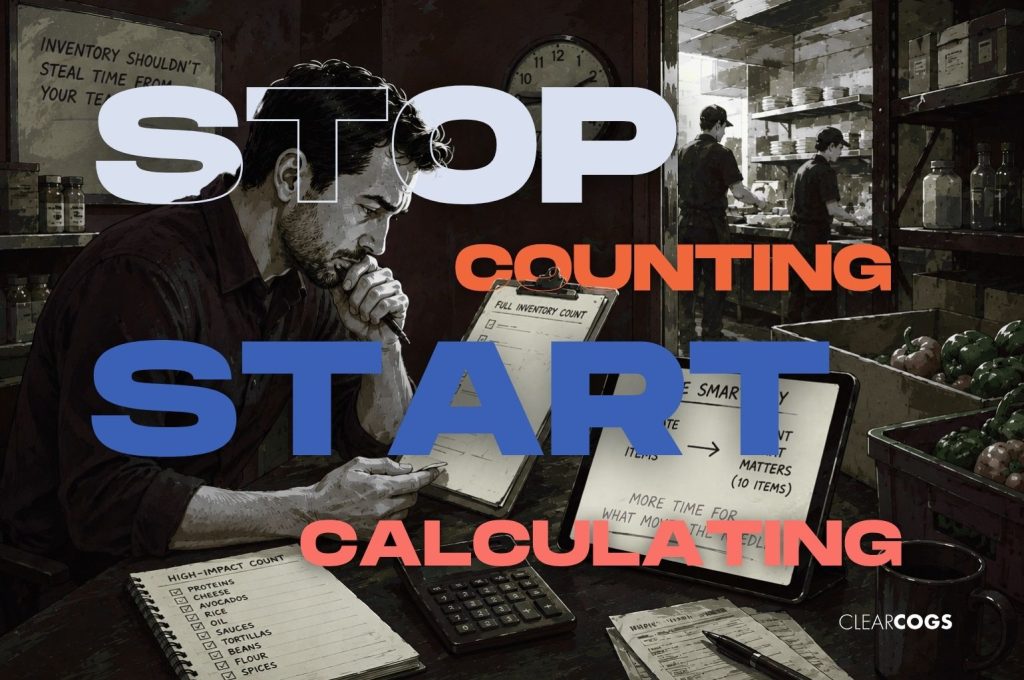
The 10-Item Model
The most operationally advanced operators are narrowing the physical count to the items where the answer to that question matters most.
High-cost proteins, items with known portioning variation, and anything with a historically wide gap between theoretical and actual usage are the candidates for nightly validation. Everything else can be calculated with reasonable accuracy and recalibrated on a periodic schedule rather than counted every day.
Consider the math on a 150-item count versus a 10-item count.
If a manager spends an average of 4 minutes per item counting, recording, and reconciling a 150-item inventory, that is 10 hours per inventory cycle. At 10 high-impact items, it is 40 minutes. Over 52 weeks at a 100-location portfolio, the difference is roughly 490,000 manager-hours per year, or the equivalent of approximately 236 full-time positions dedicated to counting items that could be calculated.
| Items counted nightly | Time per cycle | Annual hours at 100 locations |
|---|---|---|
| 150 items | ~10 hours | 520,000 hours |
| 10 items | ~40 minutes | 34,667 hours |
| Recoverable | ~485,000 hours |
The caveat is that this model requires two things to work: clean recipe data, and a forecasting system that orders off demand signals rather than off shelf audits.
What Changes When Ordering Is Driven by Forecasts
The traditional reason operators need physical counts is that ordering decisions depend on knowing current on-hand levels. If you do not know what you have, you cannot decide what to order.
When ordering is driven by predicted demand rather than reactive shelf replenishment, the dependency on the count as an input to ordering drops significantly. The model shifts from “count what I have, figure out what I need” to “know what I will sell, order accordingly, validate the high-impact items to catch exceptions.”
This is the change predictive prep enables. The count that remains is smaller, more targeted, and more useful than the sprawling ritual it replaces. Managers spend 40 minutes confirming the things that are genuinely worth confirming, rather than 10 hours generating data that confirms what the math already said.
What Gets Returned to the Floor
At 100 locations, recovering 10 hours per week per location from inventory cycles returns 52,000 management hours annually. At a loaded cost of $31 per hour, that is $1.6 million in management capacity redirected from clipboards to floor leadership, training, and guest experience.
The argument for reducing inventory overhead is not that the work does not matter. It is that most of it can be calculated rather than counted, and the hours spent counting items the model already knows are hours that cannot be spent doing things the model cannot do.
Sources
- QSR Web. Why 70% of Restaurant Managers Hate Inventory. September 2025. [URL needed — verify before publishing]


