


By Matt Wampler, CEO of ClearCOGS
A par level that keeps up with demand is one you set from a forward-looking forecast, not from last quarter’s average, and one you refresh for each location and each day. The short version: forecast what each item will sell tomorrow, convert that into how much to prep and how much to order, and let those numbers move when demand moves. Static or quarterly pars cannot do that, which is why they leave you stocked out on busy days and buried in waste on slow ones.
I have run restaurants. The par sheet taped inside the walk-in is one of the most expensive documents in the building, because every number on it is a bet on tomorrow’s demand. If those bets are stale, you pay for it twice: once in the food you throw away, and once in the sales you miss when you run out of the thing people came in for. This is a guide to setting pars and placing orders that actually track demand, written for operators who own food cost across more than one location.
A demand forecast and an inventory decision are two different things
Most operators blur these together, and it costs them. A forecast is a prediction. It says “you will probably sell 240 of these tomorrow.” An inventory decision is an action. It says “prep this much, order this much, hold this much on the shelf.”
The gap between the two is where the money leaks out. You can have a perfectly good forecast and still over-order, because nobody translated the number into a par. Or you place a great order and still run out, because the forecast it was based on was a 90-day-old average that did not know about the catering drop or the holiday weekend.
So the job is not just “get a forecast.” The job is to connect the forecast to the three decisions it should drive: how much to prep, how much to order, and what par to hold. Hold onto that distinction, because everything below depends on it.
Why static and quarterly par levels fail when demand moves
The traditional par is a fixed number you set, review every so often, and otherwise leave alone. The problem is the math underneath it. A static par assumes tomorrow looks like the average of the last several weeks. Demand does not work that way. It moves with the day of the week, the weather, local events, promotions, your delivery mix, and how fast the dining room is actually moving that afternoon.
Quarterly updates make this worse, not better. When you reset pars four times a year, every par is a snapshot of a moment that has already passed, applied uniformly to every day until the next review. Inside that 90-day window your menu mix shifts, a new LTO cannibalizes an existing item, delivery volume swings, and one location runs delivery-heavy while another runs dine-in. The single par sheet ignores all of it.
There is a human cost too. When the number on the sheet does not match the day, teams default to “scared ordering.” Running out is visible and embarrassing, while over-prepping quietly goes in the trash after close. So crews pad the par to be safe. Across one location that is a rounding error. Across thirty, it is a budget line. The dynamic that drives it is simple: a backward-looking number plus a fear of stockouts equals consistent over-production.
Dynamic par levels: order to the forecast, not to the average
A dynamic par is a target that updates as the inputs change. Instead of “hold 12 of these because that is the par,” it is “tomorrow projects to sell 240, so prep this many, order this many, and hold this on hand.” When the forecast moves, the par moves with it.
The shift is less dramatic than it sounds on the floor. The prep sheet your team works from looks almost identical. What changes is where the number comes from. Instead of a fixed value somebody set last quarter, it is a daily, location-specific, item-specific target driven by what is actually likely to sell. The cultural change is the hard part: getting the team to trust the calculated number instead of defaulting to the conservative one.
“Order to the forecast” is the same idea pushed up the supply chain. Your purchase quantities should be sized to projected demand over the order cycle, plus a deliberate safety buffer for variability and lead time, minus what you already have on hand. Not “we always order two cases.” Two cases is a par in disguise, and it has the same blind spots.
Item-level beats category-level, and it is where the savings live
Here is the part most systems get wrong. They forecast and set pars at the category or the menu-item level, then stop. “We will sell 240 sandwiches” is a fine sales number and a poor ordering instruction, because you do not order “sandwiches.” You order chicken, bread, lettuce, and the sauce that shows up in six other items.
Demand has to be translated down to the ingredient so it can drive an actual order. That means mapping each forecasted menu item through its recipe to the components it consumes, then rolling those components up across the whole menu. The chicken par is the sum of every item that uses chicken, weighted by how much each one is projected to sell. That is the level where stockouts and waste actually happen, and it is the level a 31-unit franchise like Groucho’s Deli needed when they moved to ingredient-level forecasting.
Category-level pars hide the offsetting errors. You can look “on target” at the category while you are short on one ingredient and long on another. Item and ingredient-level pars surface that, which is exactly why they are worth the effort.
How dynamic pars cut stockouts and waste at the same time
Operators often assume stockouts and waste are a tradeoff: hold more to avoid running out, accept more waste, or run lean and risk the stockout. With static pars, that tradeoff is real, because a single fixed number cannot be right for both a slow Tuesday and a packed Saturday. It is either too high half the time or too low half the time.
A forecast-driven par breaks the tradeoff because the number is allowed to be different on different days. On the slow day it comes down, so you prep and order less and throw away less. On the busy day it goes up, so you are covered and do not run out of your hero item. You are not picking a side. You are matching supply to demand, day by day, item by item. That is how you pull down stockouts and waste together instead of trading one for the other.
A practical way to set pars that keep up with demand
Here is a sequence you can actually run. It works whether you do it by hand at one location or systematize it across many.
1. Pull clean demand history from your POS
Start with item-level sales history, ideally by day and by channel (dine-in, takeout, delivery). Your POS already has it. Clean POS data is the foundation. If the history is wrong, every par downstream is wrong.
2. Forecast demand per item, per location, per day
Project tomorrow’s sales for each item, for each location, accounting for day-of-week, seasonality, events, and promotions. A chain-wide average is not good enough. The delivery-heavy store and the dine-in store need their own numbers. This is the work our menu and demand forecasting is built to do from your existing POS feed.
3. Translate item demand down to the ingredient
Run each forecasted item through its recipe and roll the components up across the menu. Now you have a projected quantity for chicken, bread, and every other ingredient, not just for finished menu items.
4. Convert demand into prep, par, and order quantities
For prep: how much to make tomorrow. For the shelf: the par to hold, set to projected usage plus a safety buffer. For purchasing: order quantity equals projected usage over the order cycle, plus buffer, minus on-hand. The buffer is a real number you choose based on how variable that item is and how long it takes to restock, not a gut pad.
5. Refresh on a real cadence, and adjust within the day where it matters
Recalculate daily, not quarterly. For high-velocity, perishable items, adjust within the shift: if the morning runs slow, the afternoon prep target should reflect that trajectory instead of the original plan. The goal is to react to today’s reality, not last quarter’s.
6. Track stockouts and waste by item, then tighten the buffers
Measure what ran out and what got thrown away, by item, by location. That feedback tells you where your buffers are too tight (stockouts) or too fat (waste), and it is how the system gets sharper over time.
The honest catch: doing all six steps by hand, every day, for every item, across every location is more work than a small team has bandwidth for. One motivated manager can build a great daily prep list for one store. It does not scale to thirty without help.
Where ClearCOGS fits
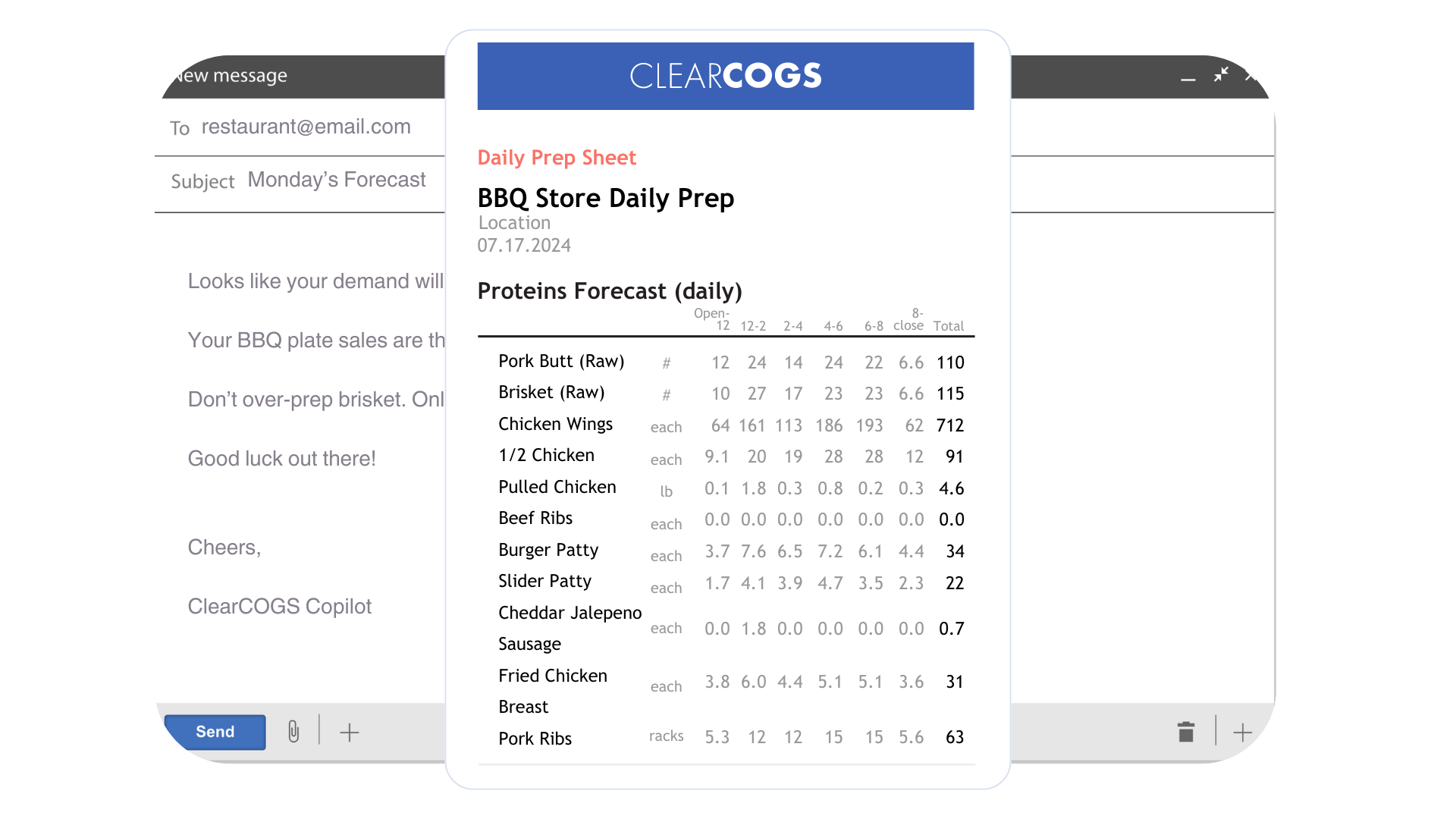
This is the gap ClearCOGS is built to close. We turn your POS data into tomorrow’s prep, order, and labor plan, per location, down to the ingredient. The forecast does not stop at a number on a screen. It becomes a daily prep sheet with how much to make, the ingredient quantities behind your order, and a par that moves when demand moves. Setup is managed, so you are not standing up a back-office project to get there.
You can also ask it questions in plain language, the way you would ask a sharp ops manager: what is driving the chicken order this week, which location is trending high, what changed since last month. ClearCOGS reports that operators cut food waste and give managers back hours each week, largely because nobody is rebuilding par sheets by hand anymore and fewer good days end in a stockout.
You do not have to take the numbers on faith. The fastest way to know if forecast-driven pars will work for your menu is to run it on your own sales history and look at the prep, order, and par output for your real items.
See it on your own data. Book a demo and get started.