




By Matt Wampler, CEO of ClearCOGS
According to a 2025 Toast survey of restaurant operators, 41% say they are extremely likely to adopt AI for forecasting and demand planning, and 24% are already using it today. A separate Deloitte survey from 2025 found that 80% of restaurant executives are increasing AI investments. The intent is there. The tools are improving. The problem most groups hit when they try to actually deploy AI forecasting is not the AI. It is the data underneath it.
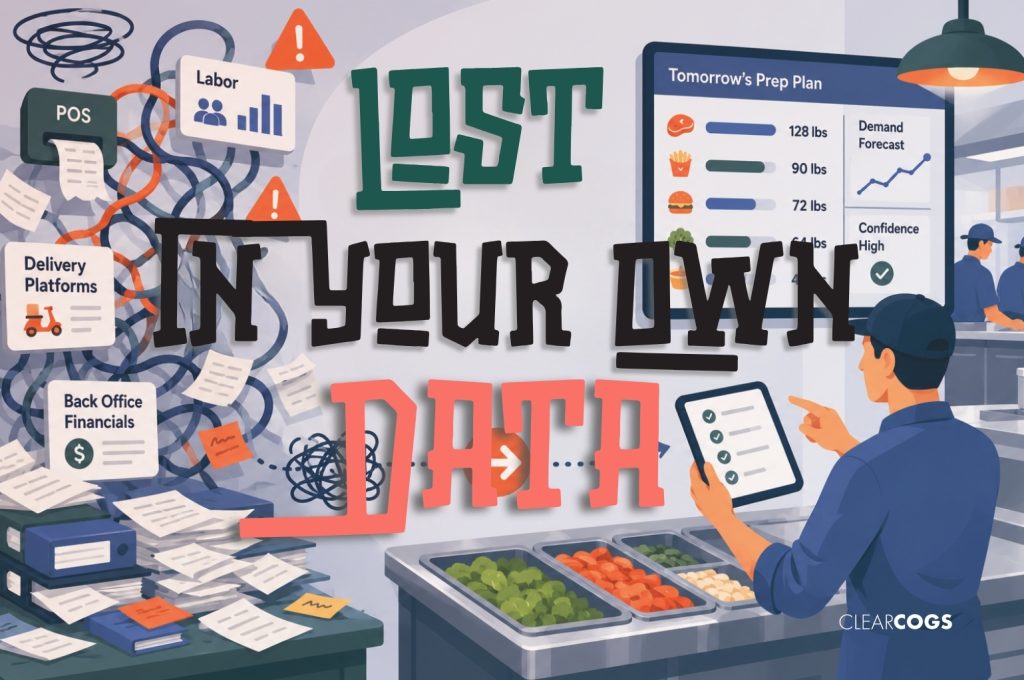
Restaurant groups have more operational data than ever. POS transactions, labor records, delivery platform reports, inventory logs, back-office financials: the data exists. It just does not talk to itself. And when it does not talk to itself, AI forecasting tools cannot reliably use it.
Why the Patchwork Stack Exists
Most multi-unit restaurant groups did not build their technology infrastructure from a plan. They added tools over time as needs arose: a POS here, an inventory platform there, a scheduling tool, a delivery integration, a back-office reporting system. Each solved a specific problem. None were designed to integrate with each other in a way that makes the whole greater than the sum of its parts.
Olo, which operates one of the largest restaurant technology integration ecosystems with more than 300 partners, describes this as one of the most significant obstacles to digital transformation in the industry: fragmented point solutions, where restaurant systems do not talk to one another. Transaction history lives in the POS. Labor cost lives in a scheduling platform. Delivery channel sales may not flow cleanly into either. When leadership needs to understand food cost variance by location, someone has to manually pull data from multiple sources and reconcile the gaps.
According to Restaurant Dive, 40% of director-level restaurant leaders globally identified manual data reconciliation as a direct result of fragmented systems, creating redundancies, reporting discrepancies, and operational inefficiencies that compound as groups scale. At 10 locations, this is painful but manageable. At 30 locations opening new units every year, it gets worse every quarter.
What the AI Layer Question Actually Means
When operators start thinking about adding AI-powered forecasting or prep planning tools, they often run into a predictable sequence: first, they realize their underlying data quality is not good enough to support AI reliably. Then they conclude they need to fix their data infrastructure before they can get the benefits they are after. Then they find themselves in a multi-year data warehouse project that never reaches a clear endpoint.
This logic is partially correct and mostly counterproductive. Data quality does matter for forecasting accuracy. Bad data produces unreliable predictions, and unreliable predictions create adoption problems: teams stop trusting the system and revert to gut feel.
But the sequencing question is not as binary as it sounds. The relevant question is not whether your data is clean in the abstract. It is whether the specific data streams that drive prep and staffing decisions, primarily transaction history, menu mix, and timestamps from your POS, are clean enough to model effectively. That is a narrower problem than a full infrastructure overhaul, and it is one that experienced forecasting platforms are built to solve as part of the engagement rather than a prerequisite to it.
What Has Changed in How Forecasting Platforms Handle This
The meaningful shift in how mature forecasting platforms are built is that data organization and cleansing is increasingly included in the setup process rather than treated as the operator’s problem to solve first. Separating catering volume from dine-in demand, flagging anomalous days, normalizing data across different POS configurations at different locations: this foundational work determines whether the output is trustworthy, and it is work that operators rarely realize they are getting until they see the difference it makes.
This matters because it changes the sequencing decision. Rather than waiting for a clean data infrastructure, operators can start with the POS data they already have, let the platform do the data organization work, and begin generating useful demand forecasting on a smaller set of high-impact items. The accuracy improves as the data relationship matures. The feedback loop makes the forecast better over time rather than requiring a clean state before anything useful happens.
The integration model that is gaining ground is not the all-in-one data warehouse but the targeted connection: pull the specific data streams that drive the decisions you care about most, clean them, and generate outputs that reach the people making those decisions in a format they can actually use.
What the Line Cook Actually Needs
The distance between leadership’s data ambitions and the line cook’s morning question is worth stating plainly. A VP of Operations who wants AI forecasting is ultimately trying to answer questions that show up at the store level in simple terms: how many pounds of protein should I thaw tonight? How much of this item should I have ready by 11 a.m.?
Answering those questions accurately requires sophisticated analysis that no individual store team member can reasonably perform: modeling seasonal patterns, day-of-week demand curves, weather and local event effects, and recipe-level math to convert demand forecasts into ingredient quantities.
The technology complexity should be invisible at the store level. What shows up for the team making prep decisions should be a daily prep plan that is simple, consistent, and reliable. The signal from leadership’s data investment reaches the kitchen not as a dashboard or a report, but as a number someone can act on before the shift starts.
Where the Technology Is Heading
The data integration problem in restaurant technology is getting structurally easier in ways that matter for forecasting. POS platforms have significantly improved their API access and data export capabilities, making it more practical to pull clean transaction data without custom development work. Open integration standards are becoming more common. The number of platforms that connect to major POS systems out of the box has grown considerably.
This does not mean the patchwork stack problem is solved. It means the cost of getting a forecasting layer running on clean POS data has come down, and the barrier that most operators imagined, a multi-year data project before any AI value is possible, is increasingly not the actual barrier. What matters more is choosing a forecasting partner that handles the data organization work rather than passing it back to the operator as a precondition.
The operators who are furthest ahead are not the ones with the cleanest data stacks. They are the ones who decided to start using the data they had, with the right partners, rather than waiting for an ideal state that never quite arrives.
If messy data is standing between your operation and smarter prep decisions, the answer is not to wait. Let’s Talk
Sources
- Restaurant Dive. From Data Fog to Clarity: How a Unified POS Clears the Air for Restaurant Groups. restaurantdive.com
- Olo. Restaurants Are Drowning in Data Silos: Integrations Can Help. Updated October 2024. olo.com
- Toast. AI in Restaurants: 2025 Survey Results. 2025. toasttab.com


