




By Matt Wampler, CEO of ClearCOGS
There is a sentence I have heard in some version from almost every operator I talk to, and it sounds so reasonable that nobody ever challenges it.
“That ingredient is cheap, so we always go overboard.”
Dough. Rice. Beans. Batter. House sauces. The base of whatever you sell. It costs almost nothing per unit, it is the thing you absolutely cannot run out of, and the arithmetic seems obvious. If running out ruins the shift and the raw material costs a few cents, you make extra. Every time.
I have never met an operator who thought this was a problem. I have met a lot of operators who could not explain where their prep labor was going.
The part the sentence leaves out
The reasoning is sound right up until you notice it prices only one of the two things you spent.
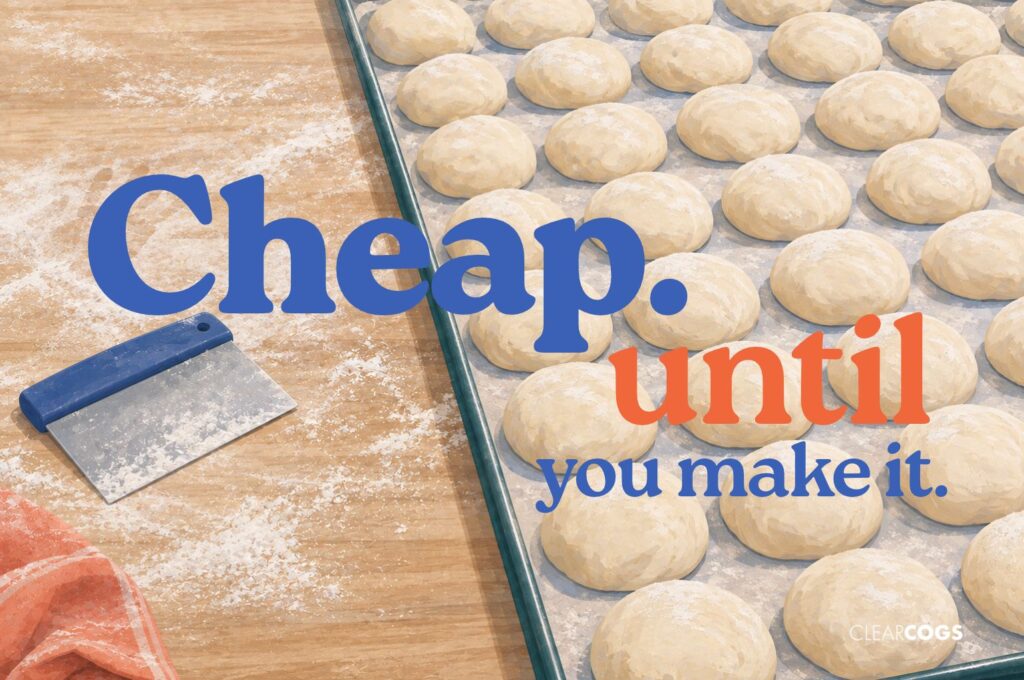
Raw dough is cheap. Portioned, weighed, shaped, panned dough that is ready to go on the line is not. Somewhere between those two states is a person, and that person spent real minutes of a real shift getting it there.
An operator described this to me recently in a way I have not been able to shake. The dough itself, he said, is so inexpensive that overproducing it barely registers. But patting out an hour of extra portions that never get sold is an hour he paid for and got nothing back from. Not a small loss. Not an invisible one either, once you decide to look.
And the food cost report will never show it to you. The wasted product shows up as a few dollars of flour. The hour shows up in labor, in a completely different line, attributed to a shift rather than to a decision. Nothing in your reporting connects the two.
The ingredient was never the expensive part
If this feels like a small point, the national numbers make the case better than I can.
The USDA’s Economic Research Service tracks where every dollar of American food spending actually goes. In its most recent update, farm establishments received 7.1 cents of each dollar spent on food away from home in 2024. The farm commodity inside a restaurant meal is a sliver of what the guest pays.
Labor is the opposite story. The same data shows that the food-away-from-home dollar uses substantially more labor than the grocery dollar, and that the foodservices group is intensely labor-driven, accounting for 44.2 cents of labor out of the 65.8 cents that foodservices contributes to each of those dollars (USDA Economic Research Service, Food Dollar Series, March 2026).
Those figures describe the whole supply chain rather than your P&L, so do not import them directly. But the shape of the thing is unambiguous, and it matches what happens in your kitchen. When you throw away product you made and did not sell, the ingredient is the smallest piece of what you are discarding. The larger piece is the labor already poured into it, and that piece never appears in a waste log.
What the hour was supposed to be doing
There is a second cost underneath the first, and it is the one that actually hurts.
A prep hour is not just money. It is capacity. The person shaping portions nobody will buy is not doing the other things that shift needed, and in most kitchens the list of other things is long: the station that did not get stocked, the closing task that got rushed, the new hire who did not get watched, the guest area nobody walked.
I heard about a recent opening where the team prepped for an enormous day and did a small fraction of it. The obvious cost is the product. But the thing the operator actually noticed, walking in that morning, was that his team was behind. Not because they were slow. Because they had spent the morning building inventory for a day that was never going to happen, and the real work of opening a restaurant was still waiting for them.
Over-prep does not just cost you the item. It quietly reschedules your labor into the least valuable thing available, and it does it before the shift even starts.
Why the cheap items never get fixed
Here is the part that should change how you build a prep list.
When operators decide which items deserve real forecasting attention, they almost always sort by ingredient cost. The expensive proteins get scrutiny, recipes, tracking, and a manager who cares. The cheap base items get a rule of thumb and a shrug, because being wrong about them looks free.
That sorting is backwards for anything with meaningful prep labor in it.
The right question is not what a case costs. It is what it costs to be wrong, and the honest version of that number has several parts: the ingredient, the labor to prepare it, the labor to store and rotate and eventually discard it, the space it occupies while it waits, and the shift work that did not happen because someone was making it.
Sorted that way, a cheap ingredient with high prep labor and a short shelf life can easily outrank an expensive one that gets portioned to order. The item that never gets forecast is frequently the item where forecasting would pay the most.
There is a useful test. For each item on your prep list, write down two numbers: what the raw material costs, and how many minutes it takes to make a batch. Then look for the rows where the first number is small and the second is large. That is where your unmeasured money lives, and it is almost never where your attention currently is.
The shelf is making the decision
One more habit worth naming, because it comes from the same instinct.
In a lot of kitchens, order quantities are set by what fits. Teams order to fill the shelf rather than to cover the days ahead. It feels prudent, it is easy to execute, and it survives because nobody ever wrote down a better rule.
You can see the evidence when a group builds a right-sized back of house and the teams react badly. The space is not too small. The ordering habit was calibrated to a bigger one.
When storage capacity is setting your order quantity, the building is making an operating decision that should belong to a forecast. And the same logic applies one step downstream at the prep table, where the size of the container or the number of pans often determines the batch more than any estimate of demand does.
What to do about it
None of this requires a new system to start on. It requires counting something you are probably not counting.
Put prep labor next to the items on your prep list. Not an exact study, just honest minutes per batch. Then ask three questions about the items where the labor is high and the ingredient is cheap. How often do we make more than we sell. What does that extra cost us in time rather than in food. And what did that time come out of.
When you cost prep properly, “it is cheap, so we go overboard” stops sounding like prudence and starts sounding like what it is: a decision that was never actually priced.
This is the work we spend our days on at ClearCOGS, turning the data a restaurant already has into a specific number for each item before the shift starts, so the cheap items get the same rigor as the expensive ones. If your prep list has items nobody has ever bothered to forecast because the ingredient is cheap, those are usually the ones worth looking at first.
Sources
- U.S. Department of Agriculture, Economic Research Service. Food Dollar Series: Summary Findings. Updated March 10, 2026, reporting 2024 data. ers.usda.gov


