


By Matt Wampler, CEO of ClearCOGS
Par levels help restaurants control inventory, but they are built on a fundamental flaw: every day is treated as the average of the last several weeks. Dynamic forecasting replaces static thresholds with location-specific, day-specific prep targets — reducing end-of-night waste and the over-production patterns that drive it across a portfolio.
Par levels feel like a system. They have numbers. They’re written down. Someone decided how much to have on hand, and now everyone follows the same rule. That sounds like operational consistency, and compared to pure gut feel, it is.
But par levels have a foundational problem: they assume tomorrow will look like the average of the last several weeks. In a restaurant, that assumption breaks constantly.
The Par Level Promise vs. Reality
The logic behind par levels is sound in theory. You look at how much product you typically move, you set a floor that keeps you from running out, and your team preps or orders to that number. Simple, repeatable, consistent.
The problem is that par levels are backward-looking by design. They reflect past performance, averaged across time, and applied forward without accounting for what’s actually different about today or tomorrow.
What changes? Almost everything. A rainy Tuesday moves differently than a sunny Tuesday. A local event two miles away can spike traffic at a specific location. A slow morning at one store doesn’t mean the afternoon will follow suit. None of that information lives in a par level.
A franchise operator with ten locations knows this problem intimately. The par sheet tells the team to rack a certain amount of product. But if it’s raining out, or if business is slow heading into the afternoon, the team doesn’t adjust. They follow the number. At the end of the night, product that was never needed gets thrown away, and the par level doesn’t register that it was wrong.
The “Scared” Ordering Problem
Par levels create a specific failure mode worth naming: scared ordering and scared production.
When teams are trained to hit a par, the number becomes a safe harbor. If we hit the par, we can’t get in trouble. If we don’t hit it and we run out, we absolutely will get in trouble. So the rational response, especially for less experienced team members, is to always hit the par, even when the day’s trajectory clearly doesn’t warrant it.
This shows up in production, rack to the number regardless of pace, in ordering, order to par regardless of on-hand inventory, and in purchasing, order more than needed because running out is worse than wasting. Each of these decisions is individually defensible and collectively wasteful.
Across multiple locations, scared ordering compounds quickly. Ten stores each over-ordering by a modest amount produces real waste and real cost, and since it’s distributed across locations, it rarely surfaces as a pattern in reporting.
What Dynamic Forecasting Does Differently
The alternative to par levels isn’t more complex par levels. It’s forecasting that accounts for the actual variables driving demand at each location.
According to Over Easy Office’s multi-unit inventory guide, one of the most common and costly par level mistakes is applying static par levels despite changes in sales patterns, a practice that leads to overstock, waste, and margin drag across locations. The guide notes that operators who shift to dynamic, data-driven inventory solutions cut waste by roughly 35%. That distinction is the difference between a system that produces consistent waste and one that actively works to eliminate it.
Dynamic forecasting starts from granular sales history, not weekly averages, but 15-minute intervals of historical transaction data across multiple years. It layers in external variables: day of week, time of year, weather, local events, trends in product mix. And it produces a location-specific, day-specific output. Not “your par for bread is X,” but “here is how much bread you need for this particular Tuesday, given everything we know about this location.”
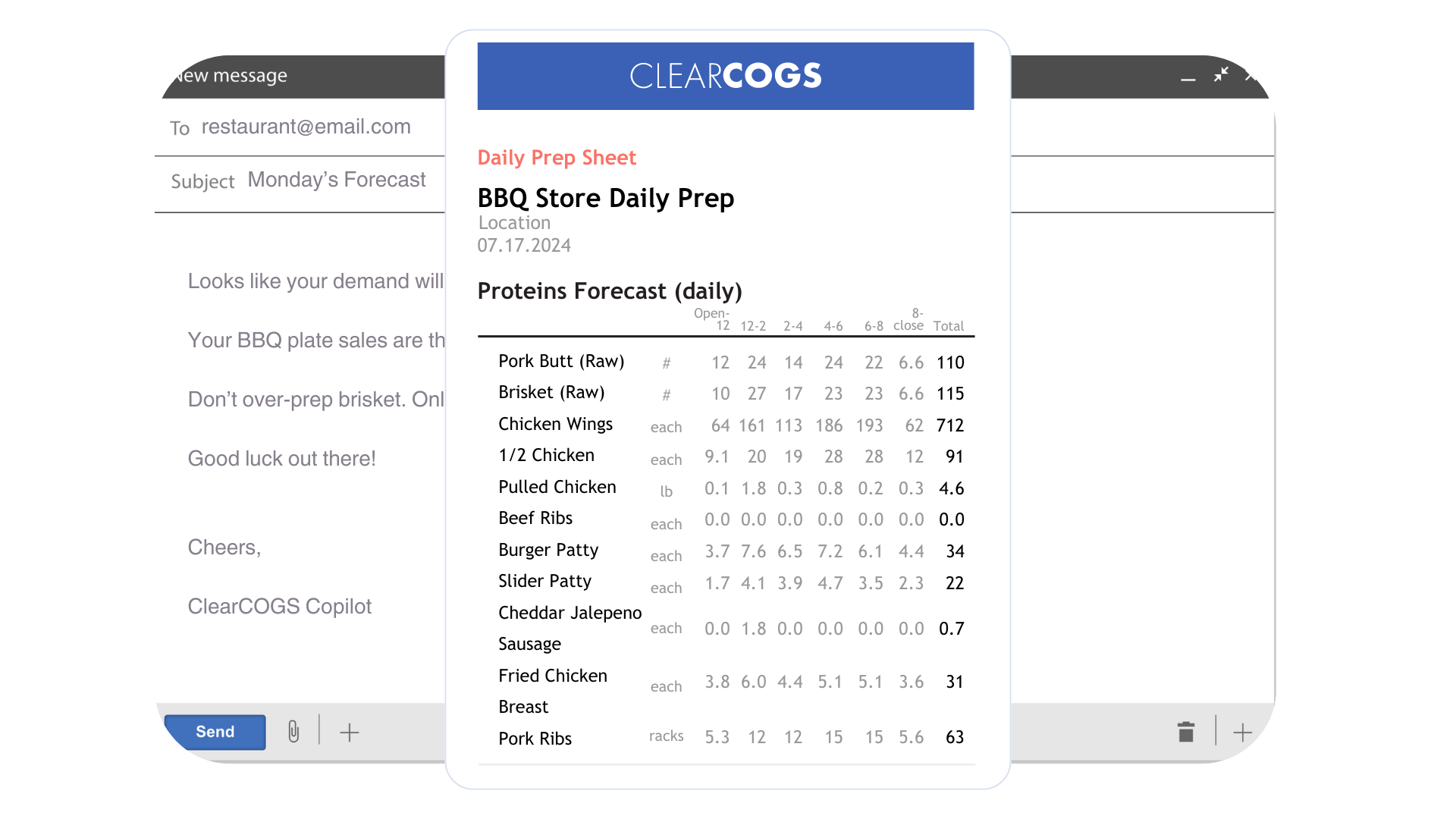
The output looks similar to a par sheet on the surface, a number for each item, adjusted for the time of day and the shift ahead. But the number changes based on actual conditions rather than being static across all Tuesdays regardless of what’s driving demand.
At shift change, the forecast updates. If the morning ran slow, the afternoon production number reflects that. The team isn’t racking to a number that was set based on a busy Tuesday four weeks ago. They’re responding to the actual trajectory of the day.
The Cost of Getting It Wrong
The gap between par-level thinking and dynamic forecasting shows up most clearly at the end of the night. That’s when product prepped to par, but not needed, gets counted, recorded as waste, and thrown out.
For a franchise with ten locations, even modest per-location waste adds up fast. An operator seeing consistent end-of-night waste across a portfolio isn’t dealing with a discipline problem at the store level. They’re dealing with a structural problem in how prep targets are set.
The waste isn’t random. It’s predictable, because the par level is predictably wrong on slow days, rainy days, days with local events, and any day where actual demand diverged from the historical average the par was built on.
Making the Shift
The transition from par-level thinking to forecasting-driven prep doesn’t require rebuilding how your team works. The daily prep sheet looks nearly identical. The difference is that the numbers on it are specific to today’s expected demand rather than a static average.
What changes most is the culture around the numbers. When teams understand that the daily prep target is calculated based on real data, and that it updates as the day progresses, they’re less likely to default to scared production decisions and more likely to trust the system.
ClearCOGS analyzes historical transaction data at a granular level, factors in external demand signals, and delivers a daily prep plan specific to each location. For franchise groups running ten or more locations, that means consistent prep targets that reflect actual expected demand, not a static par that assumes every day is the same.
Par levels got you this far. Dynamic forecasting is what takes consistent food cost management to the next level.
Curious what that looks like for your locations? Let’s Talk
Frequently Asked Questions
What are par levels in restaurant operations?
Par levels are predetermined inventory thresholds that tell a kitchen team how much product to have on hand. They are based on historical averages and are designed to prevent stockouts. The logic is to look at how much product you typically move, set a floor, and prep or order to that number. Compared to pure gut feel, par levels provide a starting point for consistency.
Why do par levels lead to food waste in restaurants?
Par levels are backward-looking by design. They reflect past sales averaged across time and applied forward without accounting for what is different about today. A rainy Tuesday, a local event, or a slow morning can change demand significantly, but none of that information lives in a par level. Teams prep to a number that may not match actual expected demand, leading to end-of-night waste when business does not materialize as the par assumed.
What is scared ordering in a restaurant kitchen?
Scared ordering is a pattern that emerges when teams are trained to hit a par number. Because missing the par and running out carries visible consequences while over-prepping does not, team members default to always hitting the par even when the day’s trajectory does not warrant it. This shows up in production, ordering, and purchasing. Across multiple locations, scared ordering compounds into real and predictable cost that rarely surfaces as a pattern in reporting.
How does dynamic forecasting work differently than par levels?
Dynamic forecasting builds a location-specific, day-specific prep target using granular historical sales data layered with variables like day of week, weather, local events, and product mix trends. The result is a number that reflects expected demand for this particular day at this particular location, not a historical average. The target also updates at shift change: if the morning ran slow, the afternoon production number reflects that rather than a busy Tuesday from four weeks ago.
What does switching from par levels to dynamic forecasting look like for a restaurant team?
The daily prep sheet looks nearly identical. The difference is that the numbers on it reflect today’s expected demand rather than a static average. What changes most is the culture around those numbers: when teams understand that the prep target is calculated from real data and updates as the day progresses, they are less likely to default to scared production decisions and more likely to trust the system.
Sources
- Over Easy Office. Par Level Inventory Guide Every Restaurant Leader Should Master. overeasyoffice.com
- WifiTalents. Restaurant Food Waste: Data Reports 2026. 2026. wifitalents.com
- Apicbase. Demand Forecasting in Restaurants: Unlocking Efficiency and Savings in Procurement and Inventory Management. get.apicbase.com