




By Matt Wampler, CEO of ClearCOGS
Somewhere in most restaurant groups this month, a leader will open a purchasing report, see a line item that looks absurd, and ask about it.
The answer will be a national food holiday. Burger day, taco day, doughnut day, pick one. There is a holiday for almost everything now, and the marketing calendar is full of them.
The useful question is the one that comes next. Where did that number come from?
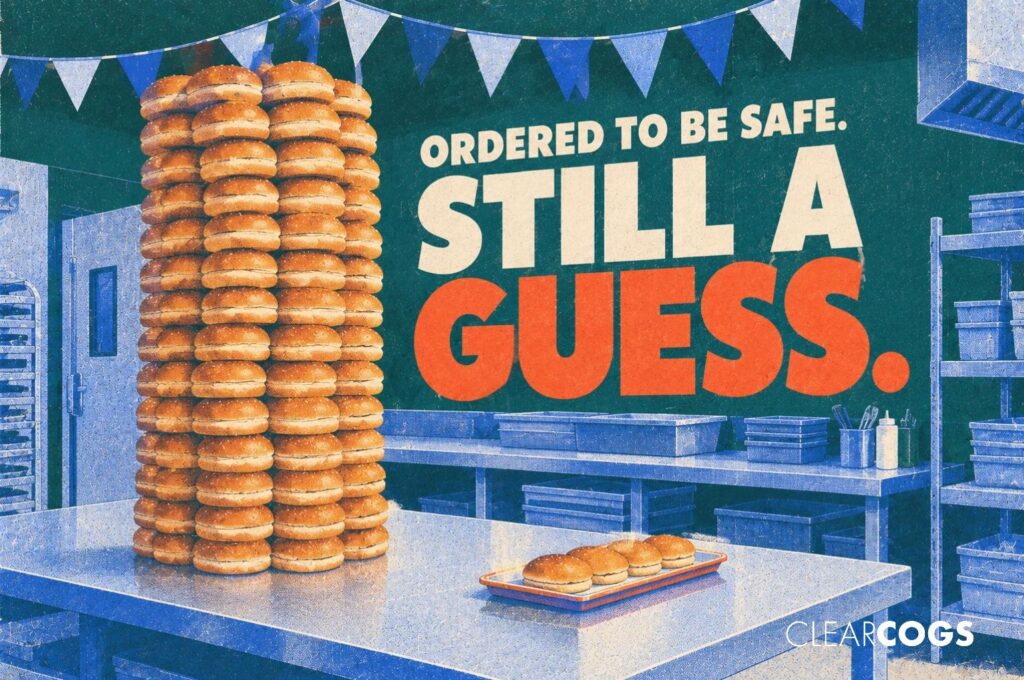
In my experience the honest answer is usually that somebody picked it. Not carelessly. They picked it because the day sounded big, because running out on the day you promoted the item is the worst possible outcome, and because ordering heavy felt like the responsible thing to do.
That instinct has a name inside most operations, even if nobody says it out loud. Purchasing to be safe. It is not the same thing as purchasing on evidence, and the gap between those two is where a surprising amount of money goes.
Two questions nobody asked
For a recurring promotional day, there are two pieces of evidence that settle the argument, and both already exist in systems the business is paying for.
What did we actually sell last time? And what did we throw away afterward?
Neither question requires a model or a vendor. They require somebody to pull last year’s mix for that date and the waste log for the week that followed. In most groups, nobody does. The order gets placed, the day happens, the product either moves or it does not, and the number is never written down anywhere that next year’s buyer will find it.
So the same guess gets made again twelve months later, by a different person, with the same reasoning.
A promo day is a different forecasting problem
There is a reason the normal process fails here specifically, and the research on promotional demand is clear about it.
Researchers testing forecasting approaches against an extensive set of store-level sales and promotion data found that simple time series techniques perform very well for periods without promotions. For periods with promotions, those same simple methods fell behind, and accuracy improved substantially only when the model used explicit features built from the sales and promotion history of that item and related items. They also found that pooling data across store combinations almost always improved performance (Gur Ali, Sayin, Van Woensel, and Fransoo, Expert Systems with Applications, 2009).
Translate that into kitchen terms and it says three things worth acting on.
Your ordinary approach, whatever it is, is probably fine on ordinary days. It is specifically on promotional days that it stops working, which is also the day you are most exposed, because you have advertised.
The fix is not a more sophisticated model applied to the same thin inputs. It is feeding in what happened during past promotions, explicitly.
And one location’s history of a given promo day is thin. The same promo across all your locations is a usable pattern.
The asymmetry that drives the over-order
Over-ordering on promo days is not irrational. It is a response to two failures that are not weighted equally.
Run out at seven o’clock on the day you advertised the item, and everyone knows. The guest who came for that specific thing is disappointed, the social post is now a liability, and somebody is explaining it the next morning.
Order sixty percent too much, and the failure is distributed. A little extra in the walk-in, some product used up over the following days, some quietly discarded in week two. No single moment anyone has to explain.
The visible failure gets managed against. The invisible one gets absorbed. That is the whole mechanism, and it is why telling buyers to be more careful does not work. They are being careful about the thing they can see.
Shelf life decides how expensive the mistake is
The reason this matters more in restaurants than in retail is that excess does not wait politely.
Consider a house-made item with a four-day shelf life, produced in a commissary and shipped to locations. Over-order on a promotional Monday and the surplus is not inventory, it is a countdown. Whatever has not sold by Thursday is waste by definition, plus the labor already invested in making it.
Here is the shape of the exposure, with illustrative numbers:
| Steady item, long shelf life | High-labor item, four-day shelf life | |
|---|---|---|
| Ordered for the promo day | 100 units | 100 units |
| Actually sold | 70 units | 70 units |
| Usable afterward | Most of the surplus | Whatever sells in three days |
| Cost of the error | Carrying cost and cash tied up | Food cost plus prep labor, written off |
| Recovery option | Sell through over following weeks | None after the window closes |
Illustrative only. The same percentage miss produces very different costs depending on shelf life.
Same percentage miss, very different bill. Which means the items that most need evidence before a promo order are the ones with the shortest window and the most labor in them, and those are rarely the items anyone scrutinizes.
What to pull before sizing a promo order
A practical routine, and none of it needs new software.
- Last occurrence, same date. Units of the promoted item sold, by location. If the promo has run three years, pull all three.
- The day before and the day after. Promotions pull demand forward and push it back. If the day after collapses, your promo lift is smaller than the headline number suggests.
- Whether you ran out, and when. If the item stopped selling at seven, last year’s number is not demand, it is your ceiling. Treat it as a floor for this year’s estimate rather than a target.
- What got wasted in the following week. This is the number nobody logs and the one that tells you whether last year’s order was right.
- What else moved. A promoted item changes the mix around it. If the promo item cannibalized a neighbor, your total protein need barely moved even though one line item spiked.
Write those five numbers down somewhere permanent, attached to the date, so next year’s buyer inherits evidence instead of a feeling.
None of this is sophisticated. That is rather the point.
Most groups already have the data to size a promotional order properly, and they have had it for years. What they lack is a routine that forces somebody to look at it before the purchase order goes out, and a place to record the outcome afterward so the exercise compounds instead of resetting.
Build a promo log. One row per promotional day, per location. Planned quantity, actual sales, stockout time if any, waste the following week. After three or four occasions, you stop guessing, and the argument about how much to order stops being a matter of who feels most strongly.
This is a large part of what we do at ClearCOGS: taking the history a business already has, including its past promotions, and turning it into a specific number per item and per location before the order goes in.
If your promotional days get ordered by feel and nobody can say where the number came from, that is worth looking at before the next one.
Sources
- Gur Ali, Ozden, Sayin, Serpil, Van Woensel, Tom, and Fransoo, Jan. SKU Demand Forecasting in the Presence of Promotions. Expert Systems with Applications, 36(10), 12340–12348. 2009. doi.org


