




By Matt Wampler, CEO of ClearCOGS
Multi-location bakeries face a production planning problem that most operators recognize immediately: the daily production ticket has to be right, and building it takes longer than it should.
When a central commissary bakes and ships product once a day, the margin for error on that ticket is narrow. Too much, and product goes to waste at the end of the shift. Too little, and stores run out before close. And when the number is built by manually pulling data from three separate systems, the odds of getting it exactly right drop with every handoff.
This article explains how multi-location bakeries can improve their production planning process, reduce the labor it takes to build a daily ticket, and cut down on waste from inaccurate demand estimates.
What Is Bakery Production Planning?
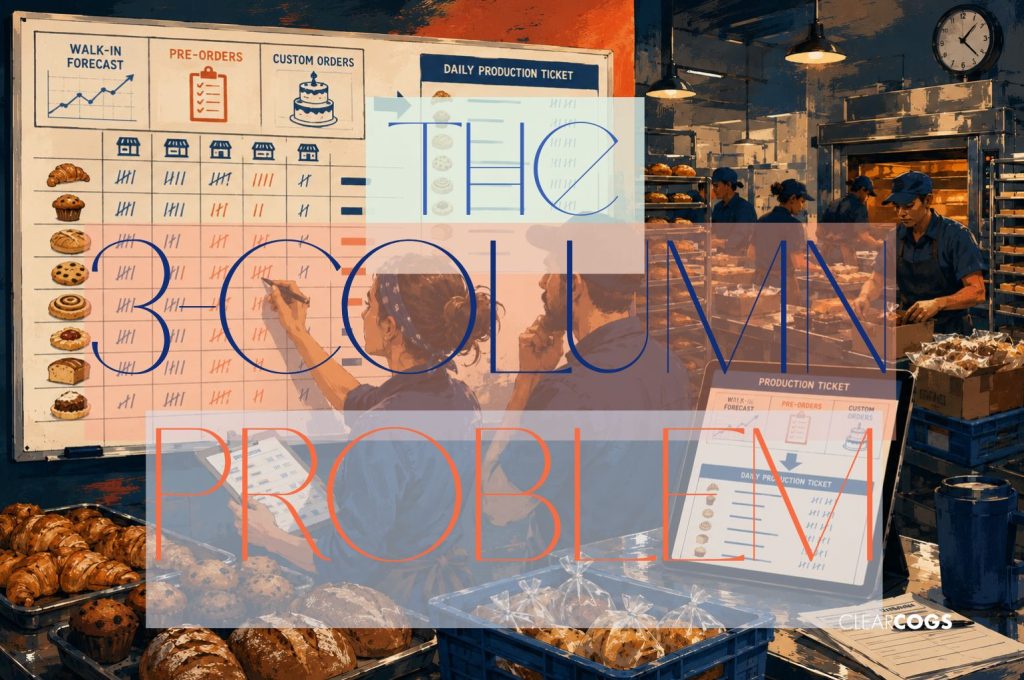
Bakery production planning is the process of deciding what to bake, how much of each item to produce, and when to have it ready for distribution across store locations. In a commissary model, this means building a centralized production ticket each day that accounts for:
- Walk-in demand: How many of each item customers are expected to buy at each location
- Pre-orders: Items customers ordered in advance through the POS
- Custom orders: Special cakes, event orders, or wholesale requests managed separately
In a single-location bakery, this process is relatively contained. In a multi-location bakery, especially one running a commissary, it becomes a coordination challenge: multiple demand signals, multiple platforms, and one daily deadline.
Why Manual Production Planning Breaks Down at Scale
Most bakeries start with a workable system. A manager or production lead checks the sales history, adjusts for day of week or seasonality, and builds a list. When the business is small, this works.
As locations multiply, the inputs multiply too. Each store may have different demand patterns. Pre-orders arrive through the POS. Custom orders are tracked in a separate platform. The person building the ticket has to open each system, pull the relevant numbers, and paste them into a shared spreadsheet before packing can begin.
This introduces several failure points:
- Version errors: If the ticket is updated after it is distributed, not everyone gets the revision.
- Timing gaps: A pre-order placed after the ticket is built may not make it into production.
- Transposition errors: Manual copy-paste introduces mistakes that compound across SKUs.
- Labor overhead: The time spent building the ticket each day is time not spent on production, quality, or customer-facing work.
Labor costs represent 20 to 35 percent of production expenses in most bakery operations, according to industry benchmarks. When a meaningful portion of that labor goes to administrative coordination rather than baking, the inefficiency is real even if it does not show up directly on a waste report.
The Three Demand Signals That Drive Commissary Decisions
In a commissary-based bakery operation, daily production decisions typically combine three distinct demand signals. Understanding how each one works helps clarify where manual processes create the most friction.
1. Walk-In Demand Forecast
This is the portion of production that covers customers who will walk in and buy from the case. It cannot be known in advance. It has to be estimated based on historical sales patterns, day of week, weather, local events, and other variables.
This is where machine learning models add the clearest value. A model trained on historical sales can account for patterns that a four-to-six week moving average misses: a rainy Tuesday that reduces foot traffic, a Friday before a holiday that spikes it, or a store that consistently sells out of croissants by 10am.
2. Pre-Orders
Pre-orders are customer-initiated orders placed in advance through the POS. These are known quantities. The customer has already decided what they want and when. The challenge is not forecasting them. It is pulling them from the right place and including them in the production ticket on time.
In most POS systems, pre-orders are attached to the day of fulfillment, not the day they were placed. Operators need a process that captures orders within a defined lead time window and flags them for the production team before the baking cycle begins.
3. Custom Orders
Custom orders, cakes built to spec, event orders, wholesale quantities, are typically managed in a separate platform. They require the most lead time and are the least predictable by volume. Like pre-orders, they do not need to be forecasted. They need to be aggregated accurately and incorporated into the production ticket before the commissary commits to a run.
The operational challenge is not that any of these signals is hard to understand. It is that most bakeries are managing all three manually, in separate systems, and assembling them by hand each day.
How Demand Forecasting Reduces Waste in Bakery Operations
Accurate demand forecasting reduces two types of waste that hit bakery margins: product waste and labor waste.
Product waste occurs when more items are produced than are sold before their shelf life expires. For most baked goods, that window is 24 to 48 hours. An overproduction of 10 percent per day compounds across a week, a month, and multiple locations.
Labor waste occurs when staff time is spent on coordination tasks rather than production. Building a daily ticket from three separate systems, reconciling discrepancies, and handling last-minute corrections adds up. This cost is easy to overlook because it does not appear on a waste log.
A 2024 survey of bakery industry executives by BEMA found that decreasing labor costs ranked among the top three operational priorities, cited by 61 percent of respondents. Investment in production efficiency, including automation and planning tools, was identified as the primary strategy for addressing that pressure.
Demand forecasting, specifically at the SKU and location level, helps address both forms of waste. It produces a more accurate starting number for the daily production ticket, and when integrated with pre-order and custom order data, it eliminates the manual aggregation step entirely.
What an Integrated Bakery Production System Looks Like
The most efficient commissary bakeries move from a manual, three-tab process to an automated one: a single daily production ticket assembled from all demand inputs before the production team arrives.
The key characteristics:
- Automated aggregation: Walk-in forecast, pre-orders, and custom orders are pulled automatically from their respective sources and combined into one ticket.
- Location-level detail: Each store’s demand is calculated separately, then rolled up to a commissary total.
- Lead time awareness: Items that require advance preparation are flagged with appropriate production timelines.
- Delivery format: The ticket arrives by email, formatted for printing and ready for the production board without manual reformatting.
When a system like this is in place, changes to one input update the ticket without requiring someone to rebuild it from scratch.
This does not eliminate the need for experienced production judgment. There will always be adjustments based on what a baker knows about a specific day. But it shifts that judgment from “building the estimate from scratch” to “reviewing and refining an estimate that is already mostly correct.”
Frequently Asked Questions
What is the difference between bakery demand forecasting and pre-order management?
Demand forecasting estimates how many units of each item are likely to sell based on historical patterns and variables like day of week, seasonality, and local conditions. Pre-order management captures orders customers have already placed in advance. Both feed into the daily production ticket, but they require different processes: forecasting uses historical data and models, while pre-order management requires pulling confirmed orders from the POS within a defined lead time window.
How accurate is AI-based demand forecasting for bakeries?
Accuracy varies by SKU volume. For high-volume items, a well-trained model will generally outperform a four-to-six week moving average. For lower-volume items, the accuracy difference narrows and operator judgment often provides the most value. Most operators find that an 80 percent accuracy threshold is where the forecast becomes practically useful, meaning the team trusts it enough to follow it, and institutional knowledge fills in the gaps for edge cases.
How does a commissary bakery build a daily production ticket?
In most operations, a production lead pulls numbers from the demand forecast, POS pre-orders, and a custom order platform separately, then combines them in a spreadsheet. The completed ticket is distributed to the packing team, which assembles orders for each store location. More automated approaches connect all three data sources to a single production planning system, eliminating the manual aggregation step and reducing the time required to produce the ticket each morning.
How can multi-location bakeries reduce food waste?
The most direct lever is improving the accuracy of the daily production estimate. Accurate SKU-level forecasting reduces overproduction for walk-in demand. Integrating pre-orders and custom orders into the same ticket ensures production accounts for all known demand before the baking cycle begins. Tracking end-of-day waste by item and location over time also reveals which SKUs are consistently over-produced, allowing for systematic adjustment.
What data do bakeries need to start using demand forecasting?
At minimum, a clean history of sales by item and location, typically from the POS, covering at least several months. The more consistent the historical data, the more reliable the initial forecast. Bakeries that have recently changed their POS system or re-mapped SKUs may need to work through a data-cleaning period first, but even a few months of clean data is usually enough to begin generating useful forecasts for high-volume items.
The Bottom Line
Multi-location bakery production planning is a daily coordination problem as much as it is a forecasting problem. Building an accurate production ticket requires combining three distinct demand signals, often from three separate systems, under a time constraint that leaves little room for error.
Manual processes create compounding risk: version errors, missing pre-orders, and labor overhead that does not appear on any waste report. Automating the aggregation step, and improving the accuracy of the walk-in demand estimate, reduces both product waste and the coordination burden that eats into production time each morning.
For bakeries running a commissary model, that shift is where the clearest near-term gains are. A more accurate ticket, assembled faster, leaves more time for what actually drives margin: better baking, less waste, and stores that are stocked without being overstocked.
If you want to see how this works in practice, Let’s Talk.
Sources
- U.S. Bureau of Labor Statistics. What Is Behind the Rise in Prices for Bakery Products? Beyond the Numbers, April 2025. bls.gov
- BEMA / Baking Business. Baking and Snack Capital Spending Study 2024 Shows a Baking Industry Streamlining Production. March 2024. bakingbusiness.com


