

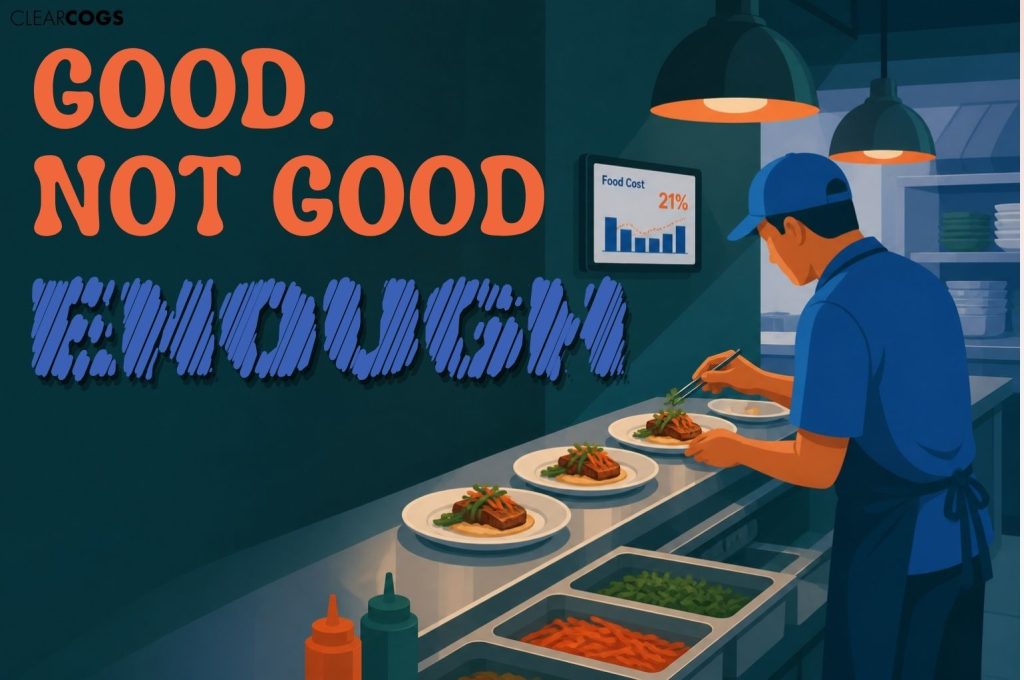



When an operator walks into a conversation about food cost optimization and says they are running 21%, the natural reaction is: what could we possibly do for you?
The average restaurant runs somewhere between 28% and 34% food cost. At 21%, you are not just below average. You are operating at a level that most of the industry considers exceptional. The recipes are dialed in. The team is disciplined. The purchasing is smart.
So why would an operator with best-in-class food cost numbers even consider a forecasting tool?
Because food cost percentage is one number. It tells you how much of your revenue goes to ingredients. It does not tell you what your team is throwing away at the end of the night. It does not tell you whether your labor is deployed efficiently against actual demand. And it does not tell you whether your scratch kitchen is prepping every day when it could be prepping every three days for items with longer shelf lives.
The operators who are already winning on food cost are the ones with the most to gain from operational intelligence. Not because they have big problems to fix, but because they have the discipline to capture gains that less organized operations would never notice.
The Waste You Cannot See
Many restaurants with strong food cost numbers do not track waste. Not because they do not care, but because the number has never been alarming enough to warrant a formal process. When food cost is running at 21%, leadership assumes waste is minimal.
That assumption may be correct in aggregate. But it hides the specifics. A prep cook who over-portions by 5% across every plate is giving away $35,000 a year in free food. A location that consistently over-preps a high-cost protein by two cases a week is burning through product that could have been ordered on the next delivery instead.
These are not crises. They do not show up in red on a P&L. But they are real money, and they are invisible without a system that tracks what was forecasted, what was prepped, what was sold, and what was left over.
For operators who have already done the hard work of getting food cost into the low 20s, adding visibility into waste is not about finding a big problem. It is about capturing the last few percentage points that separate excellent from best-in-class.
Where Forecasting Helps the Already Efficient
The typical forecasting value proposition centers on reducing food cost. Buy less. Waste less. Save money. That is true and it matters. But for operators who have already optimized purchasing and portion control, the bigger wins are in three less obvious areas.
The first is labor efficiency on prep. Scratch kitchens require significant prep labor. Sauces, dressings, marinades, and sub-recipes all need to be produced before service begins. Most scratch operations prep these items daily, which means setting up, executing, and cleaning up every single day.
If a forecasting system can predict demand two weeks out, some of those daily prep tasks can shift to batch production every two or three days. The rub that goes on a protein does not need to be made fresh every morning if the shelf life supports a larger batch produced less frequently. The labor savings are not theoretical. They show up in fewer hours, less equipment turnover, and more productive use of prep staff time.
The second is ordering precision. Even disciplined operators order based on a combination of par levels and experience. A forecasting system that knows exactly how much of each ingredient you will use over the next delivery cycle eliminates the safety buffer that most managers build into their orders. That buffer is small per item, but across a full order guide and multiple deliveries per week, it adds up to cash tied up in inventory that did not need to be on the shelf yet.
The third is consistency across locations. An operator with five locations and two experienced GMs running 21% food cost almost certainly has one or two locations running 23%. The variance is not catastrophic, but it represents the gap between the best manager’s instincts and the average manager’s habits. A forecasting system gives every location the same quality of daily guidance, narrowing that gap without requiring leadership to intervene.
Low Food Cost Does Not Mean Low Opportunity
There is a counterintuitive truth about operational optimization: the better you already are, the more precise the gains become, and the more those gains compound. An operator running 30% food cost can find big savings by fixing obvious problems. An operator running 21% has already fixed the obvious problems. Their remaining opportunity is in precision.
Precision looks like knowing that a slow Tuesday in March needs 14% less prep than a regular Tuesday. It looks like knowing that a local event will spike demand on Thursday and pulling the ordering window forward by a day to avoid a stockout. It looks like identifying that one location’s chicken usage is consistently 8% higher than the forecast, which usually means a portioning issue that can be addressed with a single training conversation.
None of these are dramatic. All of them add up. And for a scratch kitchen running five locations, a 1% improvement in efficiency across food and labor translates directly to the bottom line in a way that is hard to achieve through any other lever.
The Real Value for Disciplined Operators
Operators who have already invested in recipe development, team training, and purchasing discipline are not looking for a tool to fix their restaurant. They are looking for a tool that frees up time, reduces the cognitive load on their managers, and provides the data visibility that manual processes cannot deliver.
When a GM no longer has to calculate prep quantities in their head every morning, they spend that time on the floor. When ordering decisions are guided by a forecast instead of a par list, the cognitive overhead of managing inventory drops. When leadership can see actuals versus forecasted usage at every location without asking anyone to generate a report, accountability becomes built into the system rather than dependent on follow-up.
For the best operators, the question is not whether there is value in forecasting. It is whether they want to capture the last few points of efficiency that their current manual processes leave on the table. The answer, for operators who take pride in running a tight operation, is almost always yes.
Ready to see what precision looks like? Let’s Talk


