




Most restaurants get multiple chances to adjust throughout the day. A quick-service concept that is selling more chicken than expected can pull extra cases from the walk-in and fire up another batch. A full-service restaurant that sees a slow lunch can scale back dinner prep. The feedback loop between demand and production is measured in hours.
Commissary-based bakeries do not get that luxury.
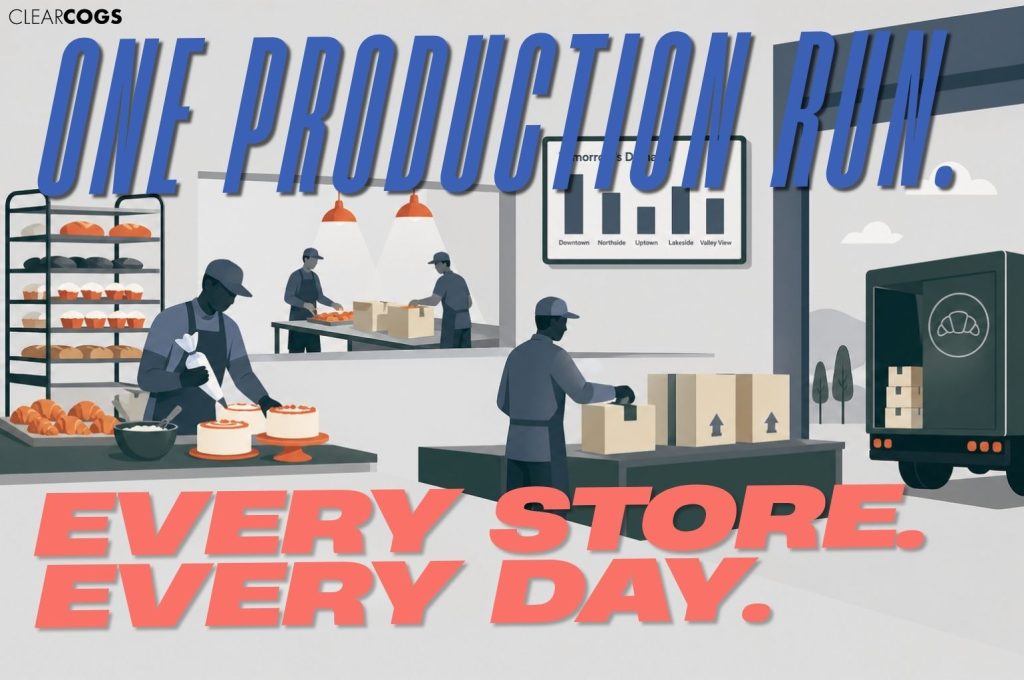
When your production facility runs two shifts to have everything finished, decorated, and packed by 9pm for overnight delivery, and your retail locations open the next morning with whatever arrived on the truck, there is no mid-course correction. What you produced last night is what you sell today. If the forecast was wrong, either the shelves are empty by 2pm or the waste bin is full at close.
That single daily production window makes forecasting the most consequential operational decision in the entire business. And for most bakery operators, it is still being done with spreadsheets.
The Spreadsheet Ceiling
The typical approach looks something like this: pull the last six weeks of sales data and look at what sold. Pull the same week from the prior year. Average the two together. Apply a product mix ratio per $1,000 of sales. Hand the resulting numbers to the production team.
It works well enough when conditions are stable. But conditions are never stable. A flagship location that was up 20% last year is suddenly down 15% this year, and nobody can pinpoint exactly why. A second location is trending in the opposite direction. A third location is about to open in a completely different market. The spreadsheet does not know any of this. It just averages.
Worse, the spreadsheet does not learn. If you only ordered 15 almond croissants last week and sold all 15, the system does not ask whether you would have sold 20 if you had them. It just locks in 15 as the baseline. Over time, chronic stockouts become invisible because the data only reflects what was available, not what the demand actually was.
GMs try to compensate by manually overriding the numbers. Some are good at it. Most are not. And the ones who are good at it cannot be replicated across every location, especially when you are adding three new stores this year and ten more in the pipeline.
The Hub-and-Spoke Amplification Effect
In a traditional restaurant, a bad forecast costs you waste at one location. In a hub-and-spoke model, a bad forecast cascades through the entire system.
The commissary produces based on aggregated forecasts from every retail location. If two locations over-forecast, the commissary produces too much. If one location under-forecasts, that store runs out while the others have surplus. The production team has no way to reallocate once items are packed and shipped.
This amplification effect means that small forecasting errors at the store level compound into significant waste or lost revenue at the system level. A 10% over-forecast across five locations does not just mean 10% more waste at each store. It means the commissary ran an extra production batch, used extra labor, consumed extra ingredients, and shipped product that will end up in the trash.
The reverse is equally painful. Under-forecasting means empty display cases, which for a bakery is a death spiral. Customers walk in, see sparse shelves, and leave. They tell themselves they will come back another time. Some of them do not. The revenue loss from a half-empty bakery case compounds far beyond the missing product.
Why Bakeries Need Self-Learning Systems
The fundamental problem with static forecasting tools is that they do not adapt. A spreadsheet that averages the last six weeks will always lag behind reality. It cannot detect that a seasonal tourism shift is pulling traffic from one location to another. It cannot account for the fact that a new competitor opened nearby, or that a local event is driving unexpected demand.
What commissary bakeries need is a forecasting system that updates its models every day based on what actually sold, at the item level, at each location. A system that does not just look at how many croissants moved last Tuesday but also considers what the weather was, what events were in town, and whether the store stocked out early, which means demand was higher than the sales data suggests.
This is the difference between a trailing average and a learning model. A trailing average tells you what happened. A learning model tells you what is likely to happen, adjusting for all the variables that your spreadsheet cannot see.
The New Location Problem
Scaling a hub-and-spoke bakery is exciting until you realize that every new store is a forecasting blank slate. You have no sales history. The market is unfamiliar. The store format might be different, maybe it is half the size of your standard footprint, or it is your first drive-through location, or it is across from a university campus with completely different traffic patterns.
Your best operations manager can probably dial in the forecast for your flagship store with her eyes closed. But she cannot be in every new location. And even if she could, her instincts are calibrated to markets she knows. A tourist town in southern Utah behaves differently from a suburban strip mall in the northern part of the state. A store near a national park responds to hotel occupancy rates, not local population density.
For high-growth bakery brands opening multiple locations per year, this is the core scaling challenge: how do you replicate your best operator’s judgment across stores they have never worked in, in markets they do not know, with GMs who are still learning the business?
The answer is a forecasting engine that does what your best operator does, learning each location’s unique demand signals, but does it systematically, across every store, every day, without needing anyone to manually crunch numbers.
Getting the Commissary Right
When store-level forecasts feed directly into commissary production planning, the entire operation tightens. The commissary knows exactly how many trays of croissants to prepare for each location. The finishing team knows what to decorate and how to pack it. The drivers know what is going on each truck.
No one is guessing. No one is overriding. The production team is not making “just in case” batches because a GM called in with a gut feeling. The system calculated the number, factoring in each location’s demand patterns, shelf life constraints, and pack sizes.
For bakeries where production happens once and delivery happens once, this precision is not a nice-to-have. It is the difference between running a profitable operation and subsidizing daily waste with yesterday’s revenue.
Ready to take the guesswork out of commissary production?


