




Every growing restaurant group eventually reaches the same crossroads. The spreadsheets are not cutting it anymore. The GMs are spending too much time calculating prep numbers. Ordering is inconsistent. Food costs swing from location to location. It is time to bring in technology.
And then the search begins for the unicorn: a single platform that does inventory management, recipe costing, sales forecasting, predictive prep, automated ordering, waste tracking, transfers between locations, and labor scheduling. All with a simple interface that a GM can use on their phone without a training manual.
That platform does not exist. And the operators who keep looking for it are delaying the improvements they could be making right now.
The Unicorn Trap
The restaurant technology market is full of platforms that promise to do everything. Back-of-house systems that claim to forecast. Forecasting tools that claim to manage inventory. Recipe management platforms that are “working on” predictive ordering. Each one does a few things well and a lot of things adequately.
Operators who have been through multiple implementations know this pattern intimately. They have used Crunch Time. They have tried Restaurant365. They have evaluated Marketman, Rosnet, and a half dozen others. The story is always the same: the platform does 60% of what they need out of the box, and the remaining 40% requires so much customization, workaround, or compromise that the implementation stalls or the tool gets abandoned.
The problem is not that these are bad platforms. Many of them are good at what they were originally built to do. The problem is trying to make a system of record do the job of a system of intelligence, or vice versa.
Two Different Jobs, Two Different Skill Sets
Inventory management is fundamentally about tracking what you have. It is a system of record. How many cases of chicken are in the walk-in? What did you receive on Tuesday’s delivery? What is your theoretical food cost versus your actual? These are accounting questions. They require accuracy, consistency, and discipline from your team.
Forecasting is fundamentally about predicting what you will need. It is a system of intelligence. How many ounces of chicken will you sell every 15 minutes tomorrow? How does weather affect your weekday lunch traffic? What happens to your prep volumes when a local event drives unexpected demand? These are data science questions. They require pattern recognition, external data integration, and continuous model refinement.
Asking one tool to do both is like asking your accountant to also be your strategist. Your accountant tells you what happened. Your strategist tells you what to do next. Both are essential. Neither is a substitute for the other.
Where Operators Actually Get Stuck
The real cost of the unicorn search is not the money spent on platform evaluations. It is the time lost. Multi-unit operators can spend six to twelve months evaluating, contracting, and implementing a comprehensive back-of-house system. During that entire window, nothing changes operationally. GMs are still guessing on prep. Ordering is still inconsistent. The problems that triggered the search in the first place continue to compound.
Meanwhile, the forecasting piece, the part that actually changes daily behavior and reduces waste, could be up and running in two to four weeks. It does not require a full system overhaul. It does not need your recipes perfectly entered into a new platform. It connects to your existing POS, ingests your recipes however they exist today, and starts delivering daily prep and ordering guidance to your GMs.
The back-of-house system implementation can happen in parallel. Or it can happen later. But the forecasting does not need to wait for it.
The Layered Approach
The operators who get the best results are the ones who stop looking for one tool that does everything and instead build a stack where each tool does one thing exceptionally well.
The recipe management platform holds your recipes, tracks your yields, and gives your team a training reference. The inventory system captures your counts, manages your invoices, and generates your actuals-versus-theoretical reporting. The forecasting engine predicts demand at the item level, generates daily prep sheets and order guides, and adjusts for weather, events, and seasonal patterns.
Each layer talks to the others, but each one does its own job. The recipe data feeds the forecasting engine. The forecasting output informs the ordering decisions. The inventory system validates the results.
This is not more complex than trying to make one platform do everything. It is actually simpler, because each tool is doing what it was designed to do instead of being stretched into functions it was never built for.
What Your GMs Actually Need
At the end of the day, the technology evaluation should start with one question: what does my GM need when they walk in the door at 5am?
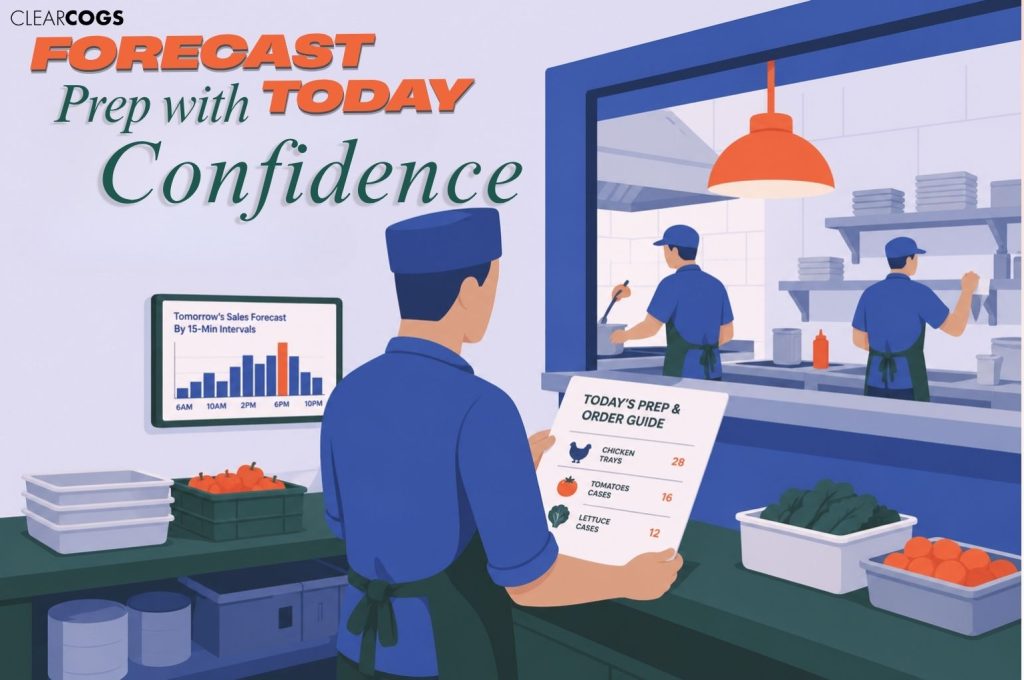
They do not need a dashboard. They do not need to log into a platform and click through reports. They need a single, clear answer: here is what to prep today, here is what to order for the next delivery, and here is what your day is going to look like.
That answer should arrive in their inbox before they arrive at the store. It should be formatted in the language they already use, in the units they already think in, matching the workflow they already follow. Trays, not ounces. Cases, not pounds. Boards, not individual units.
The technology behind that answer can be extraordinarily sophisticated. Machine learning models running 350 variations per item. Geospatial scans of local demand drivers. Weather correlation analysis down to the dew point. But the GM should never see any of that. They should see one number, trust it, and get on with running their restaurant.
That is what forecasting does. And it does it best when it is not also trying to be your inventory system, your accounting tool, and your recipe manager.
Ready to add a forecasting layer to your existing tech stack? Let’s Talk


