

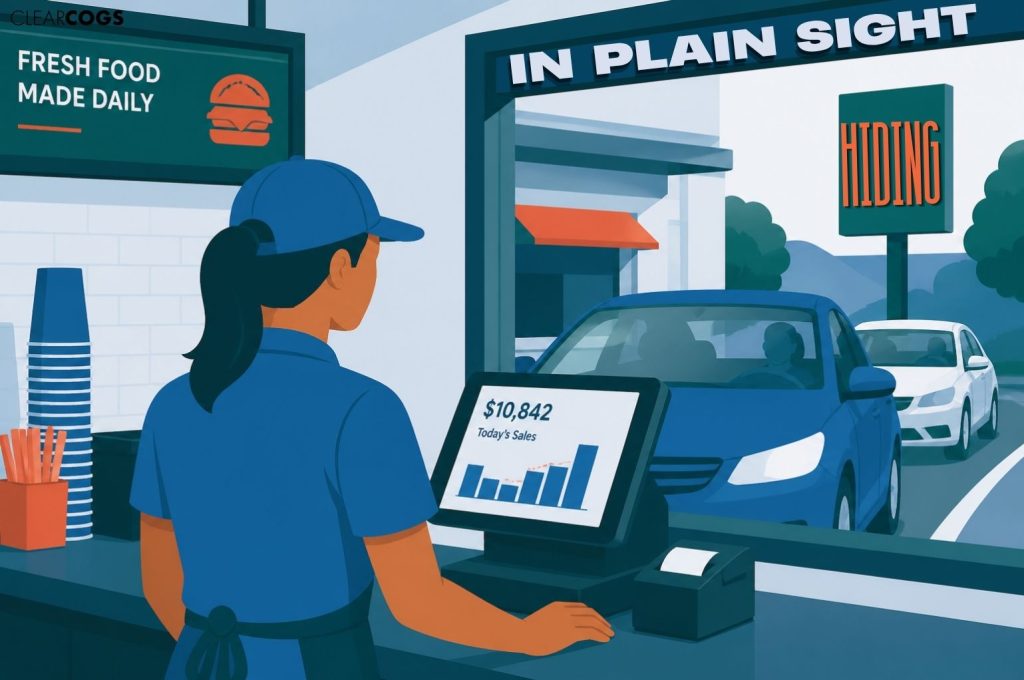



There is a saying in the restaurant industry that sales fix everything. When the top line is strong, the P&L looks healthy. Margins hold. Payroll gets covered. Nobody panics.
But sales do not fix everything. They cover everything. And there is a critical difference.
High-volume restaurants, the ones doing millions per location per year, are often the least likely to pursue operational precision tools. Their logic makes sense on the surface: we are profitable, our food cost is in range, and our managers know what they are doing. Why would we change anything?
The answer is that underneath the strong top line, there are thousands of small inefficiencies happening every week that nobody can see because the revenue absorbs them all.
The Volume Illusion
When a restaurant is doing $80,000 a week in sales, a few hundred dollars in wasted product barely moves the needle on the P&L. An extra case of beef that did not need to be ordered. A prep batch that got tossed because the forecast was off. A shift that was overstaffed by two hours during a slower-than-expected lunch.
Each one of these is invisible at the aggregate level. Food cost might still land at 30%. Labor might still hit 25%. The period financials look fine. Leadership reviews the numbers and moves on.
But multiply those small misses across 20 locations, 50 locations, 700 locations, and the math changes. A hundred dollars a day in preventable waste across hundreds of locations is not a rounding error. It is millions of dollars a year that went straight into the trash, hidden by a top line that was strong enough to absorb it.
Why Scratch Kitchens Are Especially Vulnerable
The challenge intensifies for restaurants that produce everything from scratch. When your menu is built on recipes with multiple layers of sub-recipes, prep items, and raw materials, the relationship between what you sold and what you should have used becomes extremely complex.
A four-week average of sales data does not account for the yield variance on last week’s batch of sauce. It does not capture the fact that your Tuesday prep cook portions differently than your Thursday prep cook. It does not know that a catering order for Friday threw off the normal usage patterns for three different proteins.
Scratch operations have more moving parts, more places for small variances to compound, and more difficulty tracking actuals versus theoreticals at the ingredient level. The theoretical food cost model says you should be at 28%. The actual is at 30%. That two-point gap, spread across a large system, represents real money. But because the overall number is “in range,” nobody investigates.
The Rip-and-Replace Fear
Many high-volume operators have invested years building their back-of-house systems around their specific processes. Whether it is a legacy inventory management platform, a proprietary POS configuration, or a customized reporting workflow, the operational infrastructure is deeply embedded in how the business runs.
The fear of disruption is real. These operators have seen what happens when someone tries to replace a core system. It takes 12 to 18 months. It breaks workflows. It frustrates managers. And at the end of the implementation, the new system does roughly the same thing as the old one, just with a different interface.
This fear keeps many large operators on the sidelines when it comes to operational technology. They know there are improvements to be made, but the perceived cost of change outweighs the perceived benefit of incremental gains.
What these operators often do not realize is that the most impactful operational improvements do not require replacing anything. They require layering intelligence on top of what already exists.
Layering, Not Replacing
The most effective approach for high-volume operators is to keep the existing infrastructure and add a predictive layer that enhances the decisions being made within it. The legacy inventory system stays. The POS stays. The reporting workflows stay. Nothing changes for the team on the ground.
What changes is the quality of information driving daily prep, ordering, and staffing decisions. Instead of a four-week average or a static par system, each location gets item-level forecasts that account for weather, local events, promotional calendars, and historical patterns at 15-minute granularity.
The GM still makes the final call. The district manager still reviews the schedule. The corporate team still monitors food cost by period. But every one of those touchpoints is now informed by a forecast that is orders of magnitude more accurate than what a human can produce with a spreadsheet.
The Enterprise Efficiency Frontier
For restaurant brands operating at scale, the efficiency gains from better forecasting are not just about reducing waste at individual locations. They are about closing the performance gap between your best and worst stores.
Every multi-unit operator has the same pattern: a handful of locations run exceptionally tight operations, and the rest operate somewhere between acceptable and concerning. The difference is almost always the quality of the manager making daily decisions. Your best GM is making instinctive corrections that your average GM does not even think about.
Predictive forecasting codifies that instinct. It gives every location the same quality of daily guidance, regardless of who is managing the store that day. The veteran manager still outperforms, but the floor rises. The worst-performing stores improve the most. And across a large system, raising the floor by even half a percentage point translates to substantial bottom-line impact.
The Board Is Asking
There is a reason why leadership teams at major restaurant brands are asking what their AI strategy looks like. It is not because AI is trendy. It is because the margin environment has fundamentally changed. The era of covering operational gaps with price increases is ending. Traffic is the priority now, and that means operators need to find efficiency within the four walls rather than passing costs to the guest.
For high-volume brands, the opportunity is not incremental. It is structural. The data already exists in the POS. The recipes already exist in the back-of-house system. The gap is the intelligence layer that turns that data into prescriptive daily guidance. When that layer is in place, every location operates with the same precision, every day, regardless of who is on shift.
Sales will always matter most. But the brands that stop relying on volume to mask inefficiency and start using data to eliminate it will be the ones that sustain profitability in the years ahead.
Ready to uncover what strong sales are hiding? Let’s Talk


