

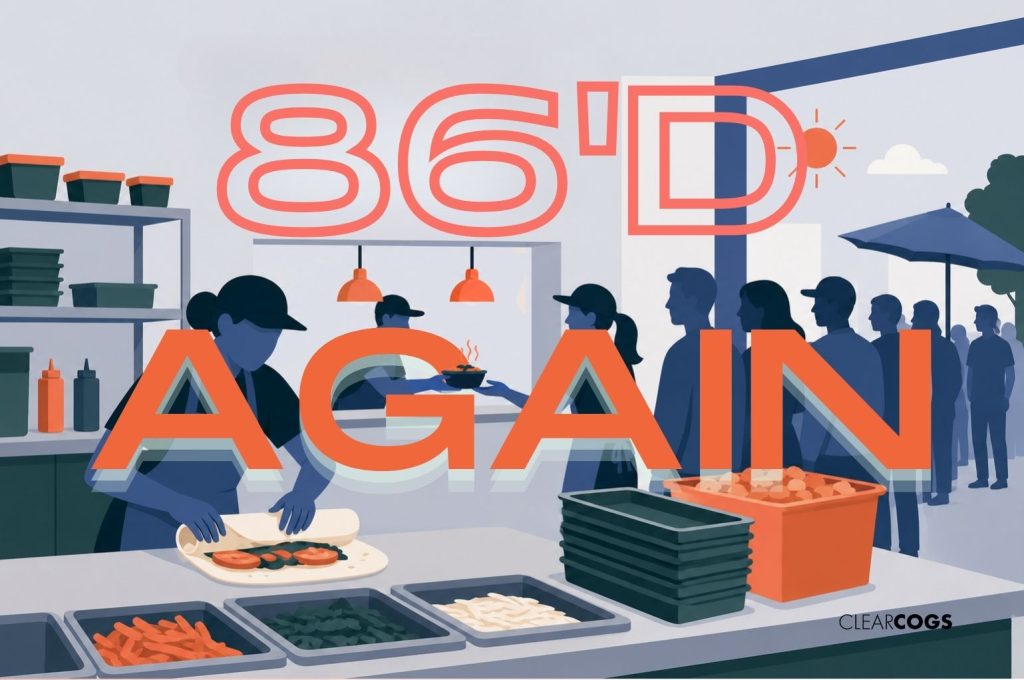



Running out of menu items during a rush isn’t just a customer service problem. It’s a forecasting problem. And for operators in growth mode, adding locations, eyeing franchising, pushing toward seven figures per unit, it’s one of the most expensive mistakes you can make without ever realizing it.
The pattern plays out the same way across concepts. A Monday rolls in, normally your slowest day. But it’s sunny and 70 degrees for the first time in weeks. Suddenly the line is out the door. The team wasn’t expecting it. They’re out of wraps before 2 p.m. Customers leave. Revenue walks out with them.
Nobody made a bad decision on purpose. The manager just didn’t have the right information.
The Under-Prep Trap
Most operators assume their biggest prep risk is waste, making too much. In reality, the more common failure at high-volume fast-casual concepts is the opposite: chronic underprepping driven by managers who underestimate what’s coming.
This isn’t negligence. It’s the natural result of prep planning without data. Managers rely on what they remember from last week, their general sense of the day, and a cautious instinct to not over-order. The result is that they prep for the day they expect rather than the day that’s actually coming.
At lower-volume locations, this gap is manageable. But as unit-level sales climb, hitting $2 million, $3 million, or more annually, the consequences compound. You’re not losing a few items on a slow afternoon. You’re losing meaningful revenue during your highest-earning hours.
What Weather Actually Does to Demand
Weather is one of the most significant and most ignored drivers of restaurant traffic. The relationship isn’t always intuitive. For some concepts, a sunny warm day drives a spike. For others, rain kills lunch but doesn’t touch dinner. Some brands do their best business when people are stuck inside.
The problem is that weather patterns are hyper-local and shift fast. A city like Vancouver can swing 20 degrees in a day. A sunny Monday can outperform a rainy Saturday by a wide margin, even though Monday is statistically your slowest day. By the time a manager feels the change in the room, the prep window has already passed.
Forecasting tools that incorporate weather data solve this by modeling the relationship between historical weather conditions and demand at the item level. The system doesn’t just know it’s going to be a nice day. It knows what a nice Monday in April has meant for your chicken patty sales over the past three years.
The Franchise Scaling Problem
Growing restaurant brands face a compounding version of this challenge. When you’re operating two or three locations, prep planning lives in the heads of your most experienced managers. It works well enough. You’ve got people who know the brand, know the neighborhood, and have seen enough seasons to have a feel for what’s coming.
Then you start scaling. You open a fourth location, a fifth. You bring on new managers who haven’t logged years on your specific corners. You start thinking about franchising. Suddenly the prep intelligence that used to live in a handful of trusted employees needs to scale across a whole organization, including operators who will never have the same pattern-recognition your veterans do.
This is where gut-feel prep becomes an operational liability. A franchisee opening their first location doesn’t have two years of seasonal data for that neighborhood. They don’t know what a spring weekend looks like on that block. They’re guessing. And guessing during your highest-volume periods is where you lose food costs, lose guest satisfaction, and lose the trust that makes a franchise brand work.
Prep Consistency as a Growth Strategy
One of the most underrated benefits of AI-powered forecasting is what it does for new locations and new managers. When prep decisions are driven by historical data, external signals like weather and local events, and machine learning models tuned to your menu, a new hire at a new location can execute prep at the same accuracy level as your most experienced GM.
That’s not a small thing. It means faster ramp time. It means less variance in food cost between your best and worst locations. It means franchisees start with a playbook that actually works instead of spending their first six months learning from expensive mistakes.
The goal isn’t to remove judgment from the operation. Good managers still make calls. But when the data is doing the heavy lifting, those calls are informed rather than intuitive.
Stockouts Are Measurable — and Preventable
One of the quietest benefits of demand forecasting is that it makes stockouts trackable. Without data, you know a rush was bad. With data, you can see exactly when sales flatlined on a high-traffic item, infer you were out, and understand how much revenue that window likely cost you.
Operators who implement forecasting consistently report that they didn’t realize how often they were 86ing items until the data showed them. The problem was always there. They just had no way to see it.
The fix isn’t more inventory or more buffer. It’s more accurate prep. Knowing that this Thursday, because of the weather forecast and the event down the street, you need 30% more of a specific item than your average suggests. That’s the number. That’s what keeps the line moving and the customers coming back.
The National Restaurant Association estimates that commercial kitchens waste 4% to 10% of the food they purchase before it ever reaches a guest. On a $1 million food budget, that’s $40,000 to $100,000 gone before a single plate hits the table. Accurate prep planning attacks that number from both sides: less over-ordering, fewer stockouts, and better margin across the board.
If your managers are making prep calls based on feel, your growth is running ahead of your data. See how ClearCOGS turns your POS history into daily prep plans that actually account for what’s coming. Let’s Talk


