

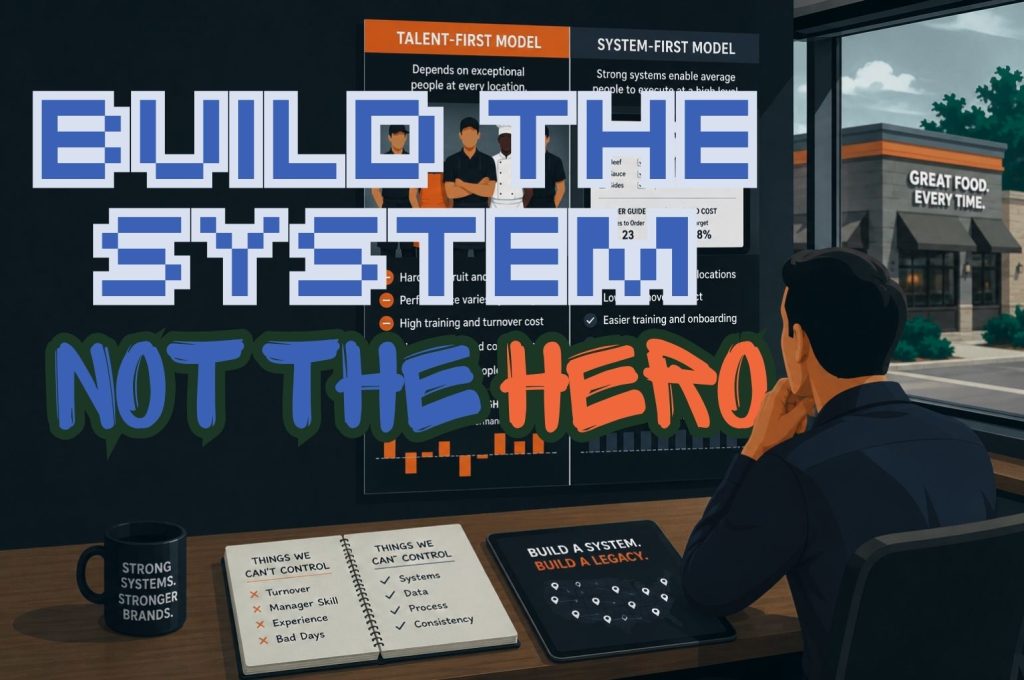



Every franchise operator eventually arrives at the same fork in the road. On one side: build a culture of exceptionally trained, highly capable people at every location who can navigate any situation through skill and judgment. On the other: build systems so reliable and simple that a good employee with solid work ethic can execute at a high level without depending on rare expertise.
Both approaches work. Neither is wrong. But only one of them scales.
The talent-first model has a hard ceiling. There are only so many exceptional operators in any given market. When a location depends on one strong general manager to make the right ordering call, run an accurate inventory, and produce the right amount of product each shift, the business is exposed every time that person leaves, gets promoted, or has a bad week. Multiply that exposure across ten, fifteen, or twenty locations and you have a system where performance varies widely depending on who happens to be working.
The system-first model has a different ceiling, a much higher one. When the platform does the thinking, the outcome does not depend on who is standing in front of it.
The Franchisee Who Cannot Afford to Be Wrong
The franchise networks where this tension matters most are not the large, well-resourced enterprise chains. They are the mid-market operators, the groups running five brands across a dozen locations, where the franchisee at the individual store level is not a career multi-unit operator with a deep bench. They are often someone who decided to leave a different industry, saw an opportunity, got the financing, and is now figuring it out.
These operators are not bad at their jobs. Many of them run profitable stores. But when the operational systems they depend on require active management and constant manual input to stay accurate, they are quietly losing ground every week. The ordering is off because someone updated the spreadsheet wrong. The prep is miscalibrated because last week’s numbers have not been refreshed. The cost of goods is creeping up and nobody can pinpoint exactly why.
When you switch a franchisee off a platform they have learned, even an imperfect one, and ask them to start over with something new, you discover quickly how much of their operational capability was actually the platform doing work they did not know it was doing. The transition exposes a dependency they did not know they had.
This is why choosing operational technology in a franchise network is not just a features conversation. It is a question of what the system does for the franchisee independently of their involvement.
Managed Service vs. Self-Service
The distinction that separates useful restaurant technology from technology that sits unused is not the sophistication of the algorithm. It is how much work the operator has to do to get value out of it.
Enterprise back-of-house platforms are powerful. They can manage cost of goods, theoretical inventory, labor, scheduling, accounting, and supplier relationships across hundreds of locations simultaneously. For an organization with a dedicated team to configure and maintain them, they deliver enormous value.
For a franchisee running one or two locations without a back-office team, those same platforms become a burden. Every new menu item needs to be mapped. Every supplier price change needs to be entered manually. Every location has to keep its data current or the outputs become unreliable. And when the outputs become unreliable, operators stop trusting them. When operators stop trusting them, they stop using them. When they stop using them, the platform becomes an expensive line item that produces no operational benefit.
A managed service model flips this dynamic. The operator does not maintain the system. The system is maintained for them. The prep number arrives each day without anyone having to generate it. The forecast adjusts as conditions change without anyone having to update a configuration. The manager’s job is to act on the guidance, not to produce it.
For a franchise network where the average unit operator is not a technology enthusiast with spare time, this is the difference between a tool that gets used and one that gets ignored.
The Case Study You Can Take to Your Partners
One of the more underappreciated advantages of starting a technology pilot at a single location is what it produces beyond the data. Done well, a single-location pilot creates an internal case study that carries more weight with skeptical stakeholders than any vendor pitch.
When a franchisee who invested their own money tests a system at their own store and comes back with numbers showing reduced waste, fewer emergency supply runs, and lower cost of goods, that testimony is credible in a way that external evidence simply is not. They had the same concerns everyone else has. They ran it anyway. They saw what happened.
For franchise networks stuck in the limbo of a technology commitment that has not delivered and a leadership team that is reluctant to formally abandon it, the single-location pilot is often the cleanest path forward. It does not require anyone to declare a previous decision a failure. It just asks one store to show what is possible.
If the results are there, the conversation changes on its own.
The best systems do not require exceptional people to get exceptional results. Let’s Talk


