

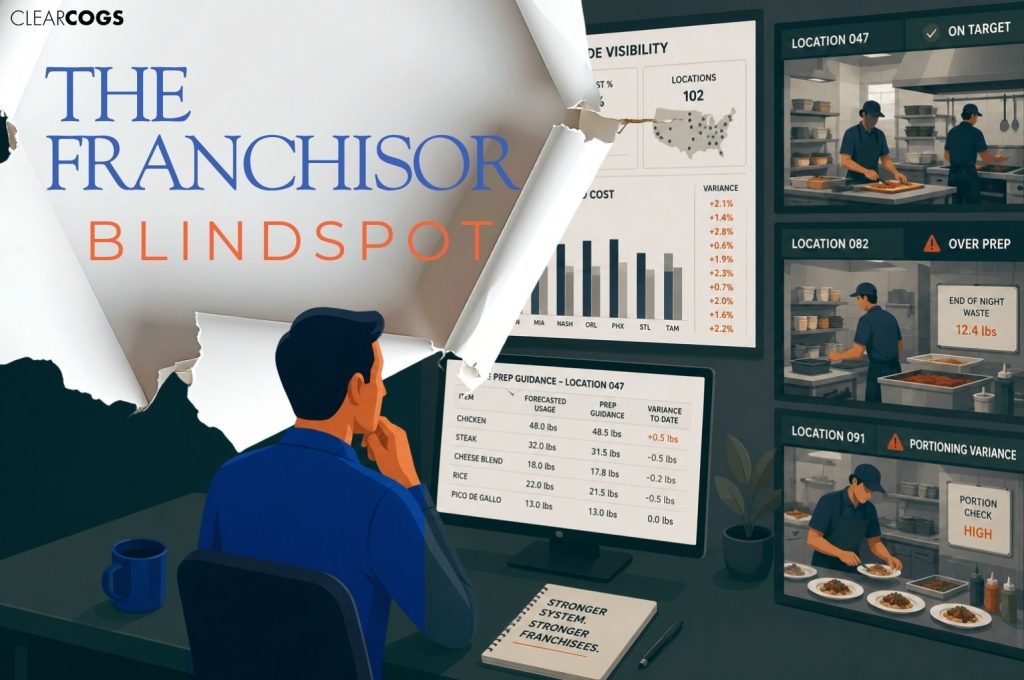



There is a gap at the center of most franchise relationships that both parties understand but rarely address directly. The franchisor knows what each location sells. They can pull POS data, see transaction counts, track check averages, and monitor sales against plan. What they cannot see is what happens inside the four walls between the delivery truck and the plate.
They do not know how much protein was cut incorrectly and discarded. They do not know whether the prep team ran out of chicken at 7pm on a Saturday or made twice as much as they needed and threw away the excess. They do not know whether the cheese blend was portioned consistently or whether one shift runs heavy and another runs light. They see the revenue number. They do not see what it cost to produce it.
For franchisees, that blind spot is a direct financial exposure. For franchisors who care about system-wide performance, it is a visibility problem with real consequences.
Why Prep Consistency Is a Franchise Problem, Not Just a Kitchen Problem
Most franchise systems invest heavily in standardizing the guest experience. Portion sizes are specified. Recipes are written. Training programs exist to ensure a franchisee in Tampa produces the same product as one in Denver. The standards are there. The enforcement is inconsistent, because enforcing standards you cannot measure is essentially guesswork.
Consider what happens in a high-prep concept where multiple proteins, batch sauces, and formatted components need to be ready before service. The recipe says the protein should be cut to a specific size. If it is cut too large, fewer portions come out of the same amount of product, and food cost rises. If it is cut too small, the guest experience suffers and yield still suffers. Both outcomes are expensive. Neither is visible to the franchisor from sales data alone.
The same problem exists for any batch-prepped component with a specific shelf life. Cheese blends made too far in advance degrade in quality. Sauces prepared in quantities larger than demand require are thrown away at close. These are daily decisions made by people who often have no data-driven guidance to reference. They use experience, instinct, and par sheets that were set at some point in the past and may or may not reflect current demand patterns.
This is where the gap between what the franchisor can see and what the franchisee actually experiences widens. Corporate can track sales. They cannot track the prep decisions that drive the gap between theoretical and actual food cost.
The Actual Versus Theoretical Problem
The most financially meaningful number a franchisor can give a franchisee is not their food cost percentage. It is the variance between their actual food cost and their theoretical food cost.
Theoretical food cost is what a location should have spent given what it sold. If a location sold 100 orders of a dish that theoretically requires four ounces of protein each, they should have used 25 pounds of protein. If they used 30 pounds, the gap is five pounds. That gap represents waste, portioning inconsistency, training failures, over-prep, theft, or some combination of all of them.
Most franchise systems can generate theoretical food cost from their recipe data. Most franchise systems cannot easily compare it against actual usage at individual locations on a daily or weekly basis. And even when they can generate that comparison, the data is often stale, incomplete, or so labor-intensive to produce that nobody is looking at it in time to do anything about it.
Predictive forecasting changes this in a specific way. When a system knows in advance what a location is going to sell, it can generate not just a prep list but a usage expectation. If the location was forecasted to use 25 pounds of protein and a manager reports using 30, that variance is identifiable the same day. Not at the monthly P&L review. Not at the quarterly operations meeting. The day it happens, when something can still be done about it.
Why This Matters More at Scale
For a single-location franchisee, the cost of untracked waste is painful but manageable. They see it in their own P&L. They feel it.
For a franchisor overseeing dozens or hundreds of locations, the cost is invisible at the individual level and enormous in aggregate. A network of a hundred locations each wasting two percent more than their theoretical food cost generates a royalty stream based on inflated costs and a franchisee base that underperforms what the system should be capable of producing. Franchisees who struggle financially close early, reduce their marketing budgets, defer maintenance, and eventually become problems for the system rather than contributors to it.
The franchisor’s interest in franchisee profitability is not abstract. It is structural. A system full of profitable franchisees is a growing system. A system full of franchisees fighting thin margins is a shrinking one.
What Visibility Actually Looks Like
The shift from guessing to knowing at the location level requires two things: accurate forecasting of what a location will sell, and a prep guidance system that translates that forecast into specific daily quantities for every prepped item.
When a location has that guidance, it stops defaulting to safety margins that result in end-of-night waste. It stops relying on managers who have the right instincts to protect profitability and starts building a system where any manager, regardless of experience level, has the information they need to make the right prep decision.
For franchisors, the downstream benefit is real-time visibility into whether locations are following that guidance and how accurately their prep is aligning with predicted demand. That is the actual versus theoretical comparison that financial reporting cannot currently provide.
The gap between what franchisors can see and what is actually happening in their kitchens is not a technology limitation anymore. It is a choice about whether to close it.
Interested in what actual versus theoretical visibility looks like across your locations? Let’s Talk


