

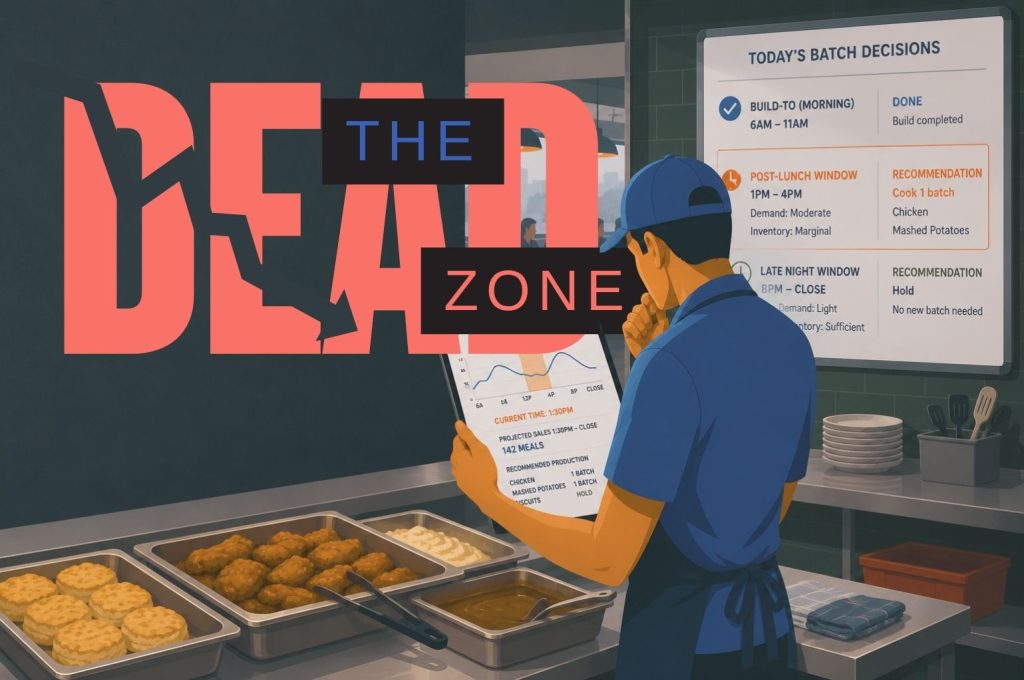



Most operators who have been in the business long enough eventually get their morning prep dialed in. They pull the historical mix, set a build-to number by day of week, and walk in every morning knowing approximately how much of each item they need to get through the lunch rush. The number is not perfect, but it is close enough. It works.
The harder problem is not the opening build-to. It is everything that comes after it.
The Dead Zone Problem
For high-prep concepts that run multiple batch cycles throughout the day, there are predictable windows where the operational uncertainty is highest. The post-lunch lull is the most common. Demand drops off after 1pm. The team has worked through the morning batch. The question of whether to start another cycle for dinner, and how much to make, hangs in the air.
If the answer is too conservative, the dinner rush starts and they run out at 5:30pm. Customers are there, the sales are there, but the product is not. The decision becomes whether to throw on another batch when it is already late, knowing it will come out of the oven or fryer right as volume is tapering off.
If the answer is too aggressive, the batch runs long, the product sits, and the end of night results in waste on items that have no viable carry-over. Gravy, mashed potatoes, fresh rolls. Items made that day with a shelf life of that shift. They go in the trash.
The same calculation plays out again near close. At 8pm, with an hour or two left of service, the question of whether to start another batch is almost entirely a judgment call. If the forecast says traffic drops off after 8 and there is enough product to cover, the answer is obvious. But most operators do not have a forecast that granular. They have experience and instinct, which is valuable but inconsistent.
Why the Build-To Number Is Not Enough
The build-to system is a good approach to a genuinely hard problem. A strong operator sets it based on real data, adjusts it seasonally, and reviews it periodically when sales patterns shift. At its best, it represents accumulated operational wisdom in spreadsheet form.
But it is a single number for the whole day or for a broad segment of the day. It does not account for what is actually going to happen on a given Tuesday in March when there is a nearby event pulling traffic earlier than usual, or a slow Monday following a long weekend that cuts the lunch rush shorter than the historical average suggests.
More importantly, it cannot answer the batch-by-batch question. It tells a team how much to have on hand at open. It does not tell them how much to fire at 2pm or whether to start that last batch at 8:15. Those decisions are made by whoever is in the building at the time, based on their read of the afternoon and their best guess about the evening.
For concepts where every batch cycle involves protein that cannot carry to the next day, or sides with a same-day shelf life, each of those batch decisions is a separate wager. Fire too much and it is waste. Fire too little and it is lost sales. The margin for error is narrow in both directions.
The Window Problem in Practice
There is a specific pattern that experienced multi-batch operators know well: the soft period that falls between the end of lunch service and the start of the dinner window. For many concepts this is roughly 1pm to 4pm. Traffic is light. Volume is unpredictable. The team is tired from the morning push.
This window is where the most avoidable waste happens and where the most avoidable stockouts happen. Not because operators are not paying attention. Because there is genuinely not enough information to make confident batch decisions in real time.
The 8pm to close window is its own version of the same problem. Operators who run late service know that the last hour is impossible to call from experience alone. Some nights it stays busy. Most nights it tapers. But the specific night matters, and the pattern changes week to week.
Getting these windows right requires knowing the shape of demand for each specific day, not just the average. Average demand on a Tuesday tells you how to set your build-to. Actual predicted demand for this Tuesday, accounting for weather, local events, and recent traffic trends at the specific location, tells you whether to fire that last batch.
The Translation from Forecast to Action
The argument for data-driven forecasting in high-prep restaurant concepts is not that algorithms should replace the judgment of experienced operators. It is that the decisions that fall outside the morning build-to are being made on instinct when they do not have to be.
A forecasting system that can tell a manager, at 1:30pm, roughly how much of each item the location will move between now and the end of service, and whether the current inventory covers that demand, gives that manager something actionable. Not a dashboard to study. Not a report to interpret. A number: you need one more batch of this, you do not need any more of that.
The morning build-to already represents years of pattern recognition built into a system. The intraday and end-of-day decisions deserve the same treatment. The data is there. The demand history exists in the POS. The only question is whether someone has turned that history into guidance that updates throughout the day rather than only setting the table in the morning.
For concepts where the last batch of the day is either a revenue decision or a waste decision, and that call is being made at 8pm by whoever happens to be managing that shift, the cost of getting it wrong adds up faster than most operators realize.
Want to see what intraday batch guidance looks like in practice? Let’s Talk


