

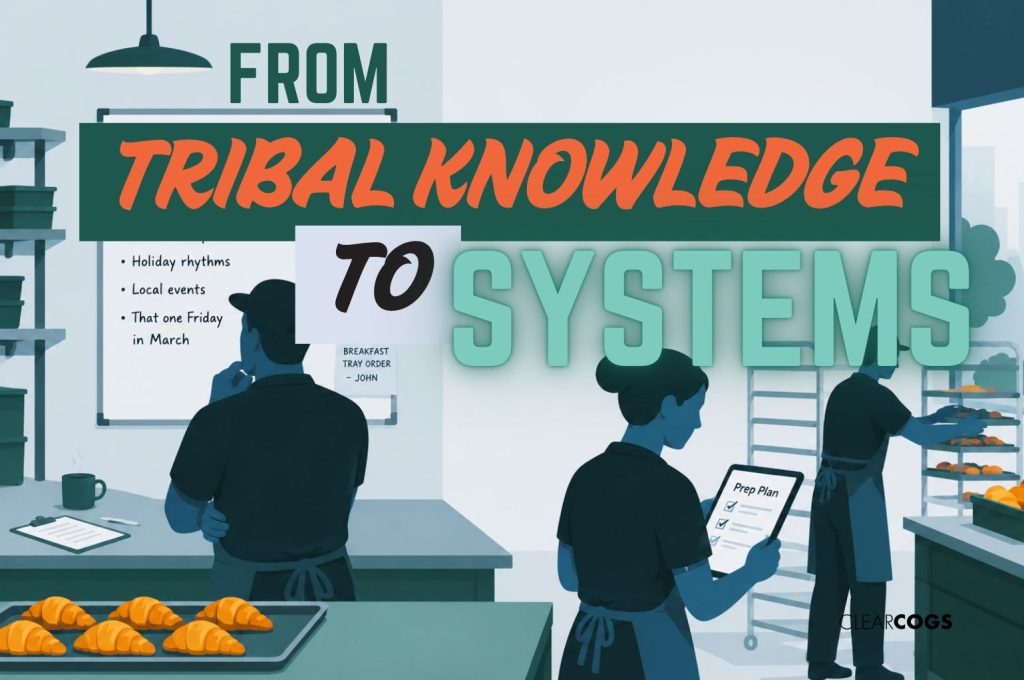



There is a particular kind of confidence that comes from running a tight operation for a long time. The general manager has been with you for over a decade. They know the rhythm of the week, the difference between a slow Tuesday in January and a slow Tuesday in March, the way foot traffic shifts when school starts. They have made thousands of prep calls and gotten most of them right.
That experience is genuinely valuable. The problem is that it lives in one person’s head, and when that person is not there, the operation is flying blind.
This is the hidden vulnerability inside some of the best-run restaurants in the industry. The more experienced the team, the more the operation depends on that experience being present and correct every single day. And the days when it is not, whether the veteran calls out sick, makes a rare miscalculation, or eventually moves on entirely, are the days when the gaps in the system become expensive.
The Catering Blind Spot
For bakery operations, the problem compounds in a specific way that does not show up in most reporting. Walk-in retail sales flow through the POS. They create a record. They feed the historical data that an experienced manager uses to make tomorrow’s production call.
Catering orders often do not. When a customer calls the night before for 60 bagels delivered at 8 a.m., when a regular places a standing weekly order over text, when a phone order comes in for a breakfast tray and gets pulled from the case without being rung in at the item level, that demand disappears from the data. The POS never saw it. The manager knows to account for it because they remember the order. But the record does not exist.
Over time, this creates a picture of demand that is systematically incomplete. When catering volume is steady, an experienced manager can compensate from memory. But as catering grows as a channel, and for most bakery operators it is growing, the gap between what the data shows and what the operation actually needs widens. The manager is no longer supplementing the data. They are replacing it.
The Cost of Getting It Wrong
The financial impact of this dynamic lands on both ends of the production decision. Over-produce and you carry the ingredient cost of every unsold unit plus the labor cost of the prep time that produced it. Under-produce and you disappoint a catering customer who had a meeting, an event, or a breakfast that depended on you.
Neither outcome is dramatic on any given day. A bag of unsold product at close feels like a minor loss. A shortage that required a last-minute substitute feels like a recoverable situation. But repeated across every day, at every location, with a catering channel that is not fully captured in the data, the cumulative impact on margin and customer reliability is significant.
The risk is especially acute when locations operate somewhat independently. Two stores with the same brand, the same menu, and similar volume can produce very different results when one has a veteran manager and one does not. The variance is not a staffing problem. It is a systems problem disguised as a staffing problem. And when that veteran manager eventually leaves, the institutional knowledge they carried walks out with them, leaving the replacement to guess at the patterns it took years to learn.
What Changes When the Forecast Is Centralized
The move from experience-based production to forecast-based production does not eliminate the manager’s role. It changes it. Instead of carrying the full burden of demand estimation, the manager receives a daily prep number that reflects actual projected demand across every channel including catering orders that have been logged, historical walk-in patterns, and day-of-week trends specific to that location.
The number is not asking the manager to override their judgment. It is giving them a reliable starting point that does not depend entirely on their memory, their current workload, or whether they happened to remember that last week’s Thursday order included an extra two dozen sesame.
For multi-location bakery operators, this matters beyond the operational efficiency argument. It means the two-location operation does not have one strong store and one vulnerable one. It means the training curve for a new manager does not require months of shadowing before they can make confident production calls. It means the operation can grow without the growth being constrained by the availability of people who have been doing it long enough to carry the institutional knowledge it requires.
The Veteran Is Still the Asset
None of this diminishes what a long-tenured, experienced kitchen leader brings to an operation. Their knowledge of the product, the customer base, the seasonal rhythms, and the staff is irreplaceable in important ways. The point is not to replace that knowledge with a number. The point is to make the operation less dependent on the continuous presence of any one person to function at its best.
A system that captures demand accurately, accounts for every channel, and delivers a daily production target frees the veteran manager to do the parts of the job that genuinely require their experience. Managing the team. Maintaining quality standards. Handling the unexpected. Building the customer relationships that keep catering orders coming back.
The prep count is the least interesting thing they should be spending their time on. And it is often where the most time goes.
Ready to reduce your operation’s dependency on tribal knowledge? Let’s Talk


