

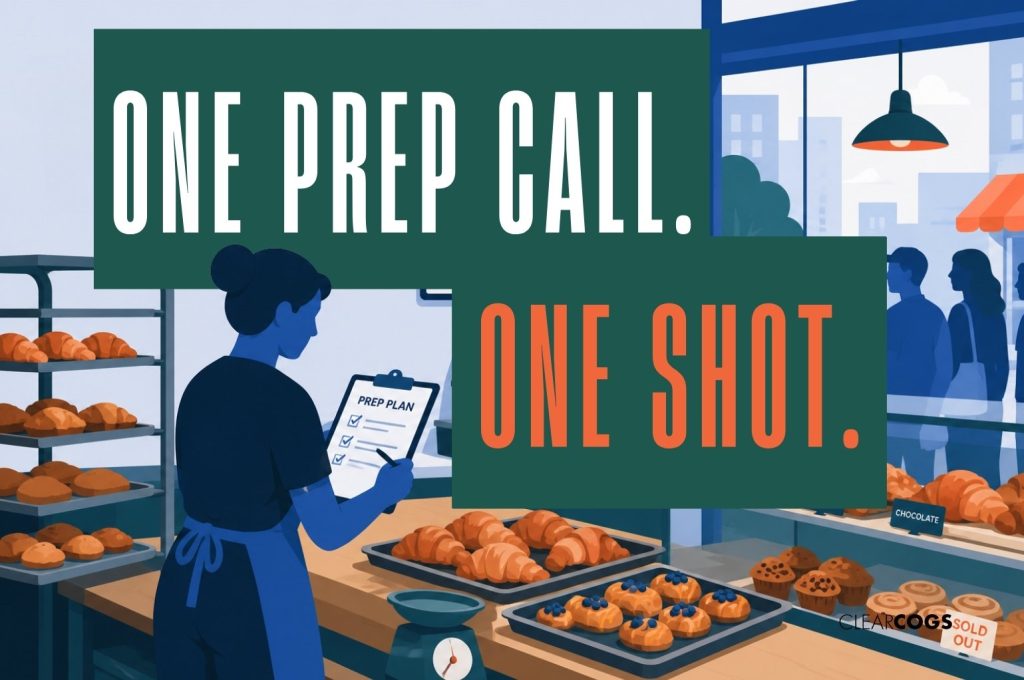



Most restaurants get to adjust during service. If lunch is running hotter than expected, a kitchen can fire more product. If the dinner rush fizzles, waste gets managed at the end of the night. The feedback loop, while imperfect, at least closes during the shift.
Bakeries and morning-prep operations don’t have that luxury. If you make 40 croissants and sell out at 10 a.m., you’re done. If you make 120 and close with 80 unsold, you’ve absorbed the loss. There’s no in-service correction. The decision you made the night before, or the morning before opening, is the decision you live with all day.
This makes accurate forecasting more valuable for morning-prep operations than for almost any other restaurant format. It also makes bad forecasting more expensive.
When Running Out Is the Worst Outcome
For many restaurant concepts, a stockout is a bad moment in a recoverable shift. For a bakery or breakfast-first concept, it’s a brand-defining failure. Guests who drive across town for a specific pastry and find it gone at 9:30 a.m. don’t quietly adjust their order. They leave. They don’t come back the next day. And they remember.
This shapes the prep psychology in bakery operations in a way that’s different from other formats. Teams tend to overbuild to avoid the embarrassment and revenue loss of running out early. The result is predictable: consistent end-of-day waste on slower items, unpredictable sellouts on high-demand days, and a constant underlying anxiety about whether the numbers will work out.
The underlying problem isn’t discipline or effort. It’s that prepping to a conservative average is the only rational response when you don’t have a better number.
According to industry analysis of bakery operations, in a well-managed bakery over 95% of products are sold by end of day, but the remaining 3-5% that goes unsold is primarily attributed to poor demand forecasting or unforeseen factors like bad weather. That gap sounds small until you’re running 600 to 1,000 items daily and every unsold unit is a sunk production cost with no recovery window.
The Complexity of LTOs in a Once-a-Day Model
Limited-time offerings add another layer of difficulty to morning-prep operations. In a standard restaurant, a new item gets introduced and the kitchen adjusts quantities over a few service cycles. In a bakery format, you may be producing a new pastry for the first time with no prior sales history and a full production commitment before doors open.
This creates real risk on both sides. A new passion fruit blueberry croissant might cannibalize demand from your standard cheese croissant. Or it might attract a new customer entirely. You won’t know until you’ve already committed to your batch sizes.
Data-driven forecasting addresses this by treating new items as members of a category family. When a new pastry launches, the system analyzes its characteristics, similar items, ingredient overlaps, positioning on the menu, and uses existing sales patterns to generate a starting estimate. Within the first week or two of sales data, the model normalizes and starts producing accurate figures.
The same system can track whether a new LTO is pulling volume from an existing item or growing the category. That kind of cannibalization visibility is especially useful for operations that rotate seasonal offerings regularly, where understanding product mix dynamics directly affects both baking decisions and menu strategy.
Stockout Detection Without a Counting System
One of the underappreciated capabilities of demand forecasting in once-a-day operations is retroactive stockout detection. Without an inventory counting system, operators often know intuitively that they ran out of something, but can’t quantify it precisely or identify the pattern over time.
Forecasting systems can infer stockouts by watching for the characteristic sales flatline: an item selling at a normal velocity that suddenly drops to zero while overall traffic remains strong. When this pattern repeats across multiple days and correlates with historically high-volume periods, the signal is clear. You’re running out before demand is exhausted.
This gives operators something they rarely have: visibility into the revenue cost of chronic underproduction. It’s not just “we ran out of the almond croissant again.” It’s a specific pattern, tied to specific conditions, with an estimated revenue impact. That’s the kind of information that changes prep behavior.
Scaling Across Multiple Concepts
Multi-brand restaurant groups operating bakery concepts face a distinct version of this challenge. Each concept has its own prep rhythm, its own customer base, its own seasonality. A savory-forward bakery concept in a tourist-heavy neighborhood will have a completely different demand profile than a traditional pastry shop in a residential area, even if both are running the same general model.
Forecasting at this level requires location-specific analysis, not just brand-level averages. The data signals that matter for a high-traffic tourist location, hotel occupancy rates, weekend foot traffic patterns, seasonal tourism curves, are completely different from what drives a neighborhood bakery. Enterprise-level operators need their forecasting infrastructure to understand those distinctions and apply them per location.
The good news is that this kind of granular, location-aware forecasting is exactly what machine learning models are built for. Each location gets its own model, trained on its own history, calibrated to its own external signals. The prep guide that arrives each morning reflects that location’s reality, not a blended average from across the portfolio.
One Chance to Get It Right
The thing that makes morning-prep operations so demanding is also what makes them so rewarding to optimize. When the prep is right, when the numbers coming out of the oven match what the day actually needs, the operation runs cleanly. Waste is low, sellouts are rare, and the team starts the day with confidence instead of anxiety.
Getting there isn’t about guessing better. It’s about having a better number to start from.
If your team is making morning prep calls without a data-driven baseline, the cost shows up in waste and in empty cases. See how ClearCOGS forecasts prep at the item level for bakery and morning-prep operations. Let’s Talk


