




By Matt Wampler, CEO of ClearCOGS
The forecasting problem in a rotisserie chicken concept is not how many birds to cook today.
It is how many to have ready in each 45-minute window across the service day, and most forecasting tools were not built to answer that question.
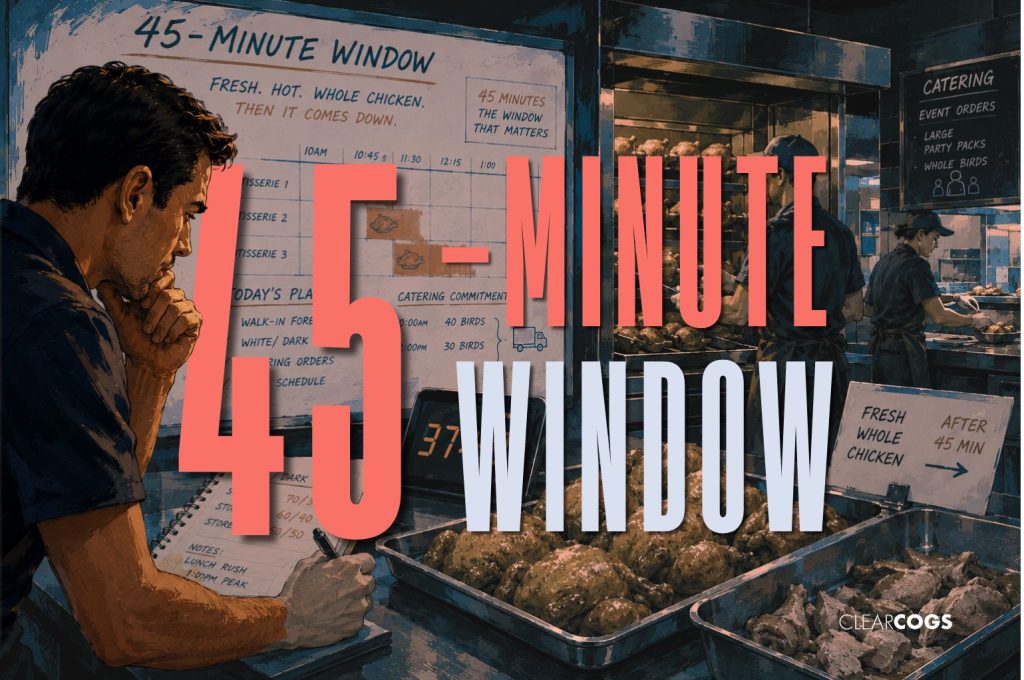
The moment a bird comes off the rotisserie, the clock runs. Forty-five minutes later, it is still whole chicken: the hero product, priced accordingly, served the way the concept was designed. After that window closes, it gets pulled. Different product, different price point, different customer. That is not a quality standard buried in an operations manual. It is the business model. Every prep decision, every load time, every ordering call placed the night before exists to protect the moments when the right number of birds are available at the right point in service.
That defining constraint changes what “accurate forecasting” even means for this kind of operation.
Why the Standard Method Falls Short
Most multi-unit operators use some version of the same approach. They pull the last few weeks of sales, adjust for day of week and obvious seasonal factors, and build a number. It is a reasonable method for most restaurant products.
For a protein with a hard 45-minute quality window, it is not enough.
A four-week moving average cannot tell a kitchen manager that this particular Friday lunch will skew heavily toward white meat based on the customer demographics around that location. It cannot account for a catering order going out at 10am that consumed most of the morning production capacity before the lunch rush starts. It does not know that last Father’s Day, one location ran out of birds at 4pm and had to turn guests away.
These are not edge cases. They are the daily operating reality in a concept where the hero product is on a clock from the moment it leaves the oven. They require a level of demand precision that a blunt historical average simply cannot deliver.
The White Meat Problem Is a Product Mix Problem
Every whole chicken produces white meat and dark meat. The customer does not always want both. And the split varies significantly by location.
In some markets, demand skews so heavily toward white meat that kitchens end up with a dark meat surplus almost every service. That excess does not disappear. It gets pulled and repurposed, which is a reasonable secondary outcome until it becomes a structural one. When a location systematically over-produces whole birds just to keep white meat available, the kitchen has essentially baked daily waste into the forecast every time it loads the oven.
The cleaner solution is a forecast that estimates the white-to-dark split at the location level, updated daily, factored into how many birds go on the spit and when. Not a total volume number for the day, but a product-mix estimate specific enough to tell the kitchen how to load for each segment of service.
That kind of forecast requires a model that understands location-level demand patterns and time-of-day behavior, not just aggregate weekly sales.
Catering Is a First-Class Input, Not an Afterthought
In a rotisserie concept with a meaningful catering business, a significant volume of production may be committed before the dining room opens. Those birds are already spoken for. They are on a timeline. And in many operations, the catering orders were placed days or weeks earlier through a channel that is not connected to the same system generating the daily prep plan.
The result: a kitchen running at full capacity since 7am to fill catering, with a lunch forecast built as though that capacity were still available. By the time the dining room fills up, the margin for error is much narrower than the prep number suggested.
Treating catering as a first-class input means building the morning production plan with commitments already factored in. The kitchen knows from the start of the shift how much capacity is reserved for catering, how much remains for walk-in demand, and when to start loading for lunch. That requires clean data flow between the ordering channel and the forecasting system. Most operations are still working toward it. The gap shows up every time a heavy catering morning rolls into an underprepared lunch rush.
What Precision Actually Requires
The fast-food chicken segment in the United States generates roughly $63.7 billion in annual revenue, according to a 2025 industry analysis by MMCG Invest. The operators competing in that market are not separated primarily by concept or product quality. The chicken is good across the board. The separation happens in execution: consistently delivering the product at the right temperature, at the right moment, without making the guest wait longer than they should.
In a rotisserie concept, that execution lives inside the 45-minute window. Getting it right, shift after shift, requires a forecasting system that works at the hourly level rather than the daily level, accounts for product mix at the location level, treats catering as a committed input from the start of the day, and delivers a number the kitchen can act on before service begins.
That is a more demanding specification than a moving average. It is also the only specification that actually matches the constraint of the business.
The Constraint Is the Map
A rotisserie concept has one defining operational truth: every meaningful prep decision is an answer to a 45-minute question. The operators who run these concepts well have already internalized that. They develop intuition for load timing, white-to-dark ratios, and how a heavy catering morning changes the day. That knowledge is real and it matters.
The question is whether the system underneath them can carry that knowledge consistently, even when the experienced manager is stretched, the new hire is running the line, or the holiday weekend looks different from the one on file.
The most useful technology for this kind of concept does not replace the experienced operator. It gives them a starting point specific enough to trust, one that already accounts for location mix, hour of day, catering weight, and historical product split. What comes after that, the adjustments based on what the system cannot see, is still the manager’s job. The difference is that they are spending five minutes confirming a number rather than thirty minutes building one.
That shift is not about tools for their own sake. It is about protecting the thing the whole operation was designed to protect.
Sources
- MMCG Invest. Fast-Food Chicken Industry 2025: Chain Expansion, Market Share and Competitive Analysis. December 2025, updated March 2026. mmcginvest.com


