

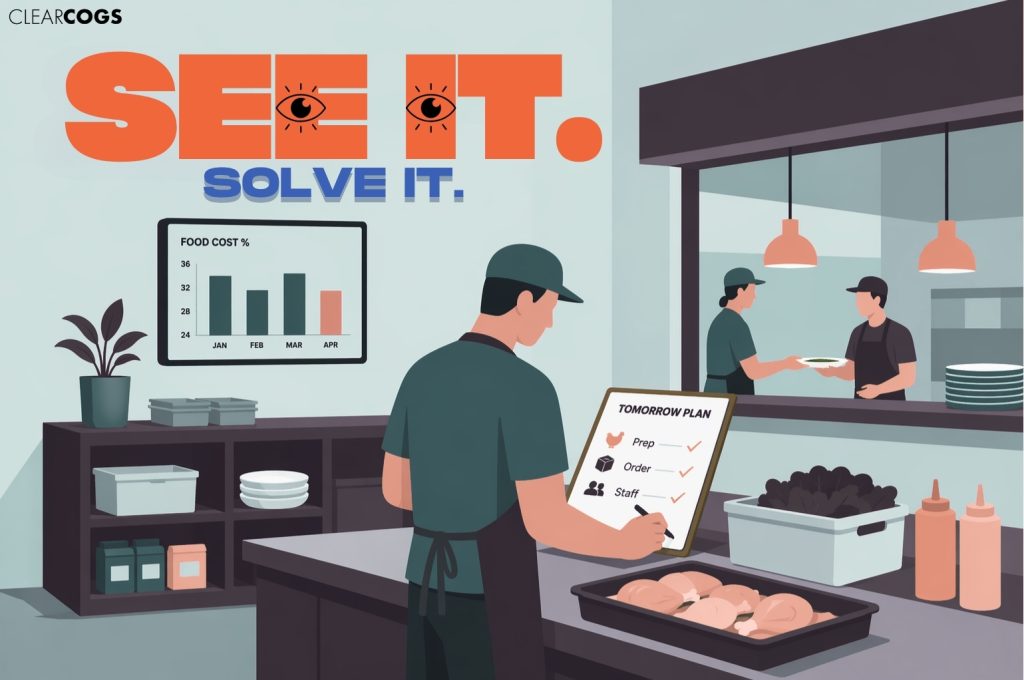



There is a moment in every growing restaurant group’s journey that feels like a breakthrough. The books are finally clean. The P&Ls are firing on time. Period financials arrive when they are supposed to. For the first time, leadership can actually see what is happening across locations.
Food cost is running high at three stores. Labor is inconsistent in the suburbs. Waste is creeping up on weekends. The numbers are right there in black and white.
And then nothing changes.
Not because nobody cares. Not because the team is incompetent. But because knowing where the problem is and knowing what to do about it tomorrow morning are two completely different capabilities. One is visibility. The other is action. Most restaurant groups get stuck in the gap between them.
The Visibility Milestone
Getting to clean, trustworthy financials is hard-won. For multi-unit operators, it means standardizing how every location closes out shifts, how expense management flows through the system, and how accounting and operations coordinate around a shared platform. It means training and retraining managers on processes that feel tedious but make everything downstream possible.
Operators who reach this milestone deserve credit. Plenty never get there. They operate on lagging data, inconsistent reporting, and gut-feel decisions that compound into margin erosion they cannot even quantify.
But here is what the milestone does not do: it does not tell your kitchen manager how many cases of chicken to prep on Wednesday. It does not tell your GM whether to cut a labor shift on a slow Tuesday. It does not close the gap between your theoretical food cost and your actual food cost.
Financial visibility is retrospective by nature. It tells you what happened. It does not tell you what to do next.
The Most Expensive Gap in Restaurant Operations
The gap between “I can see the problem” and “I know what to do about it” costs more than most operators realize. And it shows up in the same places every time.
Consider food cost. A clean P&L shows you that food cost ran 32% last period when your target was 29%. That is useful. But the 3-point variance is the result of hundreds of daily decisions made by kitchen managers across your locations over the past four weeks. How much to prep. When to order. Whether to run a special. Whether to 86 an item or push through with what is on hand.
By the time you see the number, the decisions that created it are weeks old. You can coach around it. You can have the GM meeting. You can review menu item profitability. All of that matters. But none of it changes what your prep cook does at 6am tomorrow.
The same pattern plays out with labor. A period-end report shows labor running at 33% instead of 30%. But the overstaffing happened shift by shift, day by day, across locations with different peak patterns. A historical report cannot retroactively fix a schedule that was built on a template instead of a forecast.
Why Coaching Alone Does Not Close the Gap
Many operators try to bridge visibility and action through management coaching. The logic makes sense: give managers better data, teach them to read it, and they will make better decisions.
This works to a point. Motivated, analytically inclined managers will study the numbers, adjust their prep, tighten their ordering, and dial in their labor. Those managers are also the ones who were probably already performing well.
The managers who need the most help, the ones driving the variance you see in the financials, are often the ones least equipped to translate a P&L into a different morning routine. They are not bad managers. They are busy managers running on instinct and habit, and a monthly financial review does not rewire daily behavior.
The missing piece is not more data. It is prescriptive daily guidance that tells each location exactly what to prep, what to order, and how to staff, generated automatically from the data already flowing through their systems.
From Reporting to Prescribing
The evolution from visibility to action follows a clear sequence. First, you get the accounting right. You build trustworthy financials. You create a baseline you can measure against. That is the foundation, and it is non-negotiable.
Second, you use that financial baseline to identify where the gaps are. Which locations are running high on food cost? Where is labor inconsistent? What does the trending history look like? This is the analytical layer that clean books enable.
Third, and this is where most groups stall, you translate those insights into forward-looking operational guidance. Not “your food cost was too high last month.” Instead: “tomorrow morning, prep 14 cases of chicken, order these quantities from your distributor, and here is how many labor hours you need by daypart.” That is the prescriptive layer that turns financial awareness into daily operational improvement.
The difference between a restaurant group that sees problems and one that solves them is not more reporting. It is the system that converts what you learned last month into what your team does today.
The Compounding Effect of Daily Decisions
Restaurant profitability is not built in quarterly strategy sessions. It is built in the $5, $10, and $20 decisions that happen hundreds of times a day across every location. How many sticks of bread to bake before close. Whether to prep an extra batch of sauce or wait until tomorrow. Whether to call someone in for the dinner rush or run lean.
Each decision is small. None of them shows up individually on a P&L. But collectively, they are the difference between making payroll comfortably and scrambling at the end of the period.
Financial visibility shows you the aggregate result of those decisions after the fact. Prescriptive forecasting influences each one before it happens. That is not a marginal improvement. It is a fundamentally different operating model.
The Right Sequence Matters
Operators who try to jump straight to prescriptive guidance without clean financials are building on sand. You need the baseline to measure improvement. You need the trending data to know where to focus.
But operators who stop at visibility and assume the team will figure out the rest are leaving the hardest part of the problem unsolved. The financial infrastructure tells you the score. The prescriptive layer changes how you play the game.
The groups that close the gap fastest are the ones who recognize that getting their books right was step one, not the finish line. The next step is turning that hard-won financial clarity into daily operational direction that every GM, every kitchen manager, and every prep cook can follow without needing to interpret a spreadsheet.
That is how you move from seeing the problem to actually solving it.
Ready to turn financial visibility into daily operational action? Let’s Talk


