

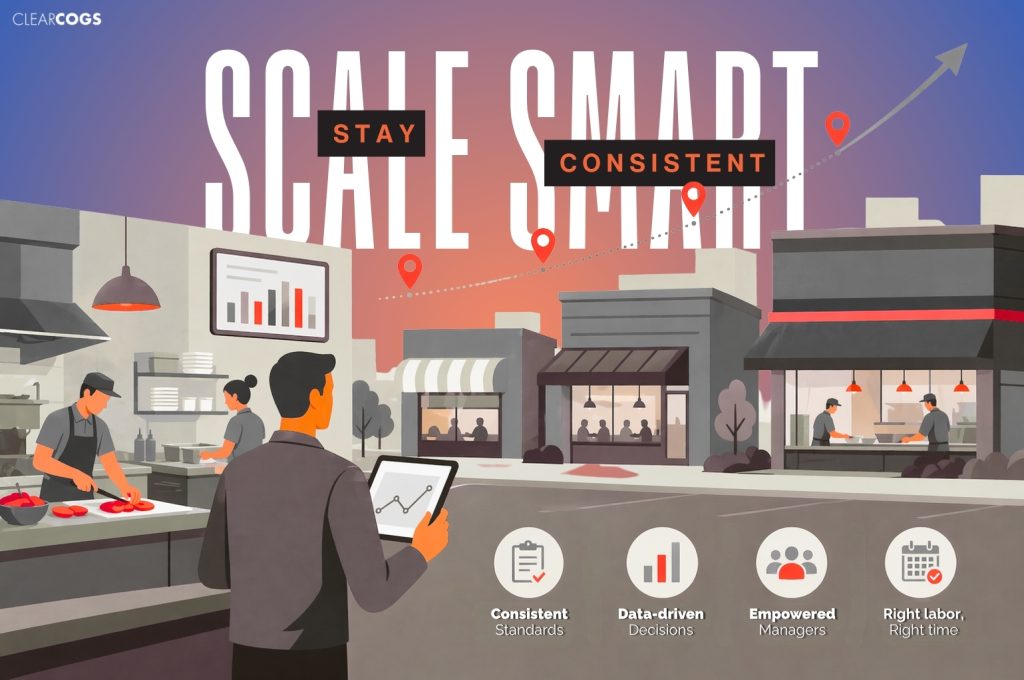



Growth is the goal. But for restaurant brands in active expansion mode, opening new locations introduces a problem that gets harder to solve the faster you move: operational consistency.
When you have 15 or 20 locations and experienced leadership in most of them, things generally work. Your seasoned GMs know their cadence. They know their prep volumes. They know when to flex labor up or down. But the moment you start adding locations at pace, bringing in green managers, and expanding into new markets, the playbook that worked at 20 stores starts fraying at 30.
The brands that scale well are not the ones with the best concept. They are the ones that build operational systems strong enough to survive the growing pains of rapid expansion.
The Consistency Problem Gets Worse Before It Gets Better
Every growing restaurant brand hits the same inflection point. The first wave of locations was built by the founding team. Standards were set by the people who created the concept. Prep habits, food quality, and labor deployment were dialed in by operators who understood the brand at a cellular level.
Then growth kicks in. New restaurants open every few weeks. New GMs come on board who did not grow up in the system. District managers are stretched across more locations. And suddenly the question is no longer “how do we open the next store?” It is “how do we make sure the last five stores are running like the first ten?”
This is where the gap between seasoned and green managers becomes painfully visible. A veteran GM with 18 months in the system knows that a rainy Tuesday means lighter prep on certain items and that the local college football schedule shifts weekend volumes. A new GM running their first location does not have that context. They are learning on the job, and the learning curve has a cost measured in waste, stockouts, and inconsistent guest experiences.
Different Layouts, Different Challenges, Same Standards
Adding complexity to the consistency problem is the reality that not every location is the same. Brands that have grown organically often end up with multiple restaurant prototypes, different square footages, different kitchen layouts, different throughput capacities. What makes sense for labor deployment in a large-format store does not translate directly to a smaller footprint.
This means you cannot just photocopy the playbook from one location and hand it to the next. Each store needs guidance that accounts for its specific sales patterns, its specific layout, and its specific team capabilities. The challenge is delivering that location-specific guidance at scale without requiring corporate to micromanage every prep sheet and every schedule.
This is where data becomes the equalizer. When a system can analyze each location’s sales history independently and generate prep and labor recommendations tailored to that specific store, the differences in format and layout become manageable. The GM in a small-format store gets guidance calibrated to their volume. The GM in a large-format store gets guidance calibrated to theirs. Both operate from the same system, the same standards, and the same data-driven logic.
Pilots Should Reflect Your Real Complexity
When a fast-growing brand decides to test a new operational tool, the temptation is to keep the pilot small. Two stores. Low risk. Easy to manage.
But a two-store pilot in a 30-plus location brand does not tell you much. If both stores have experienced managers, you will see good results, but you have not proven the tool works where you need it most: at the locations with newer leadership, higher variability, and less institutional knowledge.
A more effective approach is to pilot across a broader set of locations, specifically the ones you are already focused on improving. These are the stores where operations are volatile, not because of a crisis, but because of leadership transitions, inconsistent processes, or simply being newer. Testing the tool where the gap is widest gives you the clearest signal of whether it can actually move the needle.
It also lets you compare results across different manager profiles. How does a sub-one-year GM use the system compared to a veteran? Where does the tool add the most value? Those insights shape how you roll out across the full organization.
Full Menu, Full Picture
Some operators want to pilot by tracking only a handful of SKUs. Track chicken and cheese for 60 days and see if the numbers look right. It makes sense in theory. It keeps the pilot simple.
In practice, a narrow SKU focus limits what you learn. When your menu is relatively streamlined, covering the full item set during a pilot does not create meaningfully more work. And it gives you a complete picture of how the system handles your operation.
The five ingredients that drive the most food cost absolutely deserve the closest scrutiny. But running the full menu through the system lets you spot opportunities you would not have seen otherwise. Maybe your oil usage has more variability than you realized. Maybe flour waste spikes on certain days for reasons no one has tracked.
Going all in on the pilot, covering all items across a meaningful number of locations, gives you the data density to make a confident decision about whether to scale.
Labor Is the Other Half of the Equation
Food cost gets most of the attention in operational improvement conversations, but labor is where fast-growing brands often leave the most on the table. Not because they are overstaffed in aggregate, but because deployment does not match the shape of demand at each location.
Every restaurant has a different peak pattern. A store near an office park has a lunch spike that a suburban location does not. A store near a university shifts volume on weekends. Scheduling labor based on a brand-wide template means some stores are overstaffed during slow periods and understaffed during rushes.
The goal is not to cut labor. It is to right-size it. Bringing people in when they are needed and releasing them when demand drops. Matching prep labor to the actual prep workload for that day rather than scheduling a flat shift regardless of volume.
When forecasting feeds directly into labor recommendations, managers can build schedules that reflect the reality of their specific location rather than a generalized template. The result is not fewer labor hours. It is better-deployed labor hours, which shows up in both cost efficiency and team satisfaction.
Building the System Before You Need It
The operators who scale most smoothly build their operational infrastructure ahead of growth, not in response to it. If you wait until you have 50 locations to systematize prep and labor planning, you are retroactively fixing problems that have been compounding for years.
The better approach is to build that system while you are still in the 25 to 35 location range. Implementing data-driven forecasting now means every new location launches with the same operational backbone as your most established stores.
That is the difference between growth that creates chaos and growth that creates consistency.
Ready to scale operations alongside your growth? Let’s Talk


