

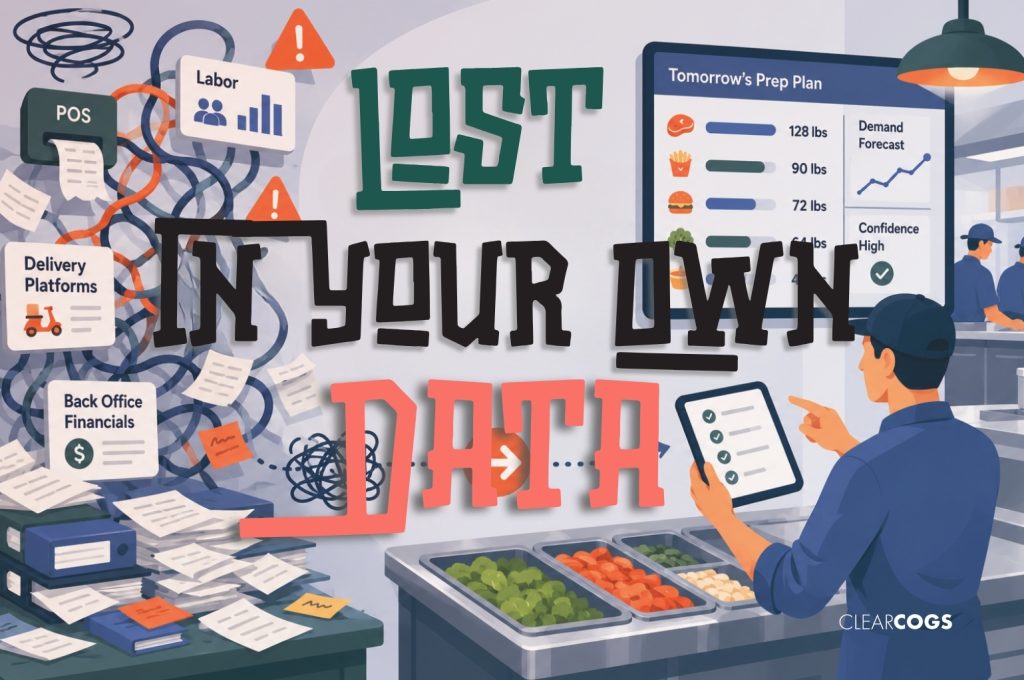



Growing restaurant groups have more operational data than ever. POS transactions, labor records, delivery platform reports, inventory logs, back-office financials: the data exists. It just doesn’t talk to itself.
For operators managing 20, 30, or 50 locations, this is one of the defining operational challenges of scaling. You know you have the information to make better decisions. You just can’t get to it in a form that’s actually usable. The result is that managers at the store level still make prep and staffing calls based on feel, even as leadership is sitting on years of granular transaction data that could answer those questions precisely.
This isn’t a new problem. But it’s becoming more expensive as operators try to layer AI and forecasting tools onto infrastructure that wasn’t built to support them.
The Patchwork Stack Problem
Most multi-unit restaurant groups didn’t build their technology stack from scratch. They added tools over time as needs arose: a POS here, an inventory platform there, a scheduling tool, a delivery integration, a back-office reporting system. Each solved a specific problem. None were designed to integrate with each other in a way that makes the whole greater than the sum of its parts.
The consequence is data fragmentation. Transaction history lives in the POS. Labor cost lives in a scheduling platform. Food cost lives somewhere else. Sales from third-party delivery channels may not flow cleanly into any of these systems. When leadership wants to understand food cost variance by location, someone has to manually pull data from multiple sources and reconcile the gaps.
According to Restaurant Dive, 40% of director-level restaurant leaders globally identified manual data reconciliation as a direct result of fragmented systems, creating redundancies, reporting discrepancies, and operational inefficiencies that compound as groups scale. At 10 locations, this is painful but manageable. At 30 locations opening new units every year, it’s a problem that gets worse every quarter.
The AI Layer Question
When operators start thinking about adding AI-powered forecasting or prep planning tools, they often run into a challenging sequence: first, they realize their underlying data quality isn’t good enough to support AI reliably. Then they conclude they need to fix their data infrastructure before they can get the benefits they’re after. Then they find themselves in a multi-year data warehouse project with no clear endpoint.
This is a real tension. Data quality does matter for forecasting accuracy. Bad data produces unreliable predictions, and unreliable predictions create adoption problems: teams stop trusting the system and revert to gut feel.
But the sequencing question isn’t as binary as it often seems. The relevant question isn’t whether your data is clean in the abstract. It’s whether the specific data streams that drive prep and staffing decisions, transaction history, menu mix, timestamps, are clean enough to model effectively. That’s a narrower problem than a full data warehouse overhaul.
Experienced forecasting platforms spend significant effort on data organization and cleansing before they ever generate a prediction. The work of separating catering volume from dine-in demand, flagging anomalous days, normalizing data across different POS configurations at different locations: that’s foundational work that determines whether the output is trustworthy. It’s also work that many operators don’t realize is included in the engagement.
What Line Cooks Actually Need
The distance between leadership’s data ambitions and the line cook’s morning question is often underestimated. A VP of operations who wants AI-powered forecasting is ultimately trying to answer questions that show up at the store level in very simple terms: how many pounds of fries should I drop at 11 a.m.? How much of this protein should I thaw tonight?
These aren’t complex questions. But answering them accurately requires sophisticated analysis that no individual store team member can reasonably perform. It requires modeling seasonal patterns, accounting for day-of-week demand curves, factoring in weather and local events, and applying recipe-level mathematics to convert demand forecasts into ingredient quantities.
The gap between what leadership wants and what the line cook needs is actually an alignment, not a contradiction. If the data infrastructure can support accurate predictions, the way those predictions get delivered to the team doing prep should be as simple as possible. A daily prep guide. A number on a screen. A consistent format that requires zero interpretation.
The technology complexity should be invisible at the store level. What shows up for the team making prep decisions should feel simple, actionable, and reliable.
Building Toward Intelligence
For growing QSR and fast-casual operators, the path toward operational intelligence typically has a few stages. The first is getting data clean enough to be useful: not perfectly clean, but clean enough for the specific decisions you’re trying to inform. The second is establishing a feedback loop, so that as new locations open and new data flows in, the forecasting gets more accurate rather than less. The third is making that intelligence actionable in a format that store teams will actually use.
None of these stages require waiting for perfect infrastructure. They can happen in sequence, or in parallel, as long as there’s a clear priority on which decisions you’re trying to improve first.
The operators who are furthest ahead aren’t the ones who have the cleanest data stacks. They’re the ones who decided to start using the data they had, with the right partners, rather than waiting for an ideal state that never quite arrives.
If messy data is standing between your operation and smarter prep decisions, the answer isn’t to wait. Let’s Talk


