

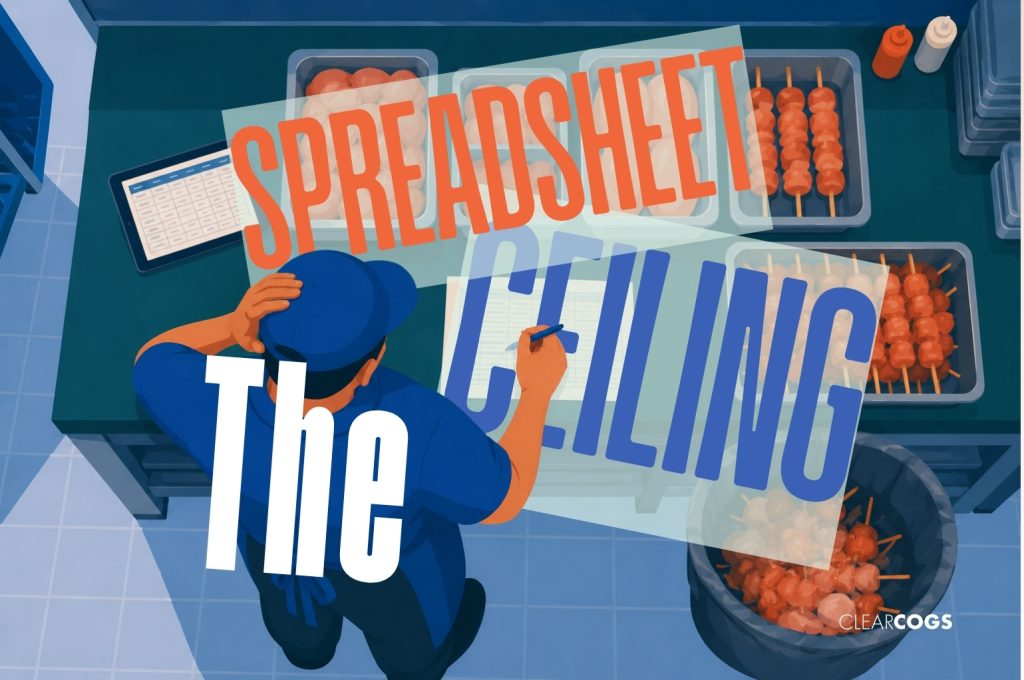



There’s a moment that every multi-unit restaurant operator who has spent time in the kitchen recognizes. A general manager walks in for the morning shift, opens their tablet, pulls up a spreadsheet, and starts filling in what they think they’ll need for the day. They look at what they sold last Tuesday. They think about the weather. They add a buffer because running out is worse than wasting a little.
Then they prep double what they needed, and 36 hours later, half of it is gone.
For restaurants where proteins have short shelf lives, where product you prepped this morning might be unusable by tomorrow evening, this isn’t a minor inefficiency. It’s a daily tax on food cost, labor, and margin. And for brands that have grown to ten, twenty, or thirty locations, that tax gets paid at every single store.
Why the “Gut Plus Buffer” Method Breaks Down at Scale
The experienced kitchen lead who has been running the same station for five years doesn’t need a spreadsheet. They’ve internalized the patterns. They know which Mondays run light and which Saturdays can turn suddenly busy. Their gut is, in many cases, genuinely calibrated.
The problem isn’t that experienced operators can’t make good prep decisions. It’s that experienced operators don’t scale.
When a brand opens new locations, it doesn’t get to clone its best kitchen lead at each one. New GMs learn by watching, by asking, by making mistakes and overcorrecting. In the meantime, some locations are over-prepping because they’re nervous, and others are occasionally running out because they haven’t built the feel yet. And when leadership is trying to manage consistency across a growing portfolio, “ask the GM to use their judgment” isn’t a system.
Spreadsheet prep sheets formalize the gut feeling, but they don’t improve it. They record what someone decided, not what the demand actually called for. And they do nothing to help a newer manager make better decisions before they’ve had the chance to develop the instinct.
The Hidden Labor Cost of Manual Prep
There’s another dimension to this that often gets underestimated. When prep is left to individual judgment, even judgment supported by a spreadsheet, it doesn’t just create waste. It consumes labor that could be deployed elsewhere.
Consider a kitchen team skewering and prepping protein for a lunch rush. If the prep target is built on a worst-case assumption rather than a data-driven forecast, those team members are spending time on product that won’t sell. That same labor could have been on the line managing service, or deployed to a lower-waste prep task that was actually undersupported.
According to MarketMan, U.S. restaurants generate 11.4 million tons of food waste each year, adding up to $25 billion in annual losses, with over-prepping and forecasting errors among the leading causes. For restaurants with perishable, time-intensive proteins, the waste isn’t just the food that gets thrown away. It’s the hands that prepared it, the time that could have been spent on something else, and the downstream effect on line throughput during the actual service window.
When a brand is running thirty-six locations, the aggregate of those daily miscalibrations is significant. Even a modest reduction in over-prep, say cutting the gap between what was prepped and what was sold by 15%, compounds quickly across a full portfolio.
What a Data-Driven Prep Process Actually Looks Like
The transition from spreadsheet-based prep to forecast-driven prep doesn’t require ripping out existing systems. For most multi-unit operators, it starts with the POS data they already have.
An AI forecasting system can analyze years of transaction history at the ingredient level: not just top-line sales, but how many of each menu item sold in each two-hour window, on each day of the week, across seasonal patterns and local variables. That analysis produces a forward-looking prep target: not “what did we sell last Tuesday” but “here is what Tuesday is likely to look like based on everything we know.”
That number gets delivered to the kitchen in whatever format makes sense for the team. For most operations, it’s an email the GM opens before the morning shift. It contains specific targets for each prep item: not ranges built on fear, but calibrated numbers built on evidence.
For new locations, this matters enormously. Instead of waiting months for a new kitchen lead to develop intuition, they start with data that reflects the brand’s actual demand patterns. The learning curve compresses. The consistency across locations improves. And the prep decisions that used to live entirely in someone’s head start living in a system that can be monitored, refined, and scaled.
Scaling Without Losing Control
The challenge of growing a restaurant group is that operational quality tends to degrade as you add locations. The systems that worked at three units start to show cracks at eight. The manager who knew every prep variable at one store can’t maintain that same knowledge across four.
Brands that get ahead of this problem invest in systems that distribute that knowledge: taking the prep intelligence built by experienced operators and making it available to every location, every morning, regardless of who’s working.
That’s what moves a brand from “our best locations run great” to “our entire portfolio runs consistently.” It’s not about removing judgment from the kitchen. It’s about making sure judgment is backed by data that scales.
For restaurants where a 36-hour shelf life makes every prep decision feel high-stakes, that consistency isn’t just a nice-to-have. It’s a margin decision, made fresh every single day.
Curious how this plays out across your locations? Let’s Talk


