

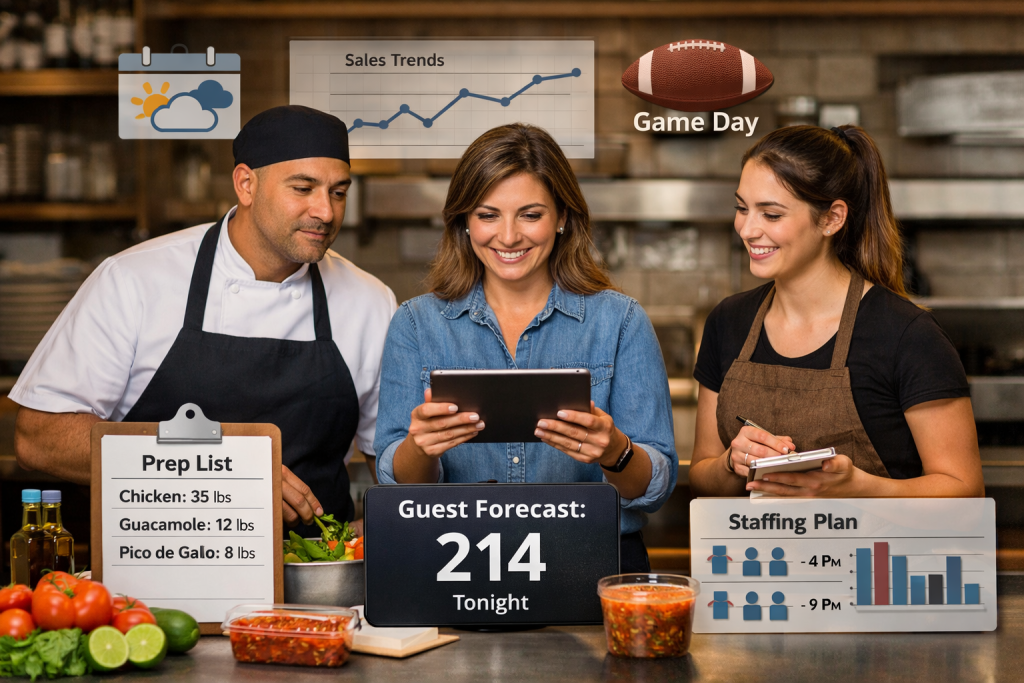



Demand forecasting for restaurants is the practice of predicting customer volume, menu item sales, and ingredient needs before each shift so operators can make smarter decisions about prep, purchasing, and staffing. Done well, it turns reactive guesswork into a repeatable system that protects margins, reduces waste, and keeps service consistent. Done poorly (or not at all), it’s the reason you’re 86’ing your top-selling taco at 6:30 on a Friday night or throwing away $400 in pulled pork on a slow Tuesday.
ClearCOGS is an AI-powered restaurant intelligence platform that delivers daily demand forecasts down to the ingredient level. Instead of asking your managers to predict the future from a gut feeling and a whiteboard, ClearCOGS analyzes your historical sales data, local trends, seasonal patterns, and real-time signals to tell your team exactly what to prep, how many people to schedule, and where your margins are at risk; every single day.
Why Demand Forecasting Matters for Restaurant Operations
Most restaurant losses don’t happen on the floor. They happen in the walk-in.
When prep decisions are based on memory, habit, or a manager’s best guess, the result is predictable: over-prepped proteins that get thrown out, under-prepped items that run out mid-service, and labor schedules that don’t match actual traffic. These aren’t one-off problems — they’re structural issues that compound across every shift and every location.
The National Restaurant Association consistently reports that food cost accounts for 28–35% of revenue for most operations. Even a 2–3% improvement in how precisely you manage that food cost can meaningfully change your profitability. For a restaurant group doing $5M annually, that’s $100,000–$150,000 in recovered margin.
Demand forecasting is the foundation of that improvement.
🔗 Restaurant industry challenges operators face in 2026 → How to Overcome Restaurant Industry Challenges: Your 2026 Success Strategy
How Demand Forecasting Works: The Basics
At its core, demand forecasting answers three questions:
- How many guests will we serve?
- What will they order?
- What do we need to have ready — and when?
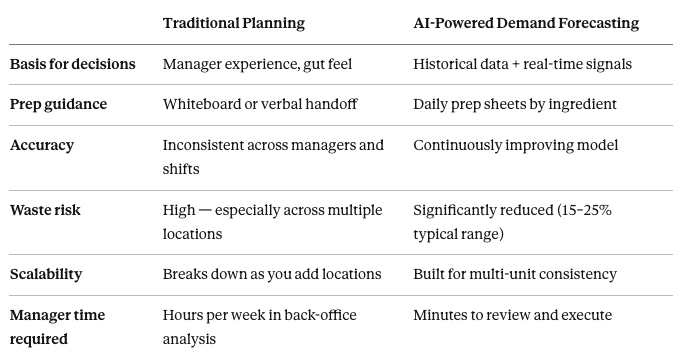
Traditional forecasting tries to answer these questions using spreadsheets, POS reports, and institutional knowledge. AI-powered forecasting answers them using pattern recognition across hundreds of variables: day of week, weather, local events, historical sales velocity, promotional calendars, and more.
Here’s how a modern demand forecasting cycle works in practice:
Step 1: Data Collection Your POS system captures sales history by item, time of day, day of week, and location. This is the foundational data layer.
🔗 What restaurant forecasting software actually does with your POS data → What is Restaurant Forecasting Software?
Step 2: Pattern Analysis The forecasting engine identifies trends in that data — which menu items spike on game days, how rain affects lunch traffic, what your average Tuesday looks like versus a Tuesday before a holiday.
🔗 Turning data chaos into smart decisions → AI’s Real Restaurant Impact: Data Chaos to Smart Decisions
Step 3: Forecast Generation The system produces a daily projection: expected guest count, expected item mix, and the ingredient quantities needed to meet that demand without over-prepping.
Step 4: Prep Sheet Delivery Your kitchen team receives a clear, actionable prep list. Not a report to interpret — a list of what to make and how much of it, down to the ingredient.
Step 5: Post-Shift Learning Actual sales are compared against the forecast. The model adjusts, improves, and gets more accurate with every shift.
Demand Forecasting vs. Traditional Restaurant Planning
🔗 How AI-powered forecasting is changing multi-unit operations → How AI-Powered Restaurant Forecasting is Revolutionizing Multi-Unit Operations
What Gets Forecasted? The Three Core Areas
1. Food Prep Forecasting
This is the most immediate payoff. Instead of a manager deciding to “make about 30 pounds of brisket” because that’s what they did last week, a demand forecast tells them to make 24.5 pounds on Tuesday and 41 pounds on Friday, based on projected cover counts and historical item mix.
The result: less waste, fewer 86’s, and a line team that’s set up to execute instead of scrambling.
🔗 How AI helps restaurants reduce food waste across locations → How AI Helps Multi-Unit Restaurants Reduce Food Waste
2. Menu Item Forecasting
Demand forecasting tells you which items will sell and in what ratios. For fast-casual operators with limited prep windows, knowing that your burrito bowl typically outsells your salad bowl 3:1 on weekday lunches is the difference between a smooth service and a bottleneck.
🔗 A strategic guide to restaurant forecasting and profit optimization → Restaurant Forecasting: A Strategic Guide to Profit Optimization and Operational Excellence
3. Labor Forecasting
Scheduling to a forecast means matching staffing levels to actual projected demand, not last week’s schedule copy-pasted into this week. If Monday is projected to be 20% lighter than your default schedule assumes, you can right-size your team before the shift, not after.
Real-World Example: What This Looks Like on the Line
Picture a fast-casual taco concept with four locations. Every Monday morning, each GM currently pulls last week’s POS report, cross-references it with upcoming local events, and makes their best call on how much to order and prep. It takes 45–90 minutes per manager. And it’s still wrong often enough to create weekly waste and stock-out problems.
With demand forecasting in place, that same GM opens a daily prep sheet on Monday morning. It reads:
- Chicken: 38 lbs (up 12% vs. last Monday due to a local school event nearby)
- Carnitas: 22 lbs
- Black beans: 14 lbs
- Pico: 9 lbs
The decision is already made. The manager’s job shifts from analyst to executor and they’re back on the floor leading their team by 8:15 AM.
That’s not a productivity improvement. That’s a fundamentally different operating model.
🔗 The restaurant AI playbook that actually delivers results” → From Go-Kart to Jet Engine: The Restaurant AI Playbook That Actually Works
The Business Case: What Demand Forecasting Actually Delivers
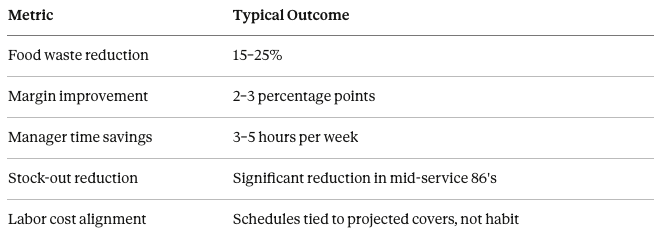
These aren’t hypothetical projections. They reflect the kind of outcomes ClearCOGS clients — including groups like Palenque Group and Goop Kitchen — see when forecasting becomes part of daily operations rather than an occasional exercise.
🔗 See if ClearCOGS is the right fit for your restaurant group → Is ClearCOGS Right for Your Restaurant Group?
Common Barriers to Adopting Demand Forecasting (And the Reality)
“Our managers already know their stores.”
Your best managers do know their stores. But knowledge doesn’t scale. When you open your fourth location, your sixth, your tenth — you can’t clone your top GM’s intuition. A forecasting system makes that institutional knowledge portable and consistent.
“We don’t have enough data.”
If you have a POS system, you have enough data. Most forecasting tools, including ClearCOGS, can work with as little as a few months of sales history and improve accuracy over time.
“It’s too complicated to implement.”
Modern forecasting platforms are built for operators, not data scientists. ClearCOGS integrates directly with your existing POS and delivers outputs your team can act on in minutes, not hours.
🔗 LINK OPPORTUNITY: Anchor text: “why waiting to adopt restaurant technology costs more than acting” → Restaurant Technology: Fear vs. Reality — Why Waiting Costs More Than Acting
“We tried something like this before and it didn’t work.”
Most AI pilot failures in restaurants come from tools that show dashboards without telling operators what to do. The difference between a tool that displays data and one that delivers actionable guidance is the difference between descriptive analytics and prescriptive analytics.
🔗 Why your POS and predictions still don’t tell you what to do” → Your POS Shows What Happened. Your Predictions Show What Might. Neither Tells You What To Do.
How to Know If Your Restaurant Is Ready for Demand Forecasting
- Use this checklist to assess your current state:
- We have a POS system that captures item-level sales data
- Our managers spend more than 30 minutes per shift on prep planning
- We regularly experience food waste or mid-service stock-outs
- Our food cost varies more than 2–3% month to month
- Prep decisions change significantly when a key manager is out
- We have more than one location and consistency is a challenge
- We want to scale without proportionally scaling back-office complexity
If you checked three or more of these, demand forecasting will deliver measurable ROI within the first quarter of implementation.
🔗 Why guest tolerance for inconsistency is collapsing in 2026 → The Collapse of Guest Tolerance: Why Restaurants Must Design for Certainty in 2026
Demand Forecasting vs. Restaurant Forecasting Software: What’s the Difference?
Demand forecasting is the capability: the ability to predict what you’ll sell and what you’ll need. Restaurant forecasting software is the tool that delivers that capability at scale.
Not all forecasting software is built the same way. Some tools generate high-level projections for owner review. Others, like ClearCOGS, go further and produce prescriptive outputs; specific, shift-ready guidance your team can act on without additional interpretation.
The distinction matters because data without direction doesn’t change operations. Your managers need answers, not more reports to analyze.
🔗 What to look for in restaurant forecasting software → What is Restaurant Forecasting Software?
Key Takeaways
Demand forecasting means predicting guest volume, item mix, and ingredient needs before each service so your team can prep and staff with precision.
The biggest payoffs are in food cost reduction, waste elimination, and manager time savings.
AI-powered forecasting outperforms traditional planning because it processes more variables, learns continuously, and delivers actionable guidance rather than raw data.
ClearCOGS translates demand forecasts into daily prep sheets and labor guidance your team can execute immediately.
The barrier to entry is lower than most operators expect — if you have a POS and a willingness to act on data, you’re ready.
Frequently Asked Questions
What is demand forecasting in simple terms for restaurants? Demand forecasting is the process of predicting how many guests you’ll serve, what they’ll order, and what you need to prepare before each shift. It replaces guesswork with data-driven guidance so your team always knows how much to make and how many people to schedule.
How accurate is AI-powered demand forecasting for restaurants? Accuracy improves over time as the system learns your specific patterns. Most ClearCOGS clients see meaningful accuracy improvements within the first 30–60 days, with the model continuously refining based on actual sales versus projected sales.
How is demand forecasting different from looking at last week’s sales? Last week’s sales are a single data point. Demand forecasting layers in dozens of variables: day of week, local events, weather, seasonal trends, promotional calendars, and your specific item velocity patterns to generate a forward-looking prediction that’s far more reliable than any single historical comparison.
Does demand forecasting work for small restaurant groups? Yes. ClearCOGS is designed for groups ranging from 1 to 20+ locations. Smaller operators often see the fastest ROI because the operational changes are easier to implement across fewer units.
What data does a demand forecasting tool need to get started? A connection to your POS system and a few months of sales history are typically enough to get started. ClearCOGS integrates directly with Toast and other major POS platforms.
How long does it take to see results from demand forecasting? Most operators begin seeing measurable waste reduction and prep efficiency improvements within the first few weeks. Financial ROI (reflected in food cost percentages and labor alignment) is typically visible within the first quarter.
Is demand forecasting only for food prep, or does it cover labor too? Both. ClearCOGS forecasts projected guest volume and item mix, which informs both prep quantities and labor scheduling. The two are directly connected, accurate demand projections mean more precise schedules with fewer over- and understaffing situations.
Ready to see what AI-powered forecasting could mean for your food costs? Book time with one of our solutions experts below:


