


By Matt Wampler, CEO of ClearCOGS
Most multi-unit QSR operators are not running wild, uncontrolled labor schedules. They built something deliberate: a fixed structure, fine-tuned over years, with small adjustments when it matters. That’s not a symptom of a problem. That’s an operator who learned, over time, how to run a lean shop.
So when someone says “you need a better scheduling system,” the experienced franchisee often tunes out. They already have a system. It works. They’re not looking to start over.
But here’s the thing: the fixed schedule is not the issue. What lives underneath it is.
The Baseline No One Talks About
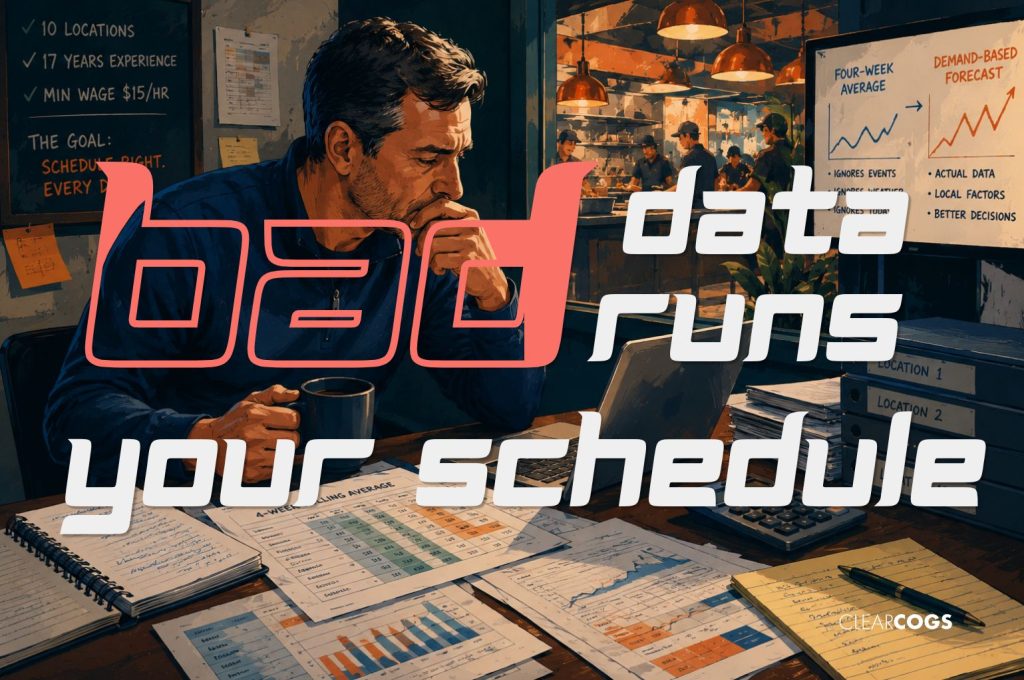
Most QSR scheduling starts with the same foundation: a four-week moving average. Take what happened the last four weeks, average it out, build your schedule from there. It’s straightforward. It’s fast. And for a long time, it was good enough.
The problem is that a four-week average tells you what already happened. It doesn’t tell you what’s coming. And in a world where labor costs in states like Illinois have hit $15 an hour, the gap between “what happened” and “what should we have planned for” has real dollar consequences at every shift.
Consider how this plays out in practice. You hold a fixed schedule because stability matters. Good operators don’t want to build a floating schedule from scratch every week; the administrative overhead alone eats into management time that’s better spent on the floor. But that fixed schedule gets adjusted based on how confident you feel about the week ahead. If the baseline underneath those adjustments is a blunt average, your confidence is built on shaky ground.
The overcorrection typically goes one direction: you hold staff a little longer than needed, or you call someone in for a shift that turned out to be slower than expected. Each of those decisions seems minor. Across 10 locations over a year, they compound quietly into a significant labor overage.
Why $15 Changes the Math
According to the National Restaurant Association’s 2025 Restaurant Operations Data Abstract, limited-service restaurants reported labor costs representing a median of 31.7% of sales in 2024, elevated compared to prior years. For QSR operators in Illinois and other states that have reached $15 minimum wage, there’s no longer a margin of error built into the old assumptions.
When labor cost was lower, a sloppy staffing call on a Tuesday afternoon was a small nuisance. Now, the same sloppy call at $15 an hour is a real line-item problem. The math didn’t change. The stakes did.
What operators need is not a new scheduling system. They need a more accurate demand picture to calibrate the one they already have.
The Adjustment Problem
The most common pattern is this: a franchisee runs a reliable fixed schedule and makes small manual adjustments based on their read of the week. Maybe it’s a local event. Maybe it’s a known slow stretch in winter. Maybe it’s a gut call based on how last week went.
This is actually smart operating. The instinct to adjust rather than rebuild is correct. The problem is that those adjustments are being made against a number that isn’t very precise.
A 15-minute ingredient-level demand forecast, updated continuously and trained on multiple years of actual POS data, produces a meaningfully different picture than a four-week average. It captures how weather shifts demand on a given Tuesday. It knows that your location near a high school runs differently on game weeks. It surfaces patterns that even an experienced operator’s memory can’t fully hold.
The goal is not to replace the fixed schedule. The goal is to give the manager making the adjustment a more reliable number to adjust around.
Small Decisions, Compounding Effect
One thing experienced multi-unit operators know is that restaurant profitability usually doesn’t hinge on a single big decision. It erodes through small decisions made under uncertainty, repeated hundreds of times a year.
The last bread bake two hours before close. The extra shift that turned out to be slow. The call-in on a Thursday that ended up being manageable without the extra body. These are not dramatic failures. They’re the normal friction of operating against imperfect information.
When the information improves, the adjustments improve. Not because managers get smarter. Because they’re working from a better starting point.
At ClearCOGS, this is fundamentally what we’re focused on: pulling your historical sales data down to the ingredient level, running it through a model that accounts for weather, day of week, and seasonal patterns, and delivering a daily forecast that your manager can actually act on. No new scheduling system. No additional training. Just a sharper number underneath the decisions you’re already making.
The Pilot Framing That Makes Sense
For operators skeptical of sweeping changes, which is most good operators, the right move is to start with a few stores. Not to overhaul anything. Just to see whether the number you’re currently adjusting around is getting you close, or costing you margin you don’t realize you’re losing.
Three stores over a few months will answer that question. If the savings show up, roll it out. If they don’t, you’ve lost very little to find out.
The fixed schedule is not the problem. The question is whether the baseline underneath it is good enough for the labor environment you’re actually operating in.
At $15 an hour in Illinois, the old baseline probably isn’t.
See how ClearCOGS works for multi-unit QSR operators
Sources
- National Restaurant Association. Restaurant Labor Costs Are Well Above Historical Averages. Restaurant Operations Data Abstract 2025, August 2025. restaurant.org