


We don’t usually find out what’s happening inside a customer’s operation through a blog post.
But that’s exactly what happened last week when Don, a bagel operator and the voice behind the From the Dish Pit newsletter, published a piece about how ClearCOGS changed his business. He didn’t tell us it was coming. He didn’t ask for anything. He just wrote it.
We’re sharing his story here because it illustrates something we see across the restaurant industry constantly; and because Don said it better than we ever could.
Read Don’s original post here →
The Problem With Bagels (And Every Other Perishable Product)
Don runs a New York–style bagel operation. Real bagels. Twenty-four-hour process. Fermented, proofed, boiled, baked and if they don’t sell that day, they’re done.
That’s a brutal forecasting constraint. There’s no markdown bin. No second chance. You make the call the night before, and you live with it the next day.
For years, Don managed this the way most operators do: experience, intuition, and a general sense of how the week should flow. And for a while, that worked. Then the last few years happened.
Consumer behavior shifted. Traffic patterns got volatile. The “feel” for the business that operators spent years developing started to feel unreliable. Don describes days of wasting more product than ever and other days selling out too early and turning customers away.
Sound familiar?
The Spreadsheet Phase (We’ve All Been Here)
Don’s response was the same one we hear from smart, motivated operators everywhere: he built something.
He spent a month creating a detailed Excel model. It pulled in sales history, projected production needs, even forecasted ingredient orders. By any reasonable standard, it was sophisticated.
It also had 2 fatal flaws.
First, it required manual data entry every single day. Pull from the POS. Enter the numbers. Update the waste log. That’s a new job on top of the job you already have.
Second, it was static. It tracked averages. It couldn’t respond to what was actually happening (like a cold snap, a local event or a slow Tuesday that came out of nowhere).
Here’s what Don said about what happened next, and it’s one of the most honest things we’ve read from an operator in a long time:
“The problem wasn’t the spreadsheet. The problem was me.”
When things got busy, as they always do, the system collapsed. Not because it was a bad system but because it depended on a human being to maintain it perfectly, every day, no matter what.
That’s not a spreadsheet problem. That’s a systems design problem. And it’s one of the most common operational failure modes we see.
What Changed
When Don started using ClearCOGS, a few things happened.
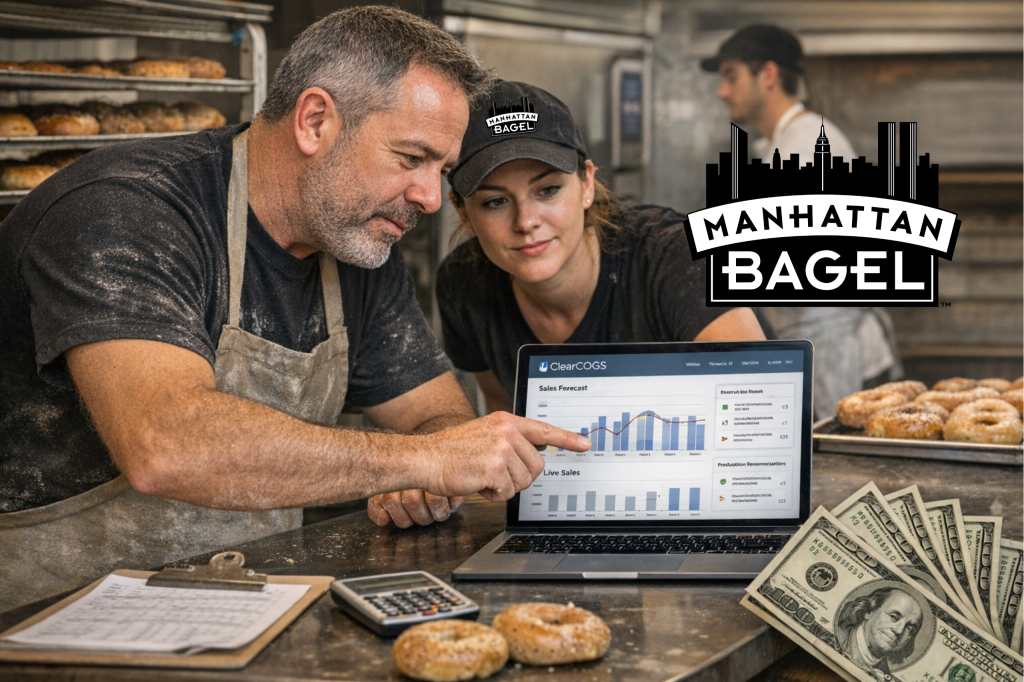
The manual data entry disappeared. Our system integrates directly with his POS and tracks sales in real time; no pulling, no entering, no maintaining.
The static averages got replaced with dynamic forecasting. Instead of looking backward at what happened, the system factors in historical trends, weather patterns, local events, and live sales data to project what’s coming.
And critically: the forecasting kept working even when Don got busy. Because it didn’t depend on Don to run it.
The Direct Result:
- Tighter production
- Less waste
- $4,000 per month in reduced labor costs tied to overproduction.
In Don’s words, they were paying someone to produce bagels, bake the bagels, and throw the bagels away. That’s not a food cost problem. That’s a forecasting problem.
The Bigger Lesson
Don’s post is about bagels. But the pattern he describes applies across the industry.
The operators we work with are not struggling because they lack data. They’re struggling because they don’t have time to act on it. They’ve built spreadsheets, hired analysts, pulled reports and the insights still never make it into tomorrow morning’s prep decision.
That gap between data and action is exactly what we built ClearCOGS to close.
Not with dashboards. Not with another report to review. With a daily operational playbook — specific, actionable guidance that tells your team what to make, how much to order, and where to adjust. Before the day starts, not after it ends.
Don put it better than we could when he described what he’d do first if he were running a large restaurant company today:
“Fix the operational leaks. Before cutting quality. Before raising prices. Before complicated restructuring.”
That’s it. That’s the whole thing.
The operators who find $4K/month aren’t doing it by cutting corners or renegotiating contracts. They’re doing it by finally being able to see what’s leaking and having a system that helps them stop it.
What This Means For Your Operation
If you’re running multiple locations and forecasting still lives in a spreadsheet, or in someone’s head, you’re probably losing money you can’t see yet. The math isn’t complicated. Overproduction ties up labor. Over-ordering drives food cost. Under-forecasting disappoints guests. Every one of those outcomes has a dollar figure attached to it.
The question isn’t whether the leaks exist. It’s whether you have the tools to find them.
ClearCOGS is a managed service built for multi-unit restaurant operators. We integrate with your existing POS, build forecasts around your real data, and deliver daily operational guidance your team can act on — without ripping out your tech stack or hiring a data team. Curious what this looks like for your operation? Let’s talk.
KEY TAKEAWAYS
Forecasting failure is usually a systems problem, not a people problem. When forecasting depends on a human to manually maintain it every day, it will eventually break down. The fix isn’t more discipline — it’s removing the dependency.
Static averages can’t keep up with volatile sales patterns. Post-pandemic consumer behavior has made intuition-based forecasting less reliable. Dynamic, multi-variable forecasting adjusts in real time — spreadsheets don’t.
Overproduction is a labor problem as much as a food cost problem. Producing product that gets thrown away means you’re also paying someone to make it. The cost stacks up fast.
The gap between data and action is where money gets lost. Most operators have access to data. What they’re missing is a system that turns that data into a daily decision — automatically, before the shift starts.
AI-powered forecasting doesn’t replace operators. It makes them better. The goal isn’t to remove human judgment from the equation. It’s to give operators better information so their judgment lands right more often.
FREQUENTLY ASKED QUESTIONS
What is AI-powered restaurant forecasting? AI-powered forecasting uses machine learning to predict future sales, production needs, and labor requirements based on multiple real-time variables — including historical sales data, weather, local events, and time of day. Unlike spreadsheet-based systems that rely on static averages, AI forecasting updates dynamically and doesn’t require manual data entry to stay accurate.
How does ClearCOGS forecasting work? ClearCOGS integrates directly with your existing POS system and pulls sales data in real time. From there, it builds daily forecasts and translates them into a practical operational playbook — telling your team how much to produce, what to order, and where to adjust before the day starts. No data team required. No spreadsheet maintenance. No rip-and-replace of your current tech stack.
How much can restaurants save with AI forecasting? Results vary by concept and volume, but operators using ClearCOGS have reduced costs by thousands of dollars per month through tighter production planning and smarter labor scheduling tied to forecasted demand. Don’s bagel operation cut $4,000/month in overproduction-related labor alone — and that’s one location.
Why do operator-built spreadsheets stop working? Spreadsheets require consistent, accurate manual input to function. When operations get busy — which is always — that maintenance is the first thing that slips. Even when maintained perfectly, most spreadsheet models rely on backward-looking averages that can’t account for real-time variables like weather or local events. They’re a good starting point, but they have a ceiling.
Is AI forecasting only for large restaurant chains? No. While enterprise chains have historically had the resources to build forecasting infrastructure, tools like ClearCOGS are built specifically for multi-unit operators who don’t have a data science team. If you’re running anywhere from 2 to 200+ locations and forecasting is still a manual process, AI forecasting is worth exploring.
What types of restaurants benefit most from predictive forecasting? Any concept with perishable inventory and variable demand — which is most of them. The impact is especially significant for concepts with tight production windows (bakeries, fresh fast casual, made-to-order concepts) or high-volume operations where small forecasting errors compound quickly across multiple locations.