


Brand: Groucho’s Deli Featured: Derek Rosenbaum, President & CTO Scale: 31 locations | Carolinas & Georgia | 600+ employees | 85 years in business Filmed at: MURTEC AI Summit 2026
The Brand That Time (and Four Generations) Built
Some restaurant brands are built to flip. Groucho’s Deli was built to last.
Founded in 1941 and now in its 85th year of operation, Groucho’s has grown from a single Columbia, South Carolina location — where the smell of decades of cooking has, as one visitor put it, “permeated the walls for generations” — into a 31-unit franchise operation spanning the Carolinas and Georgia. With more than 600 employees and four generations of people connected to the brand, Groucho’s is a living case study in how to scale without losing your identity.
Derek Rosenbaum knows that tension better than anyone. As both President and CTO, he’s responsible for honoring what makes Groucho’s irreplaceable while building the operational infrastructure to take it into the next century. That means every technology decision gets filtered through a single question: does this preserve the essence of who we are?
It’s a high bar. And it’s exactly why the way Groucho’s approached ClearCOGS matters.
The Problem: Institutional Knowledge Doesn’t Scale
Multi-unit franchise operators all face the same hidden bottleneck: the expertise that lives in the heads of your best managers doesn’t transfer automatically to your newest ones.
At Groucho’s, that gap showed up in daily prep. Experienced operators develop an intuitive feel for how much to make, what to order, and how to avoid waste — but that intuition takes years to build. New franchisees don’t have years. They have a grand opening.
“It takes a long time to gain that sort of institutional knowledge, especially if you’re new to the space,” Rosenbaum explains. “So for me, it’s about empowering our people and getting those things to work in an intelligent and accurate way.”
The compounding cost of getting it wrong is real. Rosenbaum’s inspection team regularly walks into franchise locations and finds exactly the kind of stagnant inventory that quietly eats margin: six cases of 4-ounce portion cups sitting untouched. Two hundred dollars of product going nowhere. Multiply that across 20 line items, multiply that across 31 locations, and you’re not talking about a rounding error — you’re talking about a serious drag on cost of goods.
What Groucho’s needed wasn’t another dashboard. It was a system smart enough to replace the guesswork.
The Solution: Predictive Inventory at Ingredient Level
Groucho’s completed a pilot with ClearCOGS focused on predictive inventory and automated par levels — and the scope of what that actually means is worth unpacking.
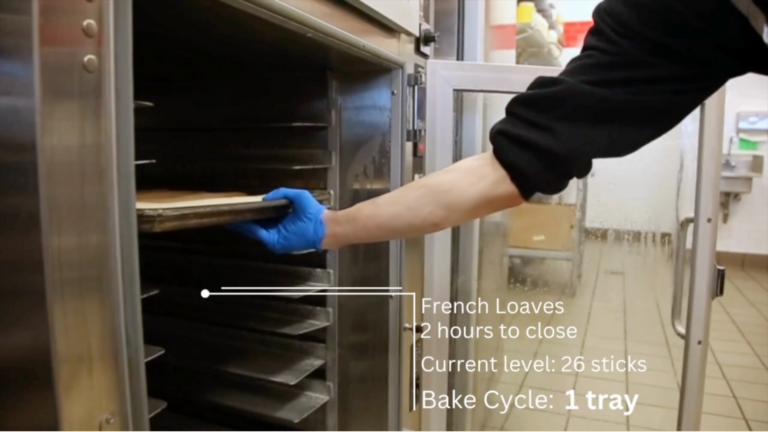
This isn’t a “how many pounds of turkey did we sell last Tuesday” type of calculation. ClearCOGS works at the ingredient level, drilling down to what Rosenbaum calls the “sub-modifier level” — accounting for every component of every menu item, across every channel, in the precise unit of measure each operator actually uses (cases, slices, ounces).
“You’re taking all of your recipes down to the actual ingredient level, to the sub-modifier level — bringing in real-time sales data and all your historical sales data to build these accurate predictions. It’s really about tuning the Ferrari.”
The build process was deliberately collaborative. ClearCOGS spent time learning Groucho’s operational nomenclature — how they measure, how they order, how they think about inventory — and built to those specifications rather than asking the brand to adapt to the software. Weekly calls included power-user franchisees, the operators most likely to adopt early and become internal advocates.
“If they’re happy, they will become evangelists,” Rosenbaum says. “The team has been amazing to work with and very open to the feedback and suggestions we’ve been giving them.”
The output flows in three directions simultaneously: daily prep guidance for team members on the floor, truck-level order recommendations for operators, and brand-level aggregated data for better broadline supplier negotiation. One system. Three layers of operational impact.
The Partnership Model: Speedboats Over Cruise Ships
Technology is only as good as the relationship behind it. That’s not a platitude for Rosenbaum — it’s a vendor selection criterion.
“It’s like turning a speedboat versus a cruise ship. I want to know if I’m having a real issue, I can just call Matt and say, ‘Hey man, help me out,’ and it’s going to happen. That’s the kind of people I tend to partner with.”
Rosenbaum draws a sharp line between vendors who collect a SaaS fee and disappear, and partners who stay in the work with you. For a 31-unit franchise system that still has the agility of a smaller brand, the latter isn’t a preference — it’s a requirement.
ClearCOGS fits that model precisely because they operate the same way. As a growing restaurant tech company, they move fast, respond to feedback, and can make changes to accommodate a brand’s specific operational reality. They aren’t asking Groucho’s to retrofit its 85-year-old processes into a generic software workflow. They’re building to the brand.
“They’ve been a great partner as far as understanding our nomenclature and how we operate,” Rosenbaum says. “We don’t have to change our operational processes around how we do these things.”
This is also what drove Rosenbaum to ClearCOGS in the first place. He’d wanted this capability for years — but his previous POS system lacked the open API infrastructure to make the connection. When Groucho’s migrated to Square for Restaurants last summer, the door opened. He’d already seen Matt Wampler (affectionately dubbed “ClearCOGS Jesus”) on LinkedIn and knew exactly who to call.
The ROI Case: Math Is Math
When Rosenbaum talks about why he’d recommend ClearCOGS to other multi-unit operators, he strips it down to first principles.
“At the end of the day, it’s math. If the algorithm is correct, the outputs will be correct. And if it’s true machine learning, it’s self-adjusting in real time. If we can shave a few points off our cost of goods while giving time back to our operators? Hell yeah, sign me up.”
The logic is hard to argue with. Accurate predictions reduce over-ordering. Reduced over-ordering cuts stagnant inventory. Cut stagnant inventory across 20 items per location, and you’re recovering real dollars that were previously invisible — buried in a walk-in cooler somewhere between the portion cups and the prep containers.
But the ROI isn’t only financial. The other half of the equation is time.
When managers aren’t running mental math on daily prep and manually building order sheets, they’re doing something more valuable: they’re on the floor. They’re interacting with guests. They’re doing the thing that no software can do for them.
“My ultimate goal with technology,” Rosenbaum says, “is to allow our team members to put the human back in hospitality while the tech runs in the background.”
That’s the vision. ClearCOGS is part of how Groucho’s gets there.
What This Looks Like for Your Brand
Groucho’s story isn’t unique to deli concepts or 85-year-old franchises. The core problem — prep decisions that rely on institutional knowledge, stagnant inventory that quietly drains margin, managers stretched too thin to focus on hospitality — shows up across QSR, fast casual, and full-service operations at every scale.
ClearCOGS works by connecting directly to your POS, pulling real-time and historical sales data, and generating ingredient-level prep and order guidance your team can actually act on — without changing how you operate.
For multi-unit operators evaluating the investment, Rosenbaum’s framework is worth borrowing: What problem are you trying to solve? What does it cost you every day not to solve it?
If the answer involves waste, inconsistent prep, or managers doing math when they should be doing hospitality — the conversation starts here.
Ready to see what ClearCOGS can do for your operation? Book time with our team below 👇