

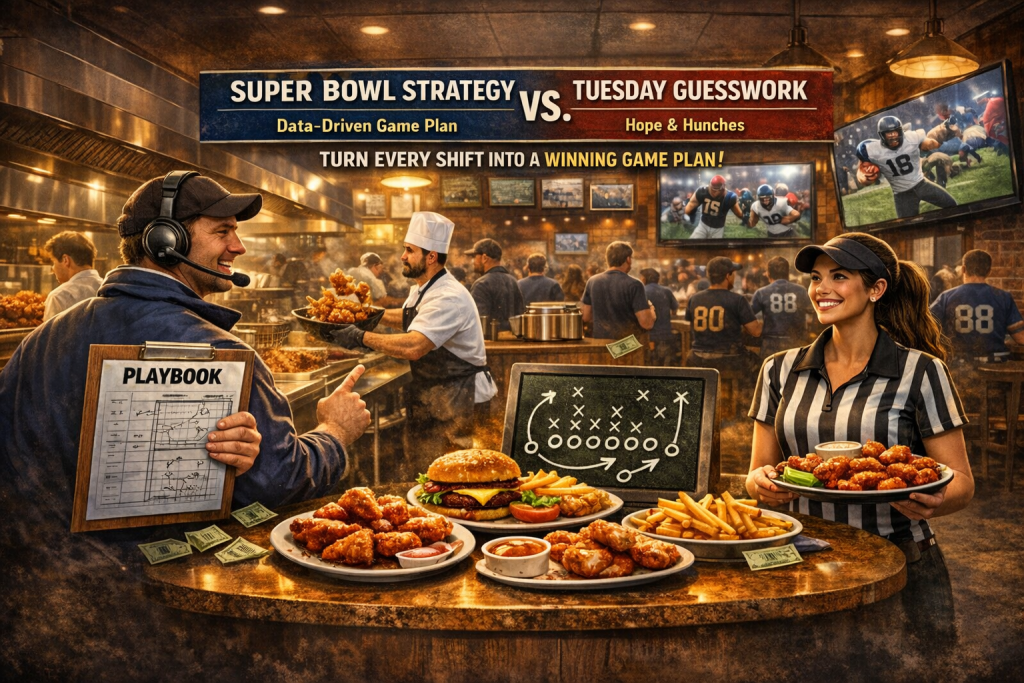



Every restaurant operator knows the feeling. Super Bowl Sunday is coming, and the pressure is on.
Will you have enough wings? Did you staff enough cooks for the rush? What happens if the game goes into overtime and your prep runs out at 9 PM?
For one day a year, the entire industry focuses on predicting the unpredictable. Operators study last year’s numbers, check weather forecasts, guess at order volumes, and cross their fingers.
But here’s the uncomfortable truth: every day in your restaurant demands the same level of precision that Super Bowl Sunday does. The stakes might feel lower on a random Tuesday, but the financial impact of getting it wrong compounds across 365 days a year.
What if you could run every single shift with the same level of preparation, confidence, and accuracy that you bring to the biggest day of the year?
The Super Bowl Playbook vs. The Tuesday Scramble
Think about how your best operators prepare for Super Bowl Sunday. They don’t wing it. They:
- Analyze historical sales data from previous years
- Factor in variables like weather and kick-off times
- Calculate precise prep quantities by menu item
- Schedule extra staff at exactly the right moments
- Set pars that anticipate demand spikes
- Create contingency plans for different scenarios
It’s methodical. Data-driven. Proactive instead of reactive.
Now think about how most restaurants handle a regular Tuesday. Managers guess at prep based on “what we usually do.” They check last Tuesday’s sales and add a little buffer. They schedule based on gut feel and hope they’re not overstaffed when it’s slow or drowning when an unexpected rush hits.
The difference isn’t the importance of the day. It’s whether you have a playbook.
For a 10-location restaurant group, that gap between Super Bowl preparation and everyday guesswork costs between $150,000 and $250,000 annually in preventable waste, labor inefficiency, and missed sales from stockouts. Multiply that across 52 weeks, and you’re looking at the profit margin difference between a thriving business and one that’s barely surviving.
What Champions Know That Average Teams Don’t
Watch any championship team, and you’ll notice something: they don’t just react better than their opponents. They anticipate better.
The quarterback doesn’t wait to see where defenders go—he reads the defense pre-snap and knows his progressions before the ball moves. The offensive coordinator doesn’t call plays based on what worked last quarter—he’s already analyzed tendencies, matchups, and situational probabilities.
Winning teams make decisions before the moment demands them.
Your best restaurant managers already think this way on your busiest days. They’re mentally running through scenarios: “If we hit last year’s Super Bowl volume, I’ll need Jenny on expo by 6:15. If we exceed it by 20%, I’ll pull Marcus from prep to support the line at 7.”
But here’s the problem: that level of analysis is exhausting to do manually. Most managers can sustain it for special events, but asking them to perform that same mental calculation for every single shift, across every location? It’s not scalable. And it’s definitely not sustainable.
This is why most restaurant operations stay reactive. Not because managers lack skill, but because predicting operational needs without technology is like asking a quarterback to play without ever studying film.
The Difference Between Reporting and Forecasting
Here’s where most restaurant technology misses the mark.
Your POS system tells you what happened yesterday. Your inventory platform shows you what’s in stock right now. Your labor scheduling tool tracks who worked last week.
All of that is valuable. But none of it tells you what to do tomorrow.
It’s like watching game film from last season without a game plan for Sunday. You have information, but not intelligence. Data, but not decisions.
Think about what a football team actually needs on game day:
- Not: A report showing they rushed for 127 yards last week
- But: A play-by-play script that exploits the opponent’s defensive weaknesses
- Not: Stats on their quarterback’s completion percentage
- But: Route combinations that work against specific coverage schemes
- Not: A dashboard of last month’s performance
- But: Adjustments for this week’s weather, injuries, and matchups
Restaurants need the same shift from historical reporting to predictive guidance.
You don’t need another system that tells you what went wrong last Tuesday. You need a system that prevents Thursday from going wrong in the first place.
How AI Turns Every Manager Into Your Championship Coordinator
The best offensive coordinators in football don’t just have great instincts—they have systems that analyze thousands of data points and turn them into simple, executable plays.
ClearCOGS does the same thing for restaurant operations.
Instead of asking your managers to manually analyze sales trends, weather patterns, local events, seasonality, day-of-week variations, and inventory levels, the AI does it automatically. Then it translates all that complexity into something beautifully simple: exactly what to prep, order, and staff for tomorrow.
Here’s what that looks like in practice:
Traditional approach for Tuesday prep:
- Manager checks last Tuesday’s sales: 87 orders
- Adds 10% buffer because it “felt busy”
- Preps 95 portions of each item
- Runs out of wings at 7 PM (stockout = lost sales)
- Throws away 12 portions of ribs (waste = lost profit)
ClearCOGS approach for Tuesday prep:
- AI analyzes 18 months of sales data, weather forecast (warm Tuesday = more cold appetizers), local events (youth soccer league night = family-oriented orders), historical prep accuracy, and inventory shelf life
- Delivers precise guidance: prep 92 portions of wings, 78 portions of ribs
- Manager executes the playbook in 5 minutes
- No stockouts. Minimal waste. Perfect execution.
The difference? Your newest manager just performed like your most experienced operator—not because they suddenly gained 10 years of intuition, but because they had a championship-caliber playbook.
The Compounding Effect of Getting It Right Daily
Super Bowl Sunday matters because the stakes are concentrated. One day. Massive volume. High visibility.
But let’s run the actual numbers on daily precision.
Scenario: 10-location fast-casual group
Current state (reactive operations):
- 8% food waste across locations (some managers better than others)
- 15 hours weekly per location on manual forecasting and adjustments
- 3-5 stockouts per location monthly = lost sales
- Labor efficiency varies 12-18% between best and worst performers
Annual cost of guesswork:
- Food waste: ~$180,000 (preventable with better forecasting)
- Manager time on spreadsheets: ~$195,000 (150 hours monthly at $25/hour across 10 locations)
- Lost sales from stockouts: ~$75,000 (conservative estimate)
- Labor inefficiency: ~$140,000 (overstaffing slow shifts, understaffing rushes)
Total operational cost: $590,000 annually
Now imagine you could recover even 60% of that through predictive operations. That’s $354,000 directly to your bottom line—or roughly 2-3 points of margin improvement for most operators.
That’s the difference between adding two new locations or barely breaking even. Between giving your team raises or cutting benefits. Between thriving and just surviving.
Why Game Plans Beat Gut Feelings
There’s a reason NFL teams spend millions on analytics departments. Human intuition is remarkable, but it’s also:
- Inconsistent (your best manager’s Tuesday might be flawless, but your newest manager’s Tuesday is chaos)
- Biased (we remember the one time we ran out of wings, so we overcompensate and waste ribs for six weeks)
- Overwhelmed by complexity (tracking 50+ variables across multiple locations exceeds human working memory)
- Reactive by necessity (you can’t manually analyze predictive scenarios fast enough to stay ahead)
AI doesn’t replace managerial judgment. It amplifies it.
Your managers still lead teams, handle customer issues, train staff, and make real-time adjustments. But they do it with the confidence of walking into every shift knowing the game plan works because it’s based on 18 months of pattern recognition, not last week’s hunch.
What This Looks Like at Kickoff
Let’s walk through how a Super Bowl Sunday actually works with ClearCOGS versus the traditional scramble.
Traditional Super Bowl prep (starting Friday):
Friday 2 PM: Operations manager pulls last year’s Super Bowl numbers, adjusts for growth, creates prep sheets manually
Friday 4 PM: Sends prep guidance to 10 locations via group text
Saturday 10 AM: Three managers text back with questions about prep quantities
Saturday 3 PM: Manager at Location #4 realizes they ordered too much chicken, not enough beef
Sunday 11 AM: Location #7 starts prepping, realizes they’re short on wings, scrambles to find emergency supplier
Sunday 6 PM: Location #2 runs out of nachos during halftime rush
Monday 9 AM: Waste reports show Location #3 threw away $840 in unsold food
ClearCOGS Super Bowl prep (starting Friday):
Friday 9 AM: AI automatically generates location-specific Super Bowl forecasts based on:
- Last 3 years of Super Bowl sales data
- Local team fanbase intensity
- Weather forecast (cold = more comfort food)
- Each location’s unique customer base
- Inventory on hand and shelf life
Friday 9:15 AM: All 10 managers receive precise playbooks in their existing systems: exactly what to prep, what to order, when to schedule staff
Friday-Sunday: Managers execute. No guesswork. No group texts. No scrambling.
Sunday 6 PM: Every location stays stocked through halftime rush
Monday 9 AM: Waste across all locations averages 4% (vs. typical 12-15% on high-volume days)
The result: Same revenue. 40% less waste. Zero stockouts. Managers spent their weekend focused on guest experience instead of buried in spreadsheets.
The Real Victory: Systemizing Success
Here’s what separates championship teams from everyone else: they don’t rely on individual heroics. They build systems that make excellence repeatable.
When the Kansas City Chiefs win, it’s not because Patrick Mahomes improvised on every play. It’s because Andy Reid’s system creates conditions where great execution becomes routine.
The same principle applies to restaurant operations.
Your veteran manager who “just knows” how much to prep? That’s heroics. That’s talent. And it’s amazing—until they take a vacation, get promoted, or leave for another opportunity.
Systemized operations mean your newest manager can execute like your best manager because they’re both working from the same intelligent playbook.
That’s how you scale profitably. That’s how you maintain consistency across 10, 20, or 50 locations. That’s how you stop playing defense every day and start playing offense.
Beyond the Big Game: Every Day Is Game Day
The lesson of Super Bowl Sunday isn’t that you should prepare better for special events.
It’s that every single day deserves the same level of predictive precision.
A slow Tuesday might not feel as important as Super Bowl Sunday, but across a full year? Those Tuesdays add up to more revenue, more waste, and more operational complexity than any single event.
The restaurants that win in 2025 and beyond won’t be the ones that react fastest to problems. They’ll be the ones that see problems coming and prevent them before they happen.
They’ll turn every shift into a winning game plan. They’ll empower every manager with championship-level guidance. And they’ll protect their margins by eliminating the guesswork that quietly drains profitability 365 days a year.
Ready to turn every day into game day? ClearCOGS transforms your existing restaurant data into precise daily playbooks for prep, ordering, and staffing. No rip-and-replace required. Just better decisions, less waste, and stronger margins across every location.
Contact our team below!


