

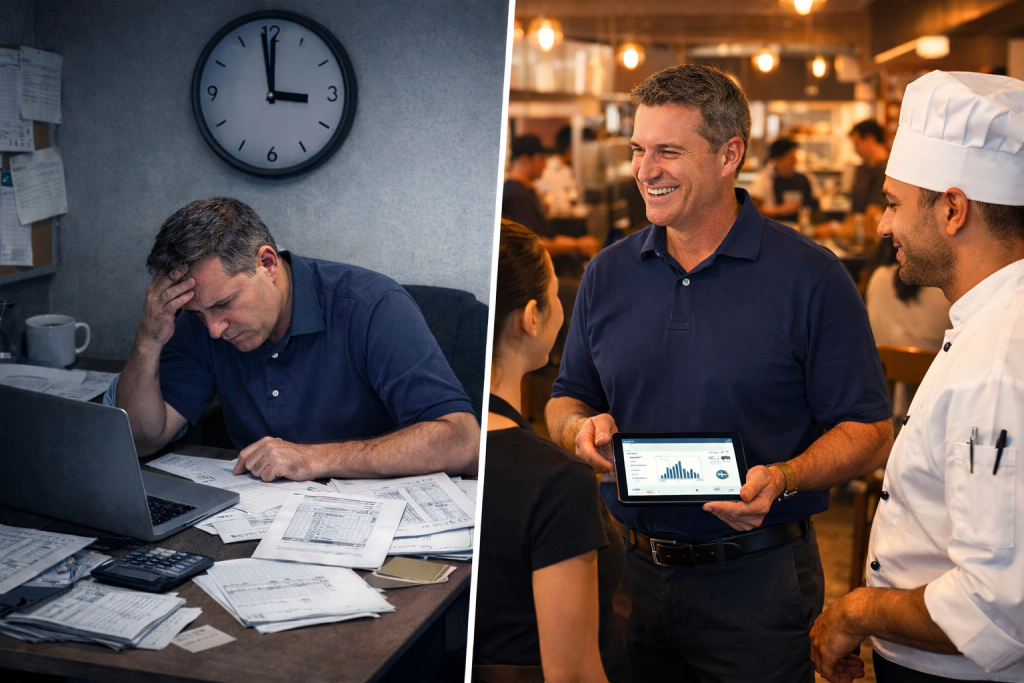



Every restaurant manager knows the feeling. It’s 6 PM on a Friday, and you’re either throwing away perfectly good food or scrambling to explain why you’re 86’ing your most popular menu items. The prep sheet that seemed reasonable at 9 AM has become your worst enemy by dinner service.
The problem isn’t effort, it’s accuracy. And in an industry where a 2-3% margin improvement can mean the difference between profitability and closure, getting prep right isn’t just operationally important. It’s existentially critical.
Why Traditional Prep Sheets Are Failing Modern Restaurants
For decades, restaurant prep has relied on the same fundamental approach: look at last week’s sales, adjust for gut feeling, and hope you’re close. Your most experienced managers develop an intuition over years of trial and error. Your newest managers? They’re guessing with a spreadsheet.
This creates three compounding problems that drain profitability from every shift:
- The Experience Gap: Your 10-year veteran manager has internalized thousands of service patterns. They know that a rainy Tuesday will run 15% below forecast, that the local high school’s away games tank Thursday sales, and that the first warm weekend in April always brings a surge. Your newest manager has none of this context and traditional prep sheets don’t bridge that gap.
- The Reactivity Trap: Even experienced managers are working with incomplete information. They’re using 4-6 week sales trends to predict tomorrow’s demand, but they’re missing critical signals: upcoming weather patterns, local events, seasonal shifts, and inventory constraints. By the time problems appear, it’s too late to prevent them.
- The Waste-Stockout Paradox: Afraid of running out during a rush, managers over-prep. Afraid of waste, they under-prep. There’s no winning. Only expensive mistakes that compound across every location, every day. A recent industry study found that restaurants waste 15-20% of the food they purchase, and much of that waste starts with inaccurate prep forecasting.
The Real Cost Hidden in Your Back Office
Here’s what most operators don’t realize: the financial cost of bad prep is just the beginning.
Walk into any restaurant kitchen at 3 PM and you’ll likely find your manager buried in spreadsheets, calculating batch sizes, reviewing inventory levels, and trying to predict tonight’s demand. That’s 2-3 hours of leadership time spent on calculations; time that should be spent coaching employees, maintaining quality standards, and creating the kind of guest experience that drives repeat business.
This is the invisible cost of manual prep forecasting: your highest-paid team members spending their most valuable hours doing work that technology can do better, faster, and more accurately.
Consider what happens across a 10-location restaurant group:
- 10 managers spending 2.5 hours per day on prep calculations
- 25 collective hours of daily leadership time lost to spreadsheets
- 175 hours per week that could be redirected to guest service
- 9,100 hours annually of management capacity trapped in the back office
That’s more than four full-time management positions worth of time, every single year, spent on manual forecasting that AI can handle in seconds.
How AI-Powered Forecasting Changes Everything
The shift from reactive to proactive operations isn’t about working harder, it’s about working with better information. AI-powered forecasting platforms analyze dozens of variables simultaneously: historical sales patterns, weather forecasts, local events, seasonal trends, inventory levels, and item-specific shelf life requirements.
But the real transformation isn’t in the data processing, it’s in what becomes possible when accuracy improves.
Systematic Scalability: When every manager, regardless of experience level, receives the same precise guidance on what to prep, order, and staff, operations become systematically scalable. Your newest manager can execute a shift with the same accuracy as your most experienced veteran because they’re both working from the same intelligence.
This eliminates the experience premium that makes multi-unit expansion so difficult. You’re no longer hunting for rare managers who can “run a restaurant by feel.” You’re empowering every manager with data-driven precision that removes guesswork entirely.
Proactive Operations: Instead of reacting to problems after they appear, AI forecasting enables preventive management. When the platform predicts a 20% demand surge for Thursday based on weather patterns and local events, prep quantities adjust automatically. When inventory levels indicate an upcoming stockout, order suggestions appear before you run out.
The result is a fundamental shift in how managers spend their time. Less scrambling, less firefighting, less explaining why you’re out of your signature dish. More consistency, more control, more time where it matters most.
Compounding Efficiency Gains: Accurate forecasting doesn’t just reduce waste, it triggers a cascade of operational improvements. When you know exactly how much to prep, you also know exactly when to prep it, who needs to do it, and how to schedule labor accordingly. Kitchen operations become predictable. Labor costs align with actual demand. Food costs stabilize across all locations.
The Practical Reality: What Changes When Forecasting Gets Precise
Let’s get specific about what AI-powered prep forecasting looks like in practice.
- Monday Morning, 8 AM: Instead of spending 90 minutes reviewing last week’s sales trends and building prep sheets from scratch, your manager opens their daily playbook. Every item is already calculated based on predicted demand, current inventory, and shelf life requirements. Prep quantities are precise down to the ingredient level. The manager reviews, makes any location-specific adjustments, and moves to the floor: total time: 15 minutes.
- Wednesday, 2 PM: The platform flags that Friday’s forecast has shifted upward by 12% based on weather pattern changes and a newly announced local event. Suggested prep quantities automatically adjust. An order recommendation appears showing exactly what additional inventory is needed. Your manager receives an alert, reviews the changes, and approves: total time: 5 minutes.
- Friday, 6 PM: Service runs exactly as predicted. Prep quantities were accurate within 2-3%. No emergency menu substitutions. No wasted product heading to the trash. Your manager spent the afternoon coaching new employees and table-touching with guests instead of panic-ordering from suppliers.
This isn’t theoretical, it’s how modern restaurant operations function when forecasting accuracy improves from 70-75% (industry standard for manual methods) to 92-95% (achievable with AI-powered platforms).
Why ClearCOGS Operators Are Getting Different Results
The difference between using AI for restaurant forecasting and using ClearCOGS specifically comes down to three critical factors: precision, integration, and prescriptive guidance.
Item-Level Forecasting: While many platforms forecast sales at the category level, ClearCOGS predicts demand for every menu item, then breaks those predictions down to ingredient-level requirements. You’re not guessing how many “chicken dishes” you’ll sell, you’re getting precise quantities for every component, accounting for batch sizes, shelf life, and current inventory levels.
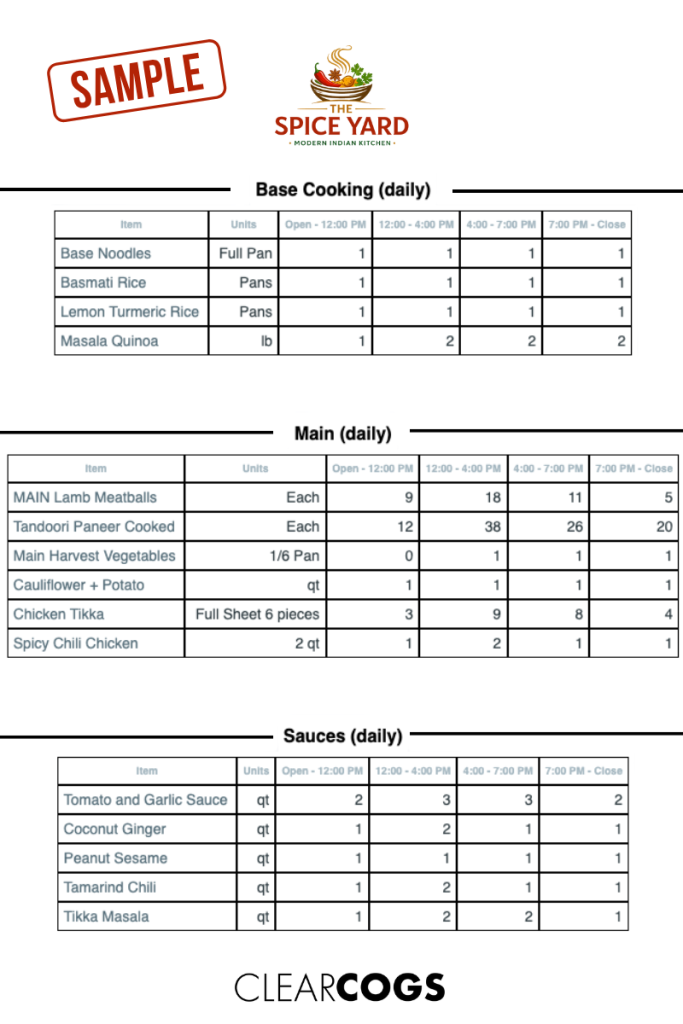
This granularity prevents both waste and stockouts simultaneously. You’re prepping exactly what you need, when you need it, based on actual predicted demand rather than broad category estimates.
Seamless Integration: ClearCOGS connects directly to your existing POS system, inventory management, and scheduling tools. There’s no data entry, no manual updates, no duplicate systems to maintain. Sales flow automatically. Inventory adjusts in real-time. Labor schedules align with demand forecasts. Everything works together as a unified system of decision, not just another system of record to manage.
For multi-unit operators, this integration is transformative. You’re not asking managers to adopt new workflows, you’re enhancing their existing processes with better information.
Prescriptive, Not Predictive: The real breakthrough isn’t knowing what might happen, it’s knowing exactly what to do about it. ClearCOGS doesn’t just predict Friday will be busy; it tells you precisely how much of every item to prep, when to prep it, how many line cooks to schedule, and what to order by Thursday morning to be ready.
This shifts operations from interpretive to executable. Managers don’t need to translate forecasts into action plans the platform delivers clear, actionable guidance that anyone can follow. Your newest manager receives the same precision as your most experienced veteran.
The Operational Transformation: From Back Office to Front of House
The most meaningful change isn’t visible in the P&L, it’s visible in how your restaurants actually run.
When managers spend 15 minutes reviewing prep plans instead of 3 hours building them from scratch, that time doesn’t disappear, it redirects to higher-value activities. Leadership training. Quality control. Guest experience. Team development.
Restaurant operators using ClearCOGS consistently report the same shift: managers spending 60-70% more time on the floor, directly impacting service quality and team performance. This isn’t about working more hours, it’s about redirecting existing capacity toward activities that actually drive customer satisfaction and repeat business.
For multi-unit operators, this becomes multiplicative. When every location’s manager has an additional 10-15 hours per week for floor leadership, you’re not just improving one restaurant, you’re systematically elevating performance across your entire portfolio.
The Measurable Impact: What Changes After Implementation
ClearCOGS operators typically see three primary improvements within the first 90 days:
- Waste Reduction: 15-25% – When prep quantities match actual demand within 2-3%, waste decreases dramatically. You’re not throwing away yesterday’s over-prep or panic-ordering expensive last-minute deliveries. Food costs stabilize, and margins improve immediately.
- Labor Optimization: 10-15% Cost Reduction – When you know exactly how much demand to expect, you can schedule precisely the right amount of labor. No over-staffing for phantom rushes. No under-staffing that crushes service quality. Labor costs align with actual business levels.
- Margin Improvement: 2-3% – The combination of reduced waste, optimized labor, and prevented stockouts compounds into measurable margin expansion. For a restaurant group doing $10M in annual sales, that’s $200,000-$300,000 in additional profitability, every year.
But the qualitative changes matter just as much: consistent execution across all locations, fewer operational emergencies, managers who feel in control rather than constantly reactive, and teams that can focus on hospitality instead of crisis management.
Why This Matters More Than Ever
The restaurant industry is facing simultaneous pressures that make forecasting accuracy more critical than ever: rising food costs, increased labor expenses, growing competition, and razor-thin margins that leave no room for waste.
In this environment, the restaurants that thrive won’t be the ones working hardest, they’ll be the ones working with the best information. The operators who can systematically reduce waste, optimize labor, and scale operations without sacrificing quality will capture market share from competitors still running on intuition and spreadsheets.
AI-powered forecasting isn’t a competitive advantage anymore, it’s table stakes for sustainable profitability.
What Happens If You Wait
Every day without accurate forecasting is a day of compounding losses: food wasted, labor misallocated, management time trapped in spreadsheets, and opportunities missed because your team is too busy reacting to prevent the next problem.
For a typical 10-unit restaurant group, that adds up to:
- $150,000-$250,000 in annual preventable waste
- $100,000-$150,000 in labor inefficiency
- 9,100 hours of management capacity that could be redirected to revenue-driving activities
The question isn’t whether AI-powered forecasting will become standard in restaurant operations; that’s already happening. The question is whether you’ll adopt it while you still have margin to protect, or after competitors using better technology have already captured your market position.
The Path Forward
The shift from reactive to proactive operations starts with a single decision: choosing to run your restaurants with the same information quality your most experienced manager has developed over years, but available to every manager, every day, from day one.
ClearCOGS transforms your existing data (sales trends, weather patterns, local events, inventory levels) into precise daily guidance that systemizes operations across every location. No rip-and-replace required. No massive change management initiatives. Just better information flowing into the decisions you’re already making.
The result is simple: managers out of the back office and onto the floor where they belong. Prep that matches demand. Operations that scale systematically. And restaurants that run profitably, predictably, consistently every singl day.
When your newest manager can execute a shift like your 10-year veteran, you’re not just improving operations, you’re building a restaurant organization that can scale without sacrificing quality, consistency, or profitability.
The technology exists. The results are proven. The only question left is: how much longer can you afford to operate without it?


