

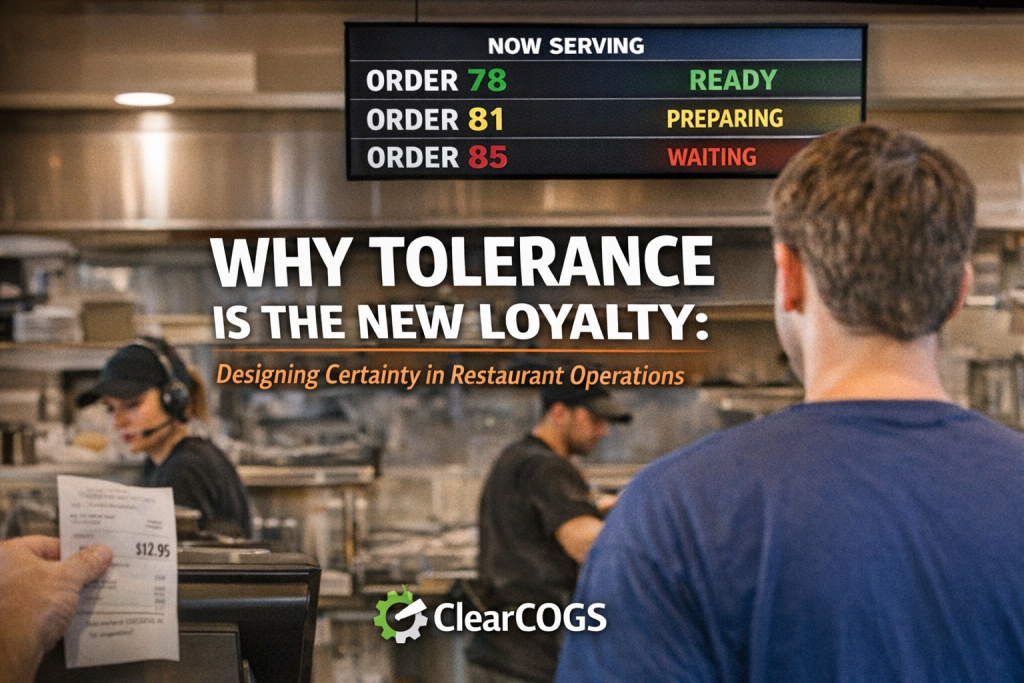



The Silent Shift Reshaping Restaurant Success
Restaurant operators are navigating inflation, labor challenges, and evolving consumer behavior. But the most critical change isn’t showing up in your P&L, it’s happening in your guests’ decision-making.
Guests are no longer tolerant of friction.
They’re not boycotting or complaining loudly. They’re simply visiting less often. This quiet disengagement is reshaping which brands grow and which stagnate.
The difference? Brands that design for certainty win. Brands that rely on guest forgiveness lose ground.
Understanding the Tolerance Collapse
For over a decade, restaurants operated in a high-forgiveness environment. Guests tolerated inconsistent portions, confusing menus, unpredictable wait times, and operational variability.
Then inflation tightened household budgets. Guests became more deliberate about where they spend time and money. As their expectations sharpened, their tolerance shrank.
The result isn’t dramatic, it’s erosion. Guests quietly drop brands from their routine when friction exceeds their threshold. One missed expectation. One disappointing experience. That’s all it takes.
What Guests Really Mean When They Talk About Value
The language hasn’t changed, but the meaning has:
“Too expensive” means “I’m uncertain about the value”
Guests are asking whether the experience will justify the spend—not just questioning the price.
“Slow service” means “I don’t know what’s happening”
Guests tolerate delays when expectations are clear. They reject uncertainty when progress stalls without explanation.
“Inconsistent quality” means “I can’t trust what I’ll get”
Small variability that was once forgiven now influences whether guests return.
“Not worth it anymore” means “The friction outweighs the benefit”
When operational unpredictability accumulates, guests remove you from consideration.
Why Even Strong Brands Are Feeling Pressure
Brands like Chipotle, Sweetgreen, and CAVA didn’t suddenly lose execution discipline. What changed was tolerance.
Portion variability that guests once overlooked now factors into visit decisions. Throughput friction that seemed minor now creates hesitation. Customization complexity that felt premium now feels uncertain.
Meanwhile, Starbucks demonstrated the path forward: simplified menus, improved accuracy, and predictable store flow. The result? Restored certainty and rebuilt frequency.
The Operational Reality Behind the Tolerance Crisis
Tolerance collapses when restaurants operate on guesswork.
Guessing creates:
- Stockouts that break trust and overproduction that kills margins
- Labor mismatched to demand, creating service delays
- Inconsistent portions and prep that vary by shift
- Guest experiences that feel unpredictable
Every guess compounds operational variability. Every variable compounds guest uncertainty.
How ClearCOGS Eliminates Guesswork and Builds Certainty
ClearCOGS transforms restaurant operations from reactive to predictive by turning historical data into precise daily forecasts.
Demand forecasting that aligns your entire operation
Predict exactly what you’ll sell, when you’ll sell it, and what you need to prepare. No more guessing on par levels or prep quantities.
Prep optimization that delivers consistency
Know precisely how much to prep for each daypart and menu item. Eliminate waste from overproduction while preventing stockouts that break guest trust.
Labor alignment that matches reality
Schedule staff based on actual forecasted demand, not last year’s averages. Reduce labor costs while improving service speed and accuracy.
Waste reduction that protects margins
Cut food waste by 20-40% by preparing exactly what you’ll sell. Turn waste prevention into profit protection.
The outcome: Guests receive the same reliable experience regardless of day, time, or location. Certainty becomes your operational standard, not your aspiration.
Why This Matters Now: Tolerance as Your New Competitive Moat
In 2026, growth won’t belong to the loudest innovators or deepest discounters. It will belong to disciplined system designers.
Restaurants using AI-powered forecasting deliver:
- Consistent portions and quality across shifts
- Reliable throughput and service speed
- Transparent value that justifies price
- Predictable experiences that build trust
Tolerance is the new loyalty program. You can’t market your way out of operational uncertainty. But you can engineer certainty into every decision.
The 2026 Playbook: From Tolerance Crisis to Competitive Advantage
- Replace guesswork with data: Stop relying on manager intuition and historical averages. Use AI forecasting to predict actual demand.
- Align prep to reality: Match production to forecasted sales, not yesterday’s patterns. Eliminate the waste-stockout cycle.
- Schedule for certainty: Deploy labor based on predicted demand curves. Reduce costs while improving guest experience.
- Measure variability as a KPI: Track operational consistency the same way you track food cost. Variability is now a strategic metric.
- Build trust through precision: Every consistent experience earns another visit. Every reliable interaction rebuilds frequency.
Conclusion: Precision Is the New Growth Engine
The restaurant industry is entering a precision era. Scale no longer protects against behavioral shifts. Predictability does.
Guests have reset their expectations. They’re voting with their frequency, not their complaints. The brands that recognize tolerance as a measurable strategic asset will grow. Those that continue operating on guesswork will struggle.
ClearCOGS gives you the operational intelligence to deliver certainty at scale. When you eliminate variability, you earn trust. When you earn trust, you rebuild frequency. When you rebuild frequency, you grow profitably.
Tolerance isn’t returning. But certainty is available to those who build for it.
Ready to Design for Certainty?
See how ClearCOGS helps restaurant operators eliminate operational guesswork and build the predictable experiences that drive frequency. Contact us below.


