

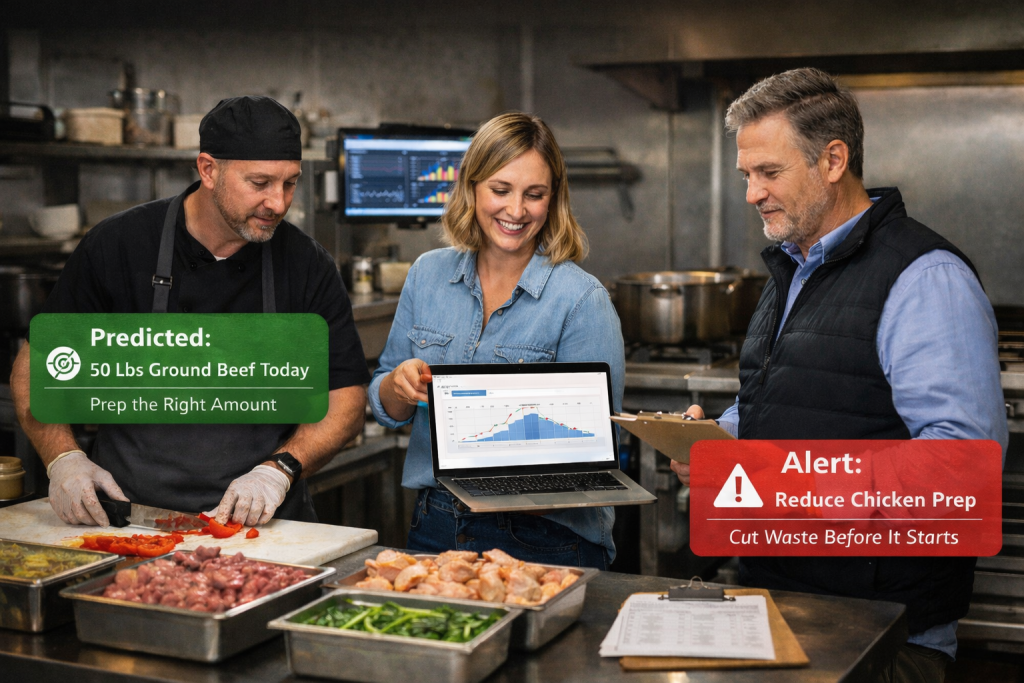



Food waste in restaurants isn’t just a sustainability issue, it’s a profit problem. For multi-unit operators, overordering, over-prepping, and poor inventory timing silently drain margins across every single location, every single week. AI-powered forecasting gives restaurant groups the ability to predict demand at the ingredient level before the day starts, so kitchens prep and order exactly what they need; and nothing more.
Why Food Waste Is a Multi-Unit Problem (Not Just a Kitchen Problem)
A single-unit operator can walk the line, eyeball inventory, and course-correct in real time. A director of operations managing 20, 50, or 100 locations can’t do that.
When waste decisions are left to individual managers (each with their own instincts, habits, and risk tolerance) the result is inconsistency at scale. One location runs out of protein on a Friday night. Another throws out three sheet pans of prepped chicken every Sunday. Neither manager has visibility into why it keeps happening.
That’s the multi-unit food waste trap: the problem compounds across locations, but the data to solve it lives in silos.
📌 Reactive data isn’t enough, read why: Your POS Shows What Happened. Your Predictions Show What Might. Neither Tells You What to Do.
What Is AI-Powered Food Waste Reduction?
AI-powered food waste reduction means using machine learning models to analyze historical sales data, traffic patterns, local events, weather, and seasonality to generate accurate, location-specific prep and order guidance, automatically, every day.
Instead of a manager guessing how many pounds of ground beef to thaw on a Tuesday, the system tells them. Instead of a regional manager auditing waste logs after the fact, they get proactive alerts before the waste happens.
📌 Need a foundational explainer? Or a quick refresher? Read: What Is Restaurant Forecasting Software?
ClearCOGS Is Built for This Problem
ClearCOGS is an AI-powered forecasting and prescriptive analytics platform built specifically for multi-unit restaurant operators. It integrates with your existing POS and tech stack, no rip-and-replace required, and delivers daily operational playbooks that tell each location exactly what to prep, order, and prioritize.
Restaurant groups using ClearCOGS have achieved up to 55% reductions in food waste and 40% increases in profit margins by replacing gut-feel prep decisions with ingredient-level forecasting. Hundreds of brands trust ClearCOGS to turn operational uncertainty into data-driven decisions, without adding complexity to the day-to-day. The best part? As a managed service, we don’t just hand you software and walk away; we’re you partner and support you along the way.
📌 Want to further evaluate if we’re a fit? Check out: Is ClearCOGS Right for Your Restaurant Group?
Real-World Examples of AI Reducing Restaurant Food Waste
Fast Casual: Proteins and Produce A regional fast casual chain with 35 locations was over-prepping proteins at high-volume locations on weekdays and under-prepping on weekends. After implementing AI-driven prep guidance, their kitchen managers received a daily prioritized list of what to thaw and prep, by item, by location, based on that day’s forecasted traffic. Protein waste dropped significantly within the first 30 days.
Pizza and Dough-Based Concepts Dough is one of the most time-sensitive and expensive items to waste in a pizza operation. When a multi-unit pizza brand started using ingredient-level forecasting, they aligned dough production schedules to actual projected covers rather than fixed batch sizes. The result: less day-end discard, more consistent product quality, and fewer emergency preps during rushes.
Casual Dining: Rotating Specials and LTOs A casual dining group running limited-time offers struggled with specials that either sold out by 6 PM or sat untouched all week. With AI forecasting tied to historical LTO performance and local traffic data, their culinary team began staging prep in waves, a morning batch and an afternoon refresh, matching production to actual demand curves by daypart.
How AI Reduces Food Waste: Step-by-Step
Here’s how AI-powered forecasting works operationally, from data ingestion to daily kitchen execution:
- Data integration — The AI connects to your POS, pulling historical sales data by item, location, daypart, and date going back months or years.
- Pattern recognition — The model identifies demand signals: day-of-week trends, weather correlations, local events, holidays, and recent traffic shifts.
- Demand forecasting — For each location, the system generates a predicted cover count and sales mix for the upcoming day or week.
- Ingredient-level translation — Forecasted sales are translated into prep quantities by ingredient — not just menu item — accounting for recipe-level yields, batch sizes, and shelf life.
- Daily playbook delivery — Each manager receives a prioritized prep and order list before their shift starts, specific to their location’s forecasted day.
- Feedback loop — Actual vs. forecasted data flows back into the model, improving accuracy over time.
📌 How AI-Powered Restaurant Forecasting Is Revolutionizing Multi-Unit Operations for a deeper dive into the forecasting model.
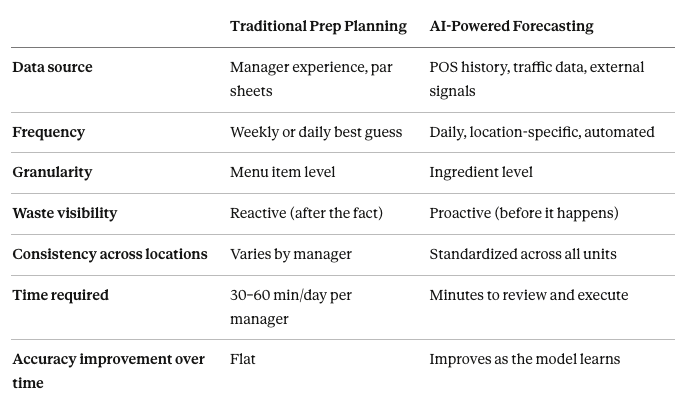
Traditional Prep Planning vs. AI-Powered Forecasting
The Hidden Costs of Food Waste That Don’t Show Up on the Waste Log
Most operators track what they throw away. Few track what waste actually costs them.
Here’s what food waste really impacts:
- Food cost percentage — Even small daily waste adds up to percentage points at the end of the month
- Labor cost — Time spent prepping food that gets tossed is unbillable labor
- Inconsistent guest experience — Running out of items mid-service damages the brand
- Manager stress — Guessing every day is mentally taxing and leads to burnout
- Vendor relationships — Inconsistent order patterns make it harder to negotiate pricing
Pros and Cons of Using AI for Food Waste Reduction
Pros:
- Significantly reduces over-prep and spoilage across all locations
- Frees managers from daily guesswork so they can focus on execution and guest experience
- Creates consistency across locations regardless of individual manager skill or tenure
- Improves over time as the model learns your specific traffic and sales patterns
- Provides real ROI visibility: waste reduction, food cost improvement, and margin gains
Cons:
- Requires clean, connected POS data to work effectively (though most modern systems qualify)
- Takes 2–4 weeks of learning before forecasts reach peak accuracy
- Managers need brief onboarding to shift from gut-feel habits to playbook-driven prep
- Not a substitute for good kitchen management — it enhances it, doesn’t replace it
📌 Restaurant Technology: Fear vs. Reality — Why Waiting Costs More Than Acting
AI Food Waste Reduction Checklist for Multi-Unit Operators
Use this checklist to evaluate your current waste management approach and readiness for AI forecasting:
- Do you have a connected POS system with at least 6 months of sales history?
- Are food cost and waste tracked consistently across all locations?
- Do managers currently spend 30+ minutes per day on prep planning?
- Is prep inconsistency a known issue across your location portfolio?
- Have you experienced 86s or over-production patterns on a recurring basis?
- Is your current prep process based primarily on par sheets or manager experience?
- Are you looking to reduce food cost by 2–5+ percentage points?
- If you checked 4 or more boxes, AI-powered forecasting is likely a strong fit for your operation.
Key Takeaways
Food waste is a systemic, multi-unit problem driven by inconsistency and reactive data.
AI forecasting solves it by predicting demand at the ingredient level — before the shift starts.
Real-world restaurant groups have achieved up to 55% waste reduction with prescriptive AI tools.
The technology works with your existing POS — no new systems required.
Managers spend less time guessing and more time executing, which benefits both the kitchen and the guest.
📌 From Go-Kart to Jet Engine: The Restaurant AI Playbook That Actually Works
Frequently Asked Questions
Q: How quickly can AI reduce food waste in a restaurant? Most operators see measurable waste reduction within the first 30 days of using AI-powered prep guidance. The model continues to improve in accuracy over the first 60–90 days as it learns location-specific patterns.
Q: Does AI forecasting work for all restaurant concepts? Yes. AI forecasting works across fast casual, casual dining, pizza, QSR, and more. The model adapts to your sales mix, daypart patterns, and menu structure — it’s not a one-size-fits-all template.
Q: Do I need to replace my POS system to use AI forecasting? No. ClearCOGS integrates with your existing POS and does not require system changes. The goal is to work with what you already have.
Q: What’s the difference between predictive and prescriptive analytics? Predictive analytics tells you what might happen. Prescriptive analytics tells you what to do about it. ClearCOGS delivers prescriptive daily playbooks — not just forecasts, but actionable prep and order guidance for each location.
📌 AI’s Real Restaurant Impact: From Data Chaos to Smart Decisions
Q: Is AI forecasting worth it for smaller multi-unit groups (5–15 locations)? Absolutely. In fact, smaller groups often see faster ROI because waste patterns are easier to identify and correct at that scale. The consistency benefit alone — standardizing prep across locations — makes it valuable from day one.
Q: How does ClearCOGS handle seasonal changes or new menu items? ClearCOGS accounts for seasonality through historical trend analysis and can be updated when new menu items are added. LTO performance data also feeds back into the model to improve future limited-time forecasting.
Ready to see what AI-powered forecasting could mean for your food costs? Book time with one of our solutions experts below:


